suspended in blue

bellinghamWhen I meditate, the big things fall into perspective. When I sit and let my body relax, I can feel my bones and muscles, my blood and tissue, letting go of all the big ideas, the big worries, the Big Bad (as Buffy would say). My breath deepens, my shoulders drop. I would like to say that I let my worries go but it is really the other way around. When I fall into the sweet relaxation that mediation opens in me, worries let me go and my consciousness expands and rises up into the sky like a soap bubble. From that high-deep place the “big things” that occupy so much of my waking life seem as small as marbles in the dust and I wonder how they ever seemed important at all.

It took a couple of whole-day meditation retreats to reach this place. I like to think that I have meditated for years, but now I realize, I dabbled. I would do it when the timing was right or the moon was aligned or if I had not hit the snooze button and rose naturally, and meditation was a yummy doorway between dreaming and awake. But I never did it for more than 20 minutes. Tops.

I began attending a weekly Satsang in Napa and got to practice 30 minutes sessions. They were challenging, but I got the hang of it. Then, I did a couple of full day retreats at Spirit Rock Meditation Center in Woodacre.  These took a little more concentration, a little more physical discipline. I struggled at first, but when I stopped efforting so much. . .and when I forgot to try, it happened.  The world and everything in it (including me) simply expanded and I found my mind floating in a sparkling pool of iridescent blue. I call this feeling Suspended in the Blue and it is completely, utterly, and deeply delicious. I won’t pretend that I get there every time, but now that I know how, it has become an unfolding, and I appreciate the practice as much as the experience.

Big worries? Meh. I breathe in, I breathe out. Everything else is optional.


poem::poet::poetry

marigold

Sylvia Berek Rosenthal is a prolific writer. And it’s no wonder, as Rosenthal, a resident at Oakmont at Montecito in Concord, CA, who will turn 92 this August, has had plenty to write about. Her latest book, Marry Me With Marigolds, is a delicious collection of poems that reads like the spicy narrative of an interesting life. The genesis of Marry Me with Marigolds began when Rosenthal won First Prize in the  2010 Benicia Annual Love Poem contest.

The writer strongly resembles someone’s smart and jolly Nanna, with her shock of white hair, large black-framed glasses, bright floral silk jacket. She smiles gleefully. “It felt so nice for an old lady to win with a love poem,” she says about the contest.

Sylvia Rosenthal didn’t begin writing poetry until she was 75, an age when people tend to be outspoken with their truths. The poetry in this collection reflects a whole lot of truths, as it was written in the 15 years between 1997 and 2012. Many of her poems are funny and downright irreverent. Some are rich and tender. In all, her personal voice rings true. In the poem called “Maid in America,” she speaks of how her parents met.

My mother was born in Detroit.

You can’t get any more American than that

Can you?

When she turned seventeen she met my father.

He spoke Yiddish and Polish

She spoke only English.

They had no trouble.

Pillow talked worked just fine.

When she turned eighteen

They celebrated by getting married.

One year later

World War One

Began.


In the book’s namesake poem, Marry Me With Marigolds,  Rosenthal uses language in a way that is both playful and evocative:

Marry me with marigolds

Tempt me with your tenderness

Covet me with coriander

Chocolate and

Cloves

Favor me with foxglove

Gather me with the garden’s garland

Circle me with summer squash

Sesame and

Sage

Woo me with water lilies

Nurture me with nutmeg

Pamper me with peppers

Red green and

Gold

And I will stroke

Your balding head

Bake you babkas

Cook you cabbage

Pat your pot belly

If you will only

Marry me with marigolds.

Rosenthal may live in Concord, CA, but to hear her speak, you know she is pure New York, where she was a grade school teacher and guidance counselor. Her husband, George, was a ceramicist and artist. For years they lived something of a bohemian lifestyle, sojourning back and forth between New York to San Miguel de Allende, Mexico. After a time, the Rosenthals moved to San Antonio, Texas, to shorten the commute between San Miguel and the states. 

It was when the couple lived in Texas, that Sylvia discovered poetry.  Her husband had broken his shoulder and was recovering from surgery and she had tired of being his nurse. “I decided to take a writing class at the San Antonio branch of Texas University and the only two courses available were poetry and a business writing course,” she explains. “I wasn’t going to write letters, so poetry it was.”  In San Antonio, Sylvia became deeply involved with local writing and poetry communities. In San Miguel, she wrote columns for the Atencion and El Independiente newspapers. 

Her first book, Mrs. Letsaveit, is the collected body of these columns, which are mainly food literature essays very much in the style of Sonoma County’s M.F.K. Fisher.  The cover of Mrs. Letsaveit features a close up photograph of some of her late husband’s ceramics. The direct and humorous essays filed between the covers of the book are redolent of a happy home as Rosenthal describes her life in Mexico through a series of narratives about cooking and eating food. “Think of it as recipes through a  filter of Like Water for Chocolate,” she says, referencing the 1989 best selling book by first-time novelist Laura Esquivel. In Mrs. Letsaveit, Rosenthal writes about making bagels, corned beef, Mandelbrot, and other family favorites in Mexico, far from New York – or Texas style grocery stores.

An avid reader and writer still, Rosenthal is a member of the San Miguel PEN and San Antonio Poets; she is now involved in writing and poetry groups in the Clayton/Concord Area. Is her work fact or fiction? She smiles mischievously and replies, “I like to think of poetry is a piece of the truth, but not all of it.”

Sylvia Beren Rosenthal’s books are available on Amazon.

stop::drop::breathe

Two weeks into my extended vacation, I am meditating. Every. Day. No more excuses, no more hitting the snooze button, blithely squeezing available meditation time down to “maybe” and “not quite enough” before dashing off to the office.

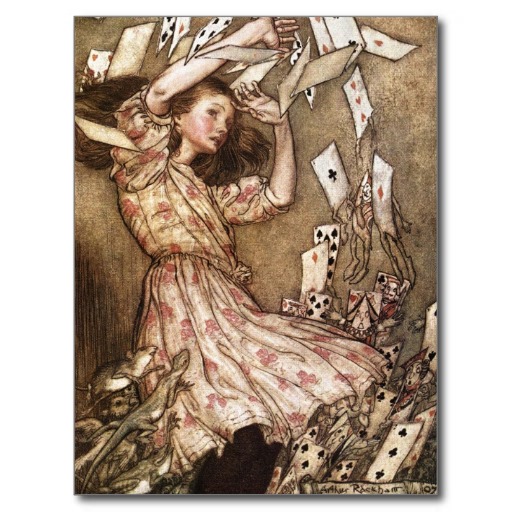
Now, I’ve got time. Lots of it. And yet, meditation can still be an illusive tease, dancing just out of reach. I’ve tried all kinds of tricks to get my mind to stop racing, to slow down enough to actually follow my breathe in, out, in, out. Sometimes a guided meditation helps. Sometimes music helps. What mostly helps. . .is just doing it. You follow the breath in, follow the breath out, and before know it, like Alice, you’re down that rabbit hole. Namaste, baby!

a gift for fiction

alice in wonderland

“Your story, that story that keeps replaying, the interaction of your expectations and what happens, the narrative, the disappoinments and the way you process it. . .it’s all invented.

“Ambien, the popular sleep aid, doesn’t actually help people sleep much more. No, the reason it works is that it’s an amnesiac. Ambien makes your forget that you didn’t get a good night’s sleep.

“. . .[our story] it’s all invented. It’s still real, the pain is real, the frustration is real, but the story that’s causing it all is something we made up, and something we can change. The pain is real, and so is a path to changing it.” 

–Seth Godin

The thing is, what is your story? What is the thing you repeat to everyone who will listen, about that thing that happened to you. The Course in Miracles says that we are all operating under a shared illusion and the fact that it’s shared, doesn’t make it any more real.

So what about it, cookie? What is your story? For goodness sake, make it a good one!

be::free

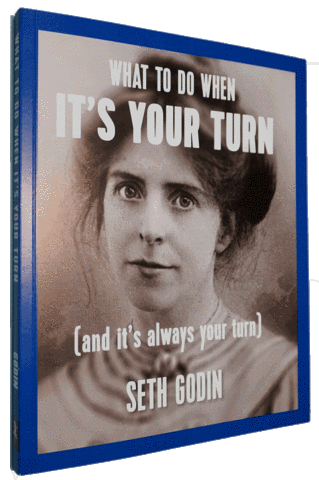
“There are three problems with freedom:   Things often don’t  turn out precisely the way we hope. Resolution takes too long. And we might fail. And so, when it’s our turn, we take a pass. It’s far more reliable to stay where we are than it is to leap, to jump to a new place different from the one we’re in. But there’s an alternative. The alternative is to assume yes [and] no. To bet on failure [and] not failure. To realize that there’s a third state, the state of no knowing, of not landing, of not yet.

Not everything has to be okay.

Perhaps it might be better for everything to be moving. Moving forward, with generosity. Moving forward, with a willingness to live with the tension. Moving forward, learning as you go. The person who fails the most, wins.”

–Seth Godin, What To Do When It’s Your Turn (and it’s aways your turn)

your turn

feet first

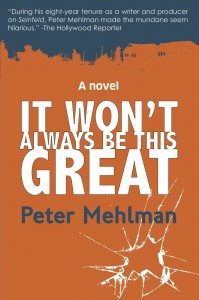
A good book is a thing of beauty. A good book that makes you laugh at a sweet, goofy, human’s folly, and you have a party wrapped in a book jacket.

Peter Mehlman’s debut novel, It Won’t Always Be This Great, is quite possibly the sweetest, funniest novel orbiting the planet of mid-life crisis well, ever.  Though Mehlman is no writing novice, he wrote for the Jerry Seinfeld show and rose to executive producer at one point; this is his first work of full-length fiction.

In It Won’t Always Be This Great, we meet a 50 year-old Long Island podiatrist who throughout the book remains nameless, just as he is about to hit stride in messy patch of mid-life angst.  Dr. X is father to two amazing kids, lovely, precocious,  14 year old Esme, and son Charlie, who while hovering at the cusp of  tweenhood, makes adorably naïve pronouncements about how the world appears to work, and according to him, how it should work. CLICK HERE TO READ MORE 

Great

peace of mind

So there I was, planning my big, fat fundraiser, and I knew what I had to do. I’ve been doing this long enough to know that all the planning, all the wheeling, dealing, and organizational faits accompli, take a toll on body and mind. And so, into every event strategy, I insert one very important task: the post-event treat. Sometimes its a spa treatment. Sometimes it’s a couple of days away. This time, it was both. I booked myself into a yoga retreat in the breathtakingly beautiful Sierra foothills. I meditated three times a day, walked, breathed, and did a little yoga. Now I’m all calm and ready to take on a whole new adventure. PS: the event was a huge success!

peac of mind

earth::mother

Happy Earth Day, my dears. We love our lovely little planet, and we love clean water, lush forests, wetlands, and wild habitats. What does our stewardship of the planet and each other say about us? It’s all about the love.


learn::smarter

Not only is his book The Four Hour Workweek one of my personal favorites, this guy is wicked smart! Happy Movie Friday!

shipwrecked love

Quote

light between

::REVIEW::

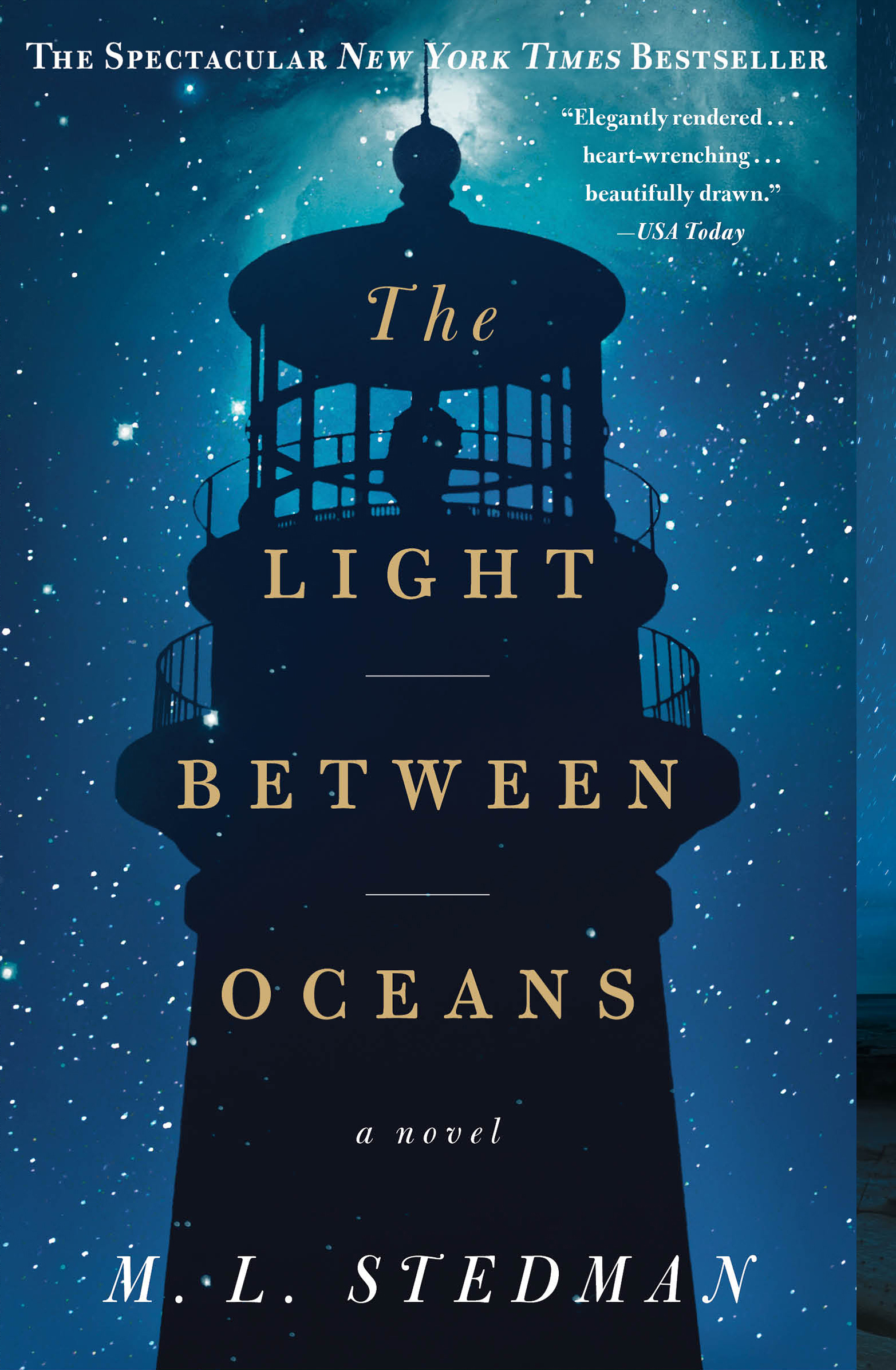
  It is just after World War II, and Tom Sherbourne returns to his native Australia seeking solace and normalcy after enduring the horrors experienced as a soldier on the Western Front. Kind, thoughtful, and meticulous Tom lands a job as lighthouse keeper on the island of Janus. It’s lonely work, but Tom enjoys the routine, and quiet accountability of helping to assure the safe passage of cargo and passengers off of Australia’s shoreline.  He sets about making repairs to the Light, and keeps strict and meticulous records of all activity on Janus, as is his responsibility.  Tom can be trusted to do a job well, and he takes great pride in being a man to be counted upon to do the right thing. To his great good fortune, if not his great surprise, Tom meets Isabel Graysmark while on leave from Janus.  Isabel is everything Tom is not: gregarious, creative, outgoing. Isabel doesn’t so much seduce Tom as declare that their match is right and inescapable.  An epistolary courtship follows and on his next leave from the island, Tom and Isabel are married. They return to Janus a couple, starting their life together in their own little island world. Isabel suffers a series of pitiful miscarriages, each one stealing a little more of her light. 

And then one day a rowboat washes up on the island carrying a dead man and a live baby. Of course, Tom is inclined to report the incident, as is his natural and assigned responsibility. But Isabel, having lost three babies and one only recently, has been delivered an infant in need of a mother. She convinces Tom to delay reporting the body and the baby. Eventually all lines blur and Isabel names the baby Lucy and insists she is their own.   As much as he loves her, Tom cannot totally reconcile baby Lucy as his; instead arguing that she belongs to someone, somewhere, who surely grieves her loss. Isabel has no such qualms.  She considers Lucy a gift from God, and being mother to the little girl in all ways feels as natural to her as breathing. Like all secrets, Tom and Isabel’s slowly unravels.

On a trip to the mainland Tom encounters a woman whose child was lost at the same time that Lucy was found. Tom is devoured by guilt. On the night before the Sherbourne family is to return from the mainland to Janus, an anonymous note is found in the grieving mother’s mail box. A cryptic hand-written message assures the woman that her daughter is loved. A second trip to the mainland, a second hand-written message, and the Sherbourne’s story dissolves like paper in water.  Baby Lucy is reunited with her birth mother,  while Tom claims all responsibility for the deceit to protect Isabel. Following her betrayal, Isabel suffers an emotional breakdown, rejecting  Tom. Lucy is torn from the loving embrace from the only mother she’s ever known, and is inconsolable, rebuffing this stranger who now possesses her, her birth mother.

The Light Between Oceans is about finding one’s way in uncertain waters. It is a book that deftly examines the choices we make, and living with the inevitable outcomes. It is about love and courage and doing the right thing.  It is a book not to be missed. Cynthia G.