contaminated water

VOIL IN WATER

Pam Lazos

Chapter Fifty-Two

Twenty-five years ago, when Ruth and Marty Tirabi purchased a ten-acre plot in the middle of bucolic farmland, they thought they’d landed in heaven. Unfortunately, the realtor who sold them the property neglected to tell them that beyond the tranquil, bucolic edge of their horizon, a toxic stew was brewing. At that time, no one thought much about the environmental hazards associated with home buying. But then the intermittent smell wafted in, the one hundred and fifty-seven single family dwellings rose up like a tsunami, and carloads of benzene, toluene, and perchloroethane joined truckloads of mercury, lead, nickel, perchloroethate, and a whole host of other hazardous substances with equally unpronounceable names, forming car pools and organizing marches to the aquifer below. The caravan traveled slowly, inch by careful inch, undiscovered until a quarter century later.

And water being what it was – ubiquitous by any standard – the contamination did not confine itself to any legal borders, but spread throughout the entire aquifer, a massive thing that provided water to the Stahl’s, the Tirabi’s and their neighbors in the new Hickory Hills development. Hickory Hills attracted wealthy city dwellers who pined for pristine country air and didn’t know most farmers’ propensity not only to sell what they grew, but to rent what they owned to cover the spread. Jim Stahl, Sr. had covered his spread by renting a portion of his property to the County to be used as a landfill. And since there were few, if any, instances where one person’s actions failed to affect the lives of others, Jim’s contaminated water spread to his neighbors’ homes and discreetly took up residence there, finding permanent quarter in the kitchens and bathrooms of all one hundred and fifty-seven single family dwellings.

Lawyers advised clients in hushed, confidential tones to get a blood test and a wave of pandemonium spread through the development as test after test came back positive for cancer. Children with their developing immune systems were hit especially hard. The local newspapers did their part to raise the level of hysteria. Gossip spread rumors like a middle-aged waist-line, forcing the EPA to mount a public awareness campaign. EPA went door-to-door, offering all the neighbors of Hickory Hills bottled water until the in-house filtration systems could be installed. But in many instances, it was too late.

Jim Stahl Sr. had started landfilling in 1975, thirteen years after Rachel Carson wrote Silent Spring, one year before Congress passed the Clean Water Act, and eleven years before they would enact CERCLA, the Comprehensive Environmental Response Compensation and Liability Act, also known as the Superfund. Rivers were catching on fire, leaded gas was leaving a smoke screen out on U.S. highways, and Love Canal had exploded into public awareness. At that time, there was more to worry about than a few hundred thousand pounds of unprotected trash. But if the Senior Stahl had complied with even the most primitive dumping laws in effect at the time he started landfilling, the Hickory Hills development might not be on the National Priorities List today, and Jim Stahl, Jr. would not be mired in the muck that his father’s landfill had become. The National Priorities List or NPL was a list of the nation’s most contaminated Superfund Sites. Making that list was not something to write home about.

Over the years, corrective measures were put into place – a bit of cover here, some plastic to act as leachate collection there – but no one anticipated the rapid growth of the surrounding communities or looked at the scheme of the landfill in its entirety. Jim’s father retired, passing the whole problem on to his son – the sins of the father, as it were – and Jim took to greeting government inspectors at the door with a shotgun.

Several months and meetings later, EPA dispatched an OSC, On-Scene Coordinator, who directed two dozen people dressed in hazmat suits, moon suits as Vera, Jim’s wife, called them, to construct a temporary cap over the landfill. The cap was like a big Rubbermaid mat comprised of heavy-duty geosynthetic material. For three weeks, backhoes, trackhoes, bobcats, bulldozers and cranes dotted the landscape. When the temporary cap was complete, the contractors fenced the front half in, packed up and drove away, leaving the seething menace to percolate below and promising to send the culpable parties along to finish the job soon. Two years later, the temporary cap, held in place by used tires strung together with rope, had begun to show its age.

to be continued. . .

this is how we got here

copyright 2012

what writers are reading

we know what we like and we really like this book.

read our review then buy the book in honor of a girl you love. gr.

tell the wolves

chalky clouds and purple prose

Journal THAT

a guide to writing

Cynthia Gregory

There are good adjectives and bad adjectives. There are the regular, hard-working-show-up-in-the-middle-of-the-night-but-go-unnoticed adjectives and then there are what I call the 25 cent adjectives. You know the kind, all flashy and shiny and bright, the kind you notice more than the noun that they’re describing. They’re like fast food; they temporarily distract you from the fact that there is nothing of substance behind them, they are the literary equivalent of a plate of whipped cream.

I know a lot about these razzle-dazzle kinds of describers, these peacocks of poetry. I used to scatter them around liberally, clever as I was. But what happened when I really got rolling, is that the point I was trying to make got totally buried under my ponderous prose. My meaning sagged under the weight of all that reckless description. My language got so pearly and polished that everything I wrote began to sound like a steaming, verdant jungle, packed with all the lush pomegranates, mangoes and papayas of meaning I could wedge in. I mean seriously, an old pair of scruffed sneakers with one broken lace is a perfectly respectable sort of description. But when I got done with it, those Keds sounded like Ritz Carlton glass slippers.

What happened when I began to excavate the core of my message, the humble meaning of my narrative began to emerge as I sliced away one fabulous phrase after another. Everyone knows by now the famous story of what Michaelango said when someone asked how he knew how to carve the statue of David – he said, “oh, I just got rid of what didn’t belong.” You need to do the same with your descriptive language. Pare it down, pare it the hell down. Make it lean and mean and dense. Never use a twenty-five cent word when a nickel will do.

Many people mistakenly think that a short story is easier to write than a novel, because it’s more compact. They think that a poem is even easier, because there are fewer words yet. But the exact opposite is true. Did you know that? The shorter the piece, the harder it is to write. This is  because with fewer words, every one has to count. There is no room for extra padding, no place to hide. There are no long stretches of narrative, expeditions into expostulation. You have to say exactly what you mean. Every word, every verb, has to carry the weight of the sentence on its meager back, so it must be strong, and it must be absolutely true. The shorter the writing, the denser it becomes. Not dese heavy, just dense: full of meaning; ripe as a summer peach, juicy and succulent.

It’s easy to see why people fall in love with a flush of flabby, fatuous descriptions; because they mean nothing. We’re a TV culture after all, we’re used to that. Flamboyant descriptors are like a magician’s trick, a sleight of hand. Honest writing, writing from the heart, strips you naked. It’s much easier to hide your fragile heart behind a veil of words. But that takes no courage. If you want to journal, you must be brave. You must go into the room you’re afraid to enter and stay there until you have emptied yourself out. And the next day, you must go in there again. You can never completely empty yourself through journaling. There is always something more, something deeper, something rich and rare and precious because it comes from within you. It comes from a place beyond the glittery surface. It comes slick and dark and wet and you must love it. You must stay with it until your heart stops quaking in your chest and you must put it on the page, make it authentic. This is real courage. This is what true love is made of: entering into that place that terrifies you and staying there, listening, writing, watching, recording it all, until the quiet enters and the writing is complete.

Sometimes you will flow with a million thoughts, like droplets of water over Niagara Falls, and there is nothing wrong with that. I would like to suggest however, that there is a balance. If you can practice both ends of this particular writing scale, you will become a better writer. When you sit down to write, think simply. Don’t think you have to impress anyone, to show off. You have an audience of one, and its you.

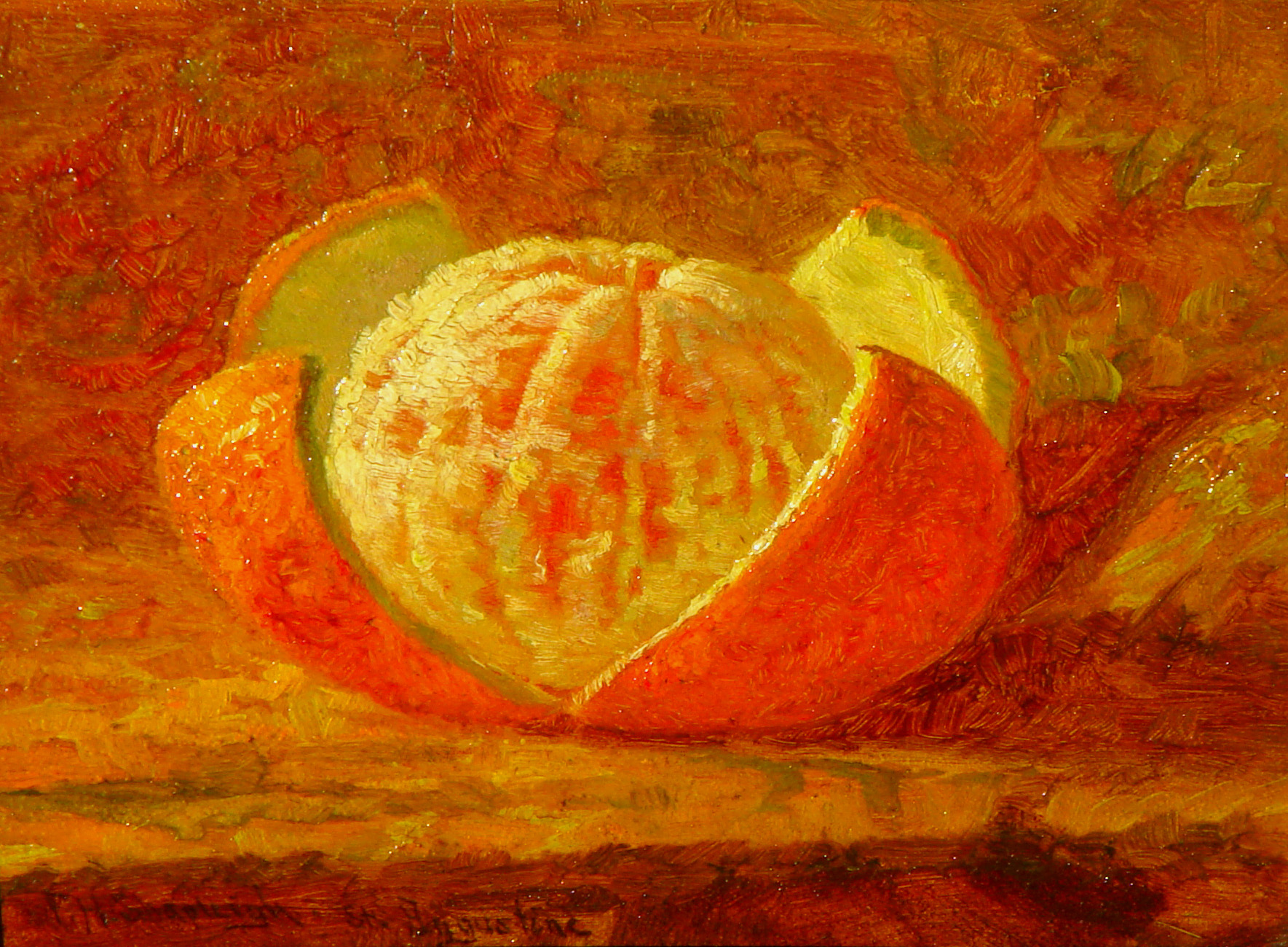
Here is an exercise that will illustrate what I’m getting at. Sit with your journal and an orange, in a quiet place. Write for fifteen minutes describing the dimpled orb of fruit without using the word orange more than once. Go into that room and stay there. You can riff on the orange if you want, start with the fruit, talk about the blossom or the orchard, or the hands that harvested the one you hold in your hand, but Don’t use the word orange more than once in your description. You can use another fruit if you wish, but the same rules apply. So chose a plum, but don’t use purple. Or choose an apple, but don’t use red or green. You get the point. Hold yourself apart from using the descriptor that is most obvious, and what you get in return is a whole new way to relate to description in general.

Be objective, be a journalist. Pick up the newspaper and read an article about an event. Journalists use the fewest adjectives than just about any writer, and most of those are worth a nickel. They don’t say  “it was a stunningly sunny day with chalky clouds dotting the horizon.”  No, they say, “the day was warm, with scattered clouds.” Period. There is an elegance in that kind of simplicity. Practice being a journal-ist. Practice simplicity with your journal. And be patient with yourself. This stuff takes practice.

journal this

Journal THAT

a guide to writing

Cynthia Gregory

Photography is amazing to me, something bordering on magical.  Imagine freezing a moment in time on a small square of paper (or on the viewing panel of a telephone), to slide into your pocket and carry with you wherever you go. There is something mythic about a photograph. I like nothing better than to wander through antique fairs and spend long moments flipping through boxes and boxes of photographs.  There’s nothing like it.  On my first trip to Paris, I found the famous Montmartre flea market and was in ecstasy to find vendors with bins and bins of dusty old photos, studying the faces in those pictures, imagining the lives that were lived beyond, before, after, the images were captured and through magic and alchemy, printed in sepia tones on thick paper. Oh, I understand  the chemical process of photography well enough; I still consider it borderline magic.

I once taught a writing workshop and asked participants to bring with them photographs or postcards of  sentimental  value, something to write from. Everyone seemed excited by this idea – then their excitement faded to dismay and then marginal alarm when I asked  them to retrieve and exchange them with their fellow workshoppers.

“I brought this picture of little LuLu and I was going to writer about her birthday.”

“But this is Barney, my dog. No one else knows him like I do; I want to write about him.”

I’m sure my darling protégées thought it a nasty trick to switch them up like that, but I had my reasons. What I was aiming at was to get them to write about the feelings that were evoked from someone else’s photo, not to write from the matched luggage of associations, memories, delights, and dark secrets that led them to choose their specific photos and postcards in the first place. I wanted them to reach back to the archetypes that we’re all hard-wired with. I wanted them to find the promise that backs every fairy tale and myth and operatic legend that we consider imaginary and yet give our lives meaning.

Things are charged with the emotions we attach to them. You might think this is a radical idea, or sounds a little too close to the far edge of woo-woo for your taste, but think about it. Words are charged with emotional impact. For instance, the words beard, tea cup, and mandolin evoke feelings, which give rise to meaning, which stirs up emotions based on memories you associate with these items. We attach words to things so we know what to call them – otherwise we’d say, “pass the tangy little granules of crystalized sea water” instead of “pass the salt.” So the words we attach to things have an emotional charge, too. Especially things that have to do with deep emotion, like family.

I would venture that an old black and white photo of your father as a young bot sitting on a pony wearing chaps and a cowboy hat, peering into the camera, stirs up a whole score of emotions for you. Of course it does. There are stories, lifetimes, imaginings, family legends, tragedies, celebrations attached to everything we own – or that owns us – and this is as it should be.

Journaling from this stew of material is easy. And, I’m sorry to say, somewhat predictable. But if you’re aiming for a family chronicle, go for it! Distribute  photographs to everyone in the family, and ask them to write about what a particular photo means to them.  While you’re at it, ask them to throw in a family recipe, too. If you cast your net wide enough, you will amass a collected family history, suitable to finding for an epic family album.

But what you get when you write from someone else’s photographs is access to a collective memory, a collective pool of archetypes that belong to our extended family – the human race. After all, we most of us have mothers, fathers, ancestors, siblings, children. We most of us have lived in a series of varied family homes, have traveled some, gone to church, gone to school, fallen in love, borne great tragedy, been moved to tears by a beautiful object, failed at something trivial, thrived at something meaningful, eaten strange food, dipped our feet in a mountain stream, watched a shooting star on a summer’s night, confided in a stranger, given something to someone who needed it more than we did, discovered the searing pain of betrayal, held a child’s hand, believed a lie, broke a rule, floated in absolute joy; in other words, have lived a slice of life. We all have this in common.

So when you look at a photograph of people you do not know, or you study a postcard that was not addressed to you, you have the potential to access a deeper story, sensations and passions buried more deeply than you ever thought possible. This in interesting territory.  I am always enchanted by the cryptic messages on the backs of old postcards – were they in St. Louis ever again, after that trip? How was the train ride? Did they ever find love in that lifetime?  Stories spin out of my imagination and I envision children and pets and automobiles long since grown or gone.

You obviously can’t write from a literal perspective by this method, but your journaling can become enriched by the subtle meanings telegraphed to your ancestral brain, where memories are stored, where legends are kept, fables are cataloged for future reference. These are jumping off places. Write from photographs – someone else’s, and stir memories you didn’t even know you had.

mas bonita

we girls have a new feature: reviewed:books. we love it & you will too.


We love this so much we wanted to share. Please read and comment. Do you agree or disagree? Love it or hate it? We honestly want to know what you have to say. Sincerely yours, PSS

SpyWriter Jack King's avatarReading. Writing. Spying.

“A recent study has shown many people benefit from rereading familiar stories as the encounter “reignites” their emotions and increases their knowledge.

In broad terms the research found that people were generally keen to return to a well-thumbed book or to listen again to a favourite piece of music so they could gain a “richer and deeper insight” of the experience and increase their understanding.

The study concluded: “Consumers gain richer and deeper insights into the reconsumption object itself but also an enhanced awareness of their own growth in understanding and appreciation through the lens of the reconsumption object. 

“Given the immense benefits for growth and self-reflexivity, re-consuming actually appears to offer many mental health benefits.” 

“Vladimir Nabokov maintained that you couldn’t say you had really read a novel till you have re-read it. On the first reading you may be gripped by the story, and so you read fast…

View original post 177 more words

does this blog make you blush?

we have a new post @ first blush. read it here, read it now.

we blush

we have a new post @ first blush. read it now!

beauty shop wisdom

JOURNAL THAT

a guide to writing

cynthia gregory

Have you ever been to the inner sanctum of a beauty salon? I mean, seriously in? The beauty salon is the modern equivalent of the Acropolis, a center of culture in ancient Greece. A symbol of the formerly glorious apex that still stands is the temple dedicated to Athena, warrior goddess, who is said to have been born fully formed from her daddy’s head. That would be Zeus, propagating some kind of mad magic, birthing an idea like that femme fatale.

Beauty is its own wisdom, and to enter the beauty salon is to enter as a clean vessel and to leave equipped with what a warrior goddess needs: beauty and a dose of attitude.  What goes on in there, you wonder? Here’s a clue: it isn’t about hair. A salon is where women share their magic. It is the adult version of the Saturday night sleepover, where we braided each others’ locks and dreamed of traveling to exotic places. It is a church where wisdom is currency, and where every woman is a goddess.

My friend Sedona is a hair styling genius. She’s also a princess, as in “I don’t do windows, and I don’t do floors” kind of girl. She is exceptional at the art of alchemical science, and she allows other people to be good at what they do, too, especially if those things hold no appeal for her. Sedona is a big believer in the service trade. “Just let them in,” she advises. “You contract with a helper, and then when you need them, they have permission to enter.” Just let them in, she says, and they fix what needs fixin’.

The idea of ‘permission to enter’ also lives behind the idea of setting up a special place in your home to write. It is also behind the discipline of setting aside a certain amount of time each day, ideally at the same hour, to do nothing but write. By doing this, you give your subconscious ‘permission to enter’ – and then you stand back and let the gods whisper in your ear, give you enough luscious lexicon to fill pages and pages.

You can go so far as to set aside an entire room, decorate it with art that you love, art that inspires you to write. Fill it with flowers and music and artifacts like an ancient Remington typewriter, and fountain pens, and framed manuscripts, first edition books. And then when you enter that room, that sacred space, that temple of contextual creation, you have given yourself permission to enter. It’s just a logical next step to open your journal, gaze out the window, allow your thoughts to unfocus for a minute, fire up your unconscious, give your creative self permission to enter.

Or not. Not everyone has a whole room that has no other purpose than to provide a gorgeous backdrop for journaling. An entire room isn’t necessary. Sit on the bed or an old wooden bench at on the back porch. Write with pencil, write with crayon, an old eyeliner stick. It doesn’t matter. What is significant is that you make an appointment with yourself, and you do your best to show up. Reliability doesn’t guarantee genius, but it doesn’t diminish it, either. It isn’t your job to judge your work to be genius or whatev. Your job is to show up and write. Really, it’s that simple. You just show up and write and let the gods take care of the rest.

This is the best advice I can offer: show up, pay attention, and give your highest creative self permission to enter. See what kinds of ideas your head can give birth to. Find out how many kinds of love your heart knows how to express. Write with your body, write from your soul. Make a date with your highest, deepest self, and see what kinds of genies spring fully formed from your godhead. Give genius permission to enter and then sit down and get ready to write. You may not get thunder bolts and crashing seas, but you might get shopping lists, thank you notes, rampages of appreciation. It’s a good start.

The creative gods are unpredictable, but one thing is for sure. If you show up, they will too. Give them permission to enter.

to be continued. . .

From the Land of the Moon

 I love a book that includes landscape as an important character almost as much as I love a story with an unreliable narrator. I also adore Italy, so for me From The Land Of The Moon, written by Milena Agus and translated from Italian by Ann Goldstein, is the trifecta of great literature.

A small book, From The Land Of The Moon is a big story of love and belonging. Our heroine remains unnamed throughout, and this is important because without a name she is no one and she is everyone. Significantly however, she is the grandmother of a girl who traces her family history as she is about to be married and create a family of her own.

Grandmother was eccentric and beautiful, and who at thirty remained shamefully unmarried. This was scandal enough to Great-Grandmother, but to make matters worse, the daughter was also a poet. She prone to kidney stones and what we would now call depression, and probably she was a little mad also. A sensitive artist, Grandmother had survived World War II in her native Sardinia, but had been unlucky in love. To her family’s great relief, a widower from Cagliari came to the family home one day, and they married their troublesome daughter off to the stranger as quickly as possible, effectively removing the taint of crazy from the family name.

Though hers was a loveless marriage, Grandmother’s husband was kind to her. He had a good job and he built her a beautiful home. Still, she felt that she was missing “that essential thing.” This, she reasoned was why she kept getting pregnant and then miscarrying: her life lacked that essential thing.

This all changed, when one year her husband sent her to the mineral springs to ‘take the cure.’ At the spa, she befriended a handsome war Veteran who had also come to take the cure at the mineral springs. Though they spent a very short time together at the spa, Grandmother fell deeply in love, and from then on the veteran played a central role in the grandmother’s life. In him, she felt that she had found what she had been missing.

Upon returning to home, Grandmother discovered that she was once again pregnant, but this time it held, and she delivered a son. She gave the boy everything and when he grew up to be a famous musician and married another musician, he left his daughter with to be raised by his mother. Lucky girl.

“My grandmother was over sixty when I was born. I remember that as a child I thought she was beautiful, and I’d watch, enthralled, when she combed her hair and made her old-fashioned crocchia, parting the hair, which never turned white or thin, then braiding it and coiling the braids into two chignons.”

To the girl, Grandmother was, and had always been beautiful and strong. Grandmother may have been delusional, her history may have been imagined, but her love was real and sustaining, and shines through as the essential thing in this sweet story.

Review by Cynthia Gregory/ceegregory@aol.com