Bee Serious

And Then There Were None

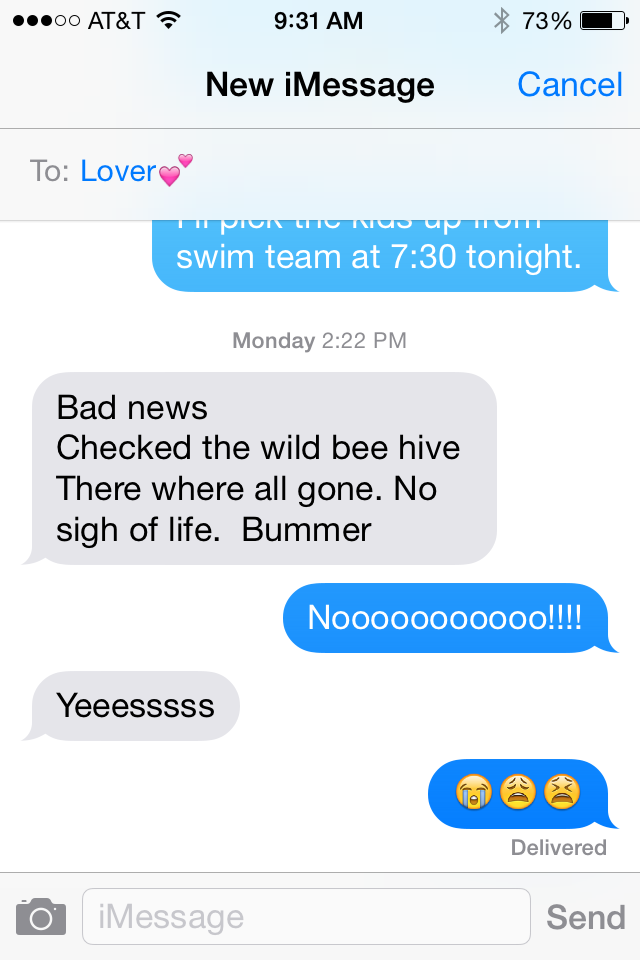
A recent text conversation between my husband and I went something like this:

bee text

First of all, ignore the typos. I blame the smartphone. It gets a little too involved. Second, there were not enough of those little crying emoticon thingees to portray the appropriate degree of sadness, despair, and outright terror I felt about the bee situation. The honey bees, our fuzzy four-winged friends responsible for pollination of about 70% of the foods we eat are dying by degrees and we, seemingly, are powerless to stop it. The story with the wild honeybees is this:  READ MORE HERE…

thanks, man

gratitude

This is such a fun writing assignment it hardly seems like work at all. Well, that’s not entirely true; it is challenging. I love this exercise because it opens all the doors and windows in my mind to let the cool breeze of appreciation blow through. This exercise will make you happy –after it makes you a little nuts. It will grow your sense of appreciation, right after it seemingly shrinks your capacity to grow creatively. It will teach you how to count not only your blessings, but your mother’s blessings, your dry cleaner’s blessings, and that guy’s on the corner, too. It will challenge you in ways you didn’t know were possible, but by the end of it, you will have developed a new-found appreciation for your writing prowess.

This exercise is a process of developing awareness for the details that comprise your life. It is about learning to look beyond the surface of things, to become like Superman, able to see in and through the ordinary facets of your life. It’s about tapping in and turning on, which is about 181 degrees from what we do on an ordinary basis. We work our daily lives into routines because it simplifies things. You take the same route to work every day because you don’t have to think about which street go down, the speed of the flow of traffic, what detour to take because the road has been torn up by the city crews. By following the same route to work each day, it frees your mind up to traipse after other thought balloons, work out other puzzles like what you want for dinner tonight, whether you’ll get the roses trimmed this weekend, the tattoo your darling daughter wants to get on the small of her back, your dream vacation to Galapagos.

Routine driving patterns are just one example of how we engage in activity, and disengage our attention. Personally, I like to devise new routes to get to the same old destinations for the adventure of it…but that’s just me. The trouble with routine is that we stop noticing the details of the world when we go on auto-pilot. Life goes by in a blur while we’re busy thinking about yesterday, dreaming about tomorrow. Right Now gets pushed off to the side as. uninteresting or unimportant. This couldn’t be further from the truth.

Some sages assert that Now is the only thing we know for sure. We can touch Now, we can taste Now. Where is the future physically located? Where is the past? Can you touch it? Can you slide it over your skin like a fine silk scarf? Now is the only tangible thing that matters and we’re busy pushing it away in our rush to be somewhere else. It’s sad. We spend so much of our time anticipating the future and replaying the past that the present slips by unnoticed. The Amish have it down. They don’t keep photographs of their beautiful, clear-eyed children because it’s against their conservative religious tenants. But as a side benefit, it anchors them firmly in the right now. Right now their girls are lovely. Right now their boys are strong. There’s something liberating about that kind of limitation. For this exercise you must anchor yourself firmly in your Now. No escaping to yesterday, no slipping off to next week. Take a deep breath and let it out slowly. Look around you, study your surroundings. If you’re in a cafe, count the people who occupy the tables around you. If you’re on the deck at home, notice the temperature of the air on your skin. Be present. It’s Now baby! Embrace it, shake it around, drink it up.

Take out your journal and put this heading at the top of a nice, clean page with the date on it; 100 Things I’m Grateful For. And there you go, that’s it. Now before you start scratching around the idea that this is too simple and too trifling, let me I can assure you, it is neither. A list of one hundred things may seem like an easy task, a task for a fool; and maybe it is. If you get to one hundred without breaking a literary sweat, bump it up to two hundred just to make it interesting.

The big stuff is easy: love, family, a comfortable life. What about the small matters? Lentils. Air conditioning. Sandals. The list really is endless, so get creative. How about guppies and bright green parrots? Make a list of 100 things –I guarantee you that the interesting stuff doesn’t even begin to show up until somewhere after 25. Generally, this is what you can expect. You’ll start at one, and streak blithely along, passing ten things you really appreciate without so much as lifting your pen from the page. Twenty will come and go. Shooting round the bend of forty may slow you down a little, scratching for ideas and then you see fifty up ahead. The incline before you has become swiftly steeper, slightly more hazardous. You’re not taking the corners as rapidly as before, maybe you’re having trouble catching your breath. Maybe this isn’t as easy as you thought it was. Panic might get you in its grip: What? Can’t think of 100 things? Approaching the summit, the forest thins and the air is vaporous and you passed all the obvious details of gratitude ages ago. Just when you think of giving up this stupid useless quest, something happens. Your minds slows its spinning, the sharp edge of your cunning softens, and what slips in, is a quiet knowing. There is so much more, more than you could ever fit into the list of 100. The thoughts pick up speed now. Suddenly the ideas rush at you and you smile knowingly. You found those things; all of them. And you found them not yesterday, not tomorrow; you got them all.  

You’re welcome.

first day

champion

Do you remember your first day of school?  I remember that I was excited, but I can’ recall more detail than that. I imagine now that when I got home that day, I drove my mom mad with details about amazingly cool! things like chalkboards, desks, coat hangers, paint boxes. No detail was too small, too mundane to be spectacular!

What would it be like if you found everything around you to be new and amazing, if the world was an exciting place to wake up to every day?

We’ve become so conditioned to our habitat, our customs, that we’ve simply stopped noticing anything that appears less than epic. But to a child, a Cheerio is an act of magic! A school bus is a marvel! An artichoke ­spectacular!  Do you sometimes wonder where the wonder went?

No, you are not too old, and unless you really insist, too stuck. You can retrieve it by tuning back in to your enormous and innate powers of observation. They’ve always been there, but over time you got busy, started to ignore them, and they went to sleep from lack of use. No worries, you can get them back by waking them up and putting them to work. Again, and again. Repeatedly.

Our brains have amazing aptitude for recording detail. We hear and see and smell things all the time. We are aware of temperature, texture, weight, balance, language, color, relative safety or danger, constantly. Your conscious brain may be focusing on having a conversation with your hair stylist, but your subconscious, the primitive part of the brain is calculating and recording every detail in a ten foot radius, from the height of the display shelves to the left and the colors of the bottles on them, to your proximity to the door, to the relative humidity of the cool air brushing your skin, to the inflection in your stylist’s voice and whether the smile on her mouth matches the smile in her eyes.

You must think like a reporter. Reporters are trained to see what’s going on, to put the evidence together like pieces of a puzzle, and draw conclusions. You need not come to any grand conclusion from your observations, but observe, you must. You must begin to see the world not in broad strokes; ‘oh, there’s a school,’ and ‘oh see, there’s a dog,’ but in very detailed specifics. Go overboard! Scrape as many details up as you can. You can never be too specific. While you’re looking at the world around you and may be tempted to get lazy and summarize the vista spread like a banquet before you, but don’t fall for that old game. You will surely regret it. You will regret it because you will forget it. You will not remember the exact butterfly pattern on the bobble-head girl’s dress who knocked into the boy at the park playground and made him cry. You will not remember that the scruffy grey dog that dropped a stick at your feet and smelled like week-old salmon and sported one blue eye and one brown. You will not remember that on that particular day, you savored a peach flavor popsicle and that the clouds marched like a row of cream puffs against a sky so blue it made your eyes ache. You will not remember these things and you will not develop a knack for populating your writing with a thousand details unless you begin to flex that muscle of observation and put it to work.

Journal keepers all agree; when you go back and read through the books stacked neatly on your bedroom shelf, when you randomly open a book to a page and scan, it completely brings you back to that day at that cafe in that town, and remember everything about it because on that sultry afternoon fifteen years ago, you sat over an iced coffee, threw crumbs to feed the sparrows, and you wrote in your journal. You took a snapshot of your life -not a fuzzy half-focused one, but an honest to God totally naked look at all the florid details that filled your life for just one miraculous day. You wrote it down as a gift to your future self, and oh my. The sensation of reliving a day you had completely lost track of While you were busy raising children, managing a career, writing a book, caring for parents, making lobster costumes for Halloween parties, baking cookies, loving a spouse, is pure; it is delicious.

 Each day is miraculous in about a million ways, but we humans have a short memory. Then another day comes, and the previous day gets tossed into the comer. And then we get another one! And another one! Pretty soon, there are thousands of such days and I don’t care how good your memory is, how many synapses you’ve got firing, how Leica-like your brainpan is, you can’t remember it all. That’s what a journal is for. Grab your journal and before you open it, open your ears and open your eyes. Learn to observe. Be an anthropologist. Be objective. Be brave. Walk into a coffee shop with nothing but a smile and a journal and sit yourself down at a comer table. Situate yourself with your coffee or your tea, and peer into the room around you. I mean, really look. See things like you had never seen them before and you were taking notes to retreat back to your home planet and report on the customs of the natives in your neighborhood. The man at the next table may be wearing glasses and reading a paper. Okay, good details. But what color are his glasses? What shape? Is the paper he’s reading an international journal or a gossip tabloid? The details tell a story. You can say the girl wore a dress. Okay, many girls wear a dress. But ‘the girl word a red dress’ tells us that maybe she’s a little fiery, a bit of a firecracker. When you fill your journal with details, you bring your images alive.

So get out of your comfort zone. Take a vacation from the familiar. Stop acting like you’ve seen and done it all, because cynicism is just boring. Train yourself to see your world like you’ve never seen it before. Begin to pay attention to the details, at least some of the time. Fill your journal pages with the flavors of your exotic life. You may not think your life is anything special, but I bet you dollars to donuts someone on the other side of the planet thinks it’s gosh-darned amazing. So act like it. Act like your life is a rich stew of tasty details, and write them down.

C. Gregory

agua fresca

PopsiclesistockSummer has arrived in the valley of the vines and we’ve arrived at the corner of  99 degrees and dry as a bone. In a state that provides produce up the wazzoo for the rest of the country, this could be a problem down the road. Our Golden State grows almost half of the fruit, nuts, and vegetables Americans eat. . . and it can’t grow bupkis without agua fresca. That’s everything from avocados to zucchini, Zeke. And if you don’t think that meat producers need water, think again. All animals need water – whether we’re at the top of the food chain or the middle or the end. That Quarter Pounder you had for lunch? It took 800 gallons of water to produce (based on the estimated 2500 gallons of water to produce one pound of hamburger). As water becomes more scarce,READ MORE HERE

earth day (h)

Unknown-1

WINTER [notes from montana]

        “It was early September and I was driving, literally, to the last road in the United States, a gravel-and-dirt road that paralleled the Canadian border, up in Montana’s Purcell Mountains. It was like going into battle, or falling in love, or walking from a wonderful dream, or falling into one: wading into cold water on a fall day.” –                    Rick Bass, Winter

      Can Rick Bass help it if his Soul’s been on a nature walkabout for all of his life? In Winter [notes from montana], Bass’s wandering spirit is alive and well and living in the Yaak Valley in Montana without electricity, without heat, other than the wood-fired variety, and without much contact with civilization… To read more of this post, go here

you’re in control

Comet_P1_McNaught02_-_23-01-07OIL IN WATER

Pam Lazos

Chapter Seventy-Eight

Fifteen minutes later due to Hart’s intercession, Bicky sat leaning against the wall of the TDU, his leg wrapped in a tourniquet that Hart was tying off. The tourniquet, made from pieces of an old ripped bed sheet turned rag, was streaked with dirt and motor oil; Jerry had refused to allow anyone in the house to get medical supplies. Bicky flinched as Hart secured the whole mess in place with a finishing nail.

“There are more civilized ways to get retribution, Jerry.” Hart snapped.

“Don’t tell me it’s not something you thought about yourself from time to time, Mr. Chief of Engineering.”  Hart snorted.

“You know what surprises me, Hart? What surprises me is that a thousand freaking people a day don’t just get up out of bed, strap on a semiautomatic, and blow the crap out of something. That’s what surprises me.” Jerry’s voice cracked. He cleared his throat and scratched the barrel of the gun against his scalp. “And everywhere there’s death. People dying.”

“People are always dying, Jerry. It’s just the one that’s got you upset.”

“Actually, it’s two. And if you give me a minute, I’ll tell you about it. But first I want to clear some things up with your boss, here. Before he passes out, that is.” Jerry stooped down next to Bicky.

“You proved your point, man. You’re in control,” Hart said. “Now let me call an ambulance.”

“And then what? Have me arrested? I’m a rich man now. Rich men don’t go to jail.”

“Look, Jerry,” Hart said, watching Bicky. “Given the extenuating circumstances, I’m sure we can work things out,” Sweat poured from Bicky’s ashen face, but he managed a nod.

“I want to tell you a story first,” Jerry said. “Sit down,” he said to Hart. “Keep the kid over there on the hammock. Take the chair over next to him.”

Hart laid a hand on Gil’s shoulder and pushed him toward the hammock

“And get that beast outta’ here.”

Gil snarled at Jerry, but did as commanded. “Come on, Max,” Gil said. Max ran over and stood next to Gil, wagging his tail. Gil walked him to the door and ushered him out. “Stay,” Gil said. Max started barking as Gil shut the door on him.

“You better shut him up or I’ll shut him up for you,” Jerry said.

Gil’s eyes watered, but his voice didn’t waiver as he opened the door again. “Ssshhh! Sit, Max. Be quiet. Understand?” Gil raised his index finger to his lips and Max whimpered once, but sat down as instructed. Gil’s sad, brown eyes blinked, shutting the spigot on them as he closed the barn door. He took a seat on the hammock. A soft low growl rolled in like a wave through the crack under the door.

“You did the right thing,” Hart said, squeezing Gil’s hand. Gil returned a brave smile. Jerry’s face clouded with something akin to regret. He rubbed a rough hand over his eyes and it was gone.

“Story time, eh?” Jerry folded his arms across his chest, facing Hart and Gil, the gun poking out from under his arm.

“You see, one night, I’m sitting outside your house — ”

“My house?” Hart narrowed his eyes at Jerry.

“— and I’m watching, and I’m waiting, and I happen to see a familiar car pull into your driveway and lo and behold, who gets out, but your father-in-law. That means kin-by-law, you know, and brings with it a certain degree of responsibility which a lot of people don’t take seriously enough, I think. It’s not just about a seat at the holiday dinner table.” Jerry fixed Bicky with an accusatory glare and the two men could not let go the sight of each other.

“Anyway, he doesn’t knock, just goes right in like he owns the place. You know what I’m talking about, right?” Jerry tilted his face toward Hart for emphasis, but wouldn’t break eye contact with Bicky. “So I get out of my car and I walk around to the kitchen window to see what’s happening. Bicky’s in there and Sonia’s got the kettle on for tea and it’s steaming, but not whistling yet. She’s putting a tea bag in her cup and she’s got her back to him. The windows are open, which I don’t understand because it’s hot as hell out…”

“Sonia didn’t like air conditioning,” Hart said, his voice thick.

Jerry nodded. “And if not for that small fact, I wouldn’t be relaying this story to you now as I’ve witnessed it,” Jerry said to Hart, his eyes still glued to Bicky’s face. Anyway, I hear bits and pieces of things. Bicky says: ‘Sonia, enough,’…and then something something. And Sonia says: ‘Where’s what,’” and Bicky says, ‘You know what…’ and the tea kettle starts screaming and I can’t hear a thing for a minute, but this ear-splitting whistle and Sonia and Bicky stare at each other and words come out of their mouths, but I can’t make them out until finally, he yells at her to ‘shut the kettle’ and she very calmly walks over, grabs the kettle and pours herself a cup of tea.” Jerry smiled at Bicky as if he had just one-upped him.

Sweat continued its downward spiral, pouring from Bicky’s face and scalp while his face changed from pale grey to pale green. Bicky squeezed his right leg, but did not avert his eyes.

“You never could back her up, could you? That’s what always pissed you off about her,” Jerry said. “How did it make you feel, Boss, to finally have no control over something?”

Using his hands for balance, Bicky tried to stand, winced in pain and dropped to the floor, both hands wrapped around his thigh just above the entry wound.

“Kind of like now?” Jerry asked, the pleasure of the moment apparent on his face.

“Jesus Christ, Jerry. What the hell are you talking about?” Hart said.

Jerry sidled over to Bicky and put the gun to his face. “You want to tell them?” Bicky shoved the gun away, breaking eye contact.

“Uh oh,” Jerry smiled and patted Bicky’s face. “You lose.” Bicky said nothing.

Jerry sauntered over to Gil and Hart. “He’s quiet tonight,” Jerry said, a note of mock concern in his voice. He let out a long, labored sigh. “So – Bicky whirls on her, like this.” Jerry grabbed Gil by both arms and gave him a violent shake.

“Hey!” Hart said, jumping up. Jerry dropped Gil’s arms, stuck the barrel of his gun in Gil’s ribs and held up a single finger. Hart froze.

“Tsk, tsk, tsk,” Jerry said, shaking his head and motioning for Hart to sit down. He grabbed Gil again.

“He was in her face, squeezing her arms, saying a bunch of what, I’m not sure, and it must have hurt because Sonia finally let out a yelp. So what’s the son-of-a-bitch do? He loosens his grip, but still doesn’t let her go.” Jerry shot Bicky a murderous look.

Jerry dropped his voice, his face taut with recall, one hand tightening around Gil’s arm, the other still poking the gun in Gil’s ribs. “I wish now I had gone through the window after him.”

“Oooww!” Gil said. Jerry jerked on Gil’s arm as if to bring him back in line, but when he looked at Gil’s small, pinched face, he released his grip.

“Sorry,” Jerry said. Gil inspected his reddened forearm, already forming a bruise.

Jerry’s eyes misted over, but he continued: “‘I don’t have it,’ she said. ‘Don’t lie to me,’ he said. ‘What you sent wasn’t what you took,’ he said, and then a bunch of stuff I didn’t hear.”       Jerry swiped at his watery eyes with his free hand, then rubbed his forehead with the barrel of the gun, leaving a bright, red welt. He pushed Gil toward Hart and motioned them back to their seats. He shook his head like a wet dog, before pointing the gun at Bicky. “Son-of-a-bitch,” he said, drawing back the trigger.

“Jerry!” Hart yelled, and pulled Gil behind him.

Bicky braced for the bullet, his face scrunched and tense, but his eyes were unwavering in their gaze. Jerry leaned back, inhaled slowly and fired, lifting his gun slightly before pulling the trigger. The bullet drove harmlessly into the wall above Bicky’s head. Bicky began shaking and sucked in a long, raspy, breath.

Jerry stood up and walked over to the drawing table where Gil had laid out a blueprint of the TDU. He thumbed through the drawings using his gun as a finger to turn the pages. He turned back to Bicky.

“What were you thinking that day, Boss? Did you understand? Were you resigned? I’ll never get why you so uncharacteristically backed up. Why’d you leave without it, huh? When you knew she had it? Cause you know, she’d be alive today if you would have just done what you always do which is not taken no for an answer.”

“I was with Bicky at the Union Club that night, Jerry,” Hart said. “I left before he did. So he couldn’t have been at my house.”

Bicky looked at his son-in-law; his lips forming into a slow, sad smile.

“Loyal to the end, aren’t you, Hart?” Jerry sat down on Gil’s stool, pointed the gun and spun around once. The moment he was in a direct line of fire with Bicky’s head, he planted his feet on the ground with authority.

“I tell you your wife would be alive today if not for him and you defend him. You’ve been duped. We all have.” Jerry spun around again and came to another abrupt stop in direct line with Bicky. This time he fired. The shot went into the wall just above Bicky’s right shoulder. Bicky heaved out a lung full of air, but refused to utter a sound.      

“‘Just tell me you didn’t go to the newspapers,’ he said, and she shook her head. Just the way he looked at her, trying to see inside her, to see what she was up to. But he never could, never did understand her. Not like I did. Jerry swiped at his eyes and stared at the floor.      

“What happened next?” Hart asked.

Jerry spun around a third time and once again pointed the gun at Bicky who was now sobbing quietly, the muscles in his face tight with pain. “I’ll tell you what happened next.” Jerry fired and the shot drove into the wall less than an inch above Bicky’s left shoulder.

“Bicky left.”

 to be continued

there is more before

copyright 2013

one loyal group

cactusOIL IN WATER

Pam Lazos

Chapter Seventy-Six

Hart sat on the bed in his hotel room reading the newspaper behind closed eyelids. Two sharp raps on the door startled him awake.

“Hold on,” Hart called. He rubbed his entire face with one hand before rising to look through the peephole.

“What the — ?” Hart said, throwing the door open.

Bicky held up a hand to silence him. “May I come in?”

Hart stepped aside to allow Bicky ingress. Bicky headed straight to the window.

“I’ve been calling you all day,” Hart said. “What the hell are you doing here?” Hart grabbed two beers out of the mini-fridge, popped the tops and set one down on the window sill next to Bicky. “And what happened to your hand?”

Bicky appraised the appendage as if it were an alien species, but said nothing so Hart switched topics.

“I’ve secured financing. But it means I have to sell out. Completely sell out. Every last stock certificate.” Hart gave this information some time to sink in, but Bicky didn’t answer, just stared out the window, his face glued to the view. “Look, I know what that could do to you…to the company. And I’m not trying to undermine you, Bicky, so if you can get the money together….”

“I spent the whole day with the kids.” Bicky stood as still as Billy Penn atop City Hall Tower, staring out over the Delaware, watching the ships come in. “She came back nicely, didn’t she?” he said, nodding toward the river. “Not even a trace of the spill is visible to the naked eye. And it’s only been what? Two months? He picked up his beer and raised the neck to tap Hart’s own. “To the healing power of nature.” Bicky took a seat on the window sill and turned to Hart, his entire body engaged.

It was the atypical nature of the gesture that made Hart uneasy. “I’m guessing you didn’t come here to talk about nature.”

Bicky shook his head. “I was wrong. Too many times over these years I’ve treated you with less than the respect you deserved.” Bicky picked up the beer, but did not drink. “You’re a fine engineer, and a fine son-in-law. Probably the best I’ve ever seen in both categories.” He set his beer down and stood up. “I just wanted to tell you that.”

Hart stared at Bicky, mouth agape. In the ten years he’d known his father-in-law, Hart had received more than his share of the booty for a job well done: new cars, six-figure bonuses, vacations in exotic settings, even a boat once, but this one small comment, mixed with confession, was the most profound and heartfelt gesture Bicky had ever made. Perplexed and more out of sorts than when Bicky first walked in, Hart stood up, too.

“Thanks,” he said. He looked at Bicky queerly for a moment until Bicky’s words sunk in. “The kids? I guess you’re talking about my kids?”

“Very fascinating family. I’ve been thinking about this all day and I’m prepared to make a deal that benefits everyone. Truly benefits everyone.”

“I’m listening.”

“Tomorrow. Let’s meet at the Tirabis’ in the morning. Say ten?”

“You want to give me a glimpse into the future?”

“The thought struck me that you could benefit from an existing facility, not just for refining purposes, but for transport. We have pipelines all over the country bringing raw crude into our refineries. What if we reversed the process? Instead of pumping to us, we send the finished product, the stuff you distill from trash, away from us to be either sold or further refined around the country. We can run this without the additional capital and I predict….”

Hart’s smile was so wide, Bicky stopped in mid-sentence.

“What?” Bicky asked.

“Had you given me the chance on the phone that night…”

“Oh. You already thought of that, is it?” Bicky smiled, his trademark half-smile. “Thanks for humoring an old man.” Bicky patted Hart on the back and walked to the door. “Tomorrow.”

“The Tirabi kids know we’re coming?”

“Yes.” Bicky stood face-to-face with his son-in-law, his hand on the doorknob. “They are one loyal group. They wouldn’t deal with me at all until you were at the table. You should be proud of that. The ability to engender loyalty is a lost art.”

Hart smiled, but couldn’t formulate a response because of the large boulder in his throat. Bicky squeezed Hart’s shoulder and shook his hand at the same time.

“See you tomorrow, son.”

to be continued. . . .

this is what happened before

copyright 2013

assault the page

dancing poodleJournal THAT

Cynthia Gregory

Here is a writing challenge that is completely over the top: write with your non­-dominant hand for one page. No more. More than one page is just torture.

The reasoning behind this exercise is similar to the logic behind writing by hand and not relying on the computer keyboard for one hundred percent of your writing output. Writing with your dominant hand allows your thoughts to flow unimpeded from your dazzling brain, down your graceful arm and onto the page in a liquid script. You learned to do this type of writing so long ago that the muscular memory is well established and you no longer need to think about how to grip the pencil, focus like a mountain lion, rear back, and assault the page. This type of writing is automatic, never requiring a second thought to secure a type of fluency, and elegance of process. You pick up the pen, you write.

When you write with a computer, you access both parts of your brain and manage a fairly linear process of calculating thought, interpreting electronic impulses, dashing off messages with lightning speed. You are capable of producing great amounts of written material quickly; if you are an accomplished enough typist, your fingers can almost keep pace with your thoughts. Likely however, you are able to dash off great tracts of prose produced at a formidable rate, interspersed with small interludes of calm while the thinking apparatus generates more material, whereupon the typing commences at high speed.

Alternately, writing by hand slows you down by a least half. The statelier pace of recording thoughts on the page also slows your mind down, and everything relaxes. Your brain has time to linger over thoughts, to meander down lanes of memory and drowse in the dapple shade of summer trees. You can write quickly, but you are still operating at about half-throttle, and there is a more reflective quality to your thoughts and ideas. You can immerse yourself into an idea, you may actually visualize it, take it in with your senses, spend some time with it, date it, get to know it’s quirks, understand the sweetness of it, savor each nuance of meaning before moving on to the next idea. Writing by hand is a tactile and timely experience. You feel the gravity of each word, pushing your pen around the paper. You smell memories; you taste nouns. The idea in your mind merges with your heart and produces lines on a page that more or less mean something. Writing by hand actually means writing by body. It’s not as if your hand is a separate unit from your shoulder, elbow, neck, or heart. You write with it all; because it’s all connected.

If writing by hand is a physical experience, writing with your non-­dominant hand is meta-physical. It requires a concurrent focus just to grasp the pen, to align yourself with the paper, figure out at what slant to approach a line of dictation, how firmly or lightly to squeeze the pen. Suddenly, words with billboard-sized letters loom in your mind, waiting, while you work out the downward loop in your cursive f and move on. What an accomplishment!  

Don’t try to be perfect –you’ll frustrate yourself– unless you were born a leftie and a well-intended but completely disconnected nun forced you to be normal by learning how to write and color and cut paper chains with your right hand. If this is the case, allow me to apologize on behalf of teachers everywhere. You were perfect the way you were, and no one had the slightest right to alter your natural impulses.

Write with your weaker hand –and as you do, you will notice that you have to loosen up. At first you’ll be all stiff and stilted, which will be of no discernible help at all. Struggle less, write more. It’s almost as if with less effort your writing becomes more legible, and the mess of spaghetti on the page begins to resemble actual letters connected to convey meaning. Start by practicing writing your name, then the names of the ones you love. Then gradually, work your way up to words and sentences. A paragraph becomes a grand achievement. Once you master the paragraph, work your way up to a page. Don’t worry about speed, it takes as long as it takes, and it isn’t a competition.

As you write with your weaker hand, you may begin to notice simplicity of thought emerging in your writing. As your neural pathways struggle to fire and connect, you may find your writing taking an intuitive leap, a creative catapult toward new meaning. While writing with your non-dominant hand is awkward, difficult, unseemly, unruly, undignified, it is also as unimaginably liberating as a good walk in the summer rain, as a slice of pizza for breakfast.

We all walk around with a virtual circus playing in our heads and hearts. We carry a lifetime of memories, and a universe of potential. We are at once a young child, and a wise mentor. We are co-workers, and doting grandparents. We are friends and dog-trainers. Vegetarians and comparison shoppers. We are none of us completely and one hundred percent just one thing or even the face we show the world. This is maybe just one of the things that make us such interesting and complex individuals. When we write with our dominant hand, our worlds remain intact, there is no color outside of the lines; all personalities more or less behave as expected. When you write with your non-dominant hand, buried thoughts may rise up to the conscious level, may veer outside the lines in splashes of magenta and vermilion. It becomes messy and a trifle chaotic, but it becomes something beautiful, too.

Writing with your non-dominant hand is a bit of a magic trick; now you see it, now you don’t. While you focus on your inelegant claw struggling to grasp a pen, hidden thoughts may trickle in; tiny hairline fractures may appear in the wall you’ve built around the creative juices; the wall itself may start to crumble just a little, and ideas you’d forgotten you had may just trickle in. Et voila! A dove materializes from a handkerchief.

I believe in magic. I believe in illusion. I believe that coloring outside the box is not just fun; it’s an innate responsibility of the creative heart. So get out there and write with your less popular, ugly step-sister, non-dominant hand. You won’t like it at first. In the beginning it will be as difficult and awkward as a poodle in a tutu. But once you relax and flow with the process, you’ll learn to know yourself in a whole new way, chances are pretty good you’ll like the other, less dominant you.

shutting down

pondscum2OIL IN WATER

Pam Lazos

Chapter Seventy-Five

“All this,” Jack said, placing his hand on Kori’s heart, “is highly combustible. When things heat up like this, it always gets a little dicey.” Jack removed his hand from Kori’s heart and pulled her to him. “It’s all about chemical reactions, Kori,” Jack said. “The most dangerous part of the process is starting up and shutting down. That’s when things are the most precarious.” He squeezed her hand and smiled. “But you already knew that.” She smiled back despite herself.

“Are we starting up or shutting down?” Kori asked. She hoped her voice didn’t belie the need in her.

“That depends on if you can stand the temperatures?” Jack asked.

“Well, how hot’s it gonna get?” Kori asked.

“As much as thirteen hundred degrees Fahrenheit for some of these processes,” Jack said.

“What processes?” Kori asked.

“Refining processes,” Bicky said.

“What are you talking about?” Kori asked. She took a deep breath and rose back to the surface of consciousness opening first one eye and then the other. When she realized where she was, she groaned and squeezed both eyes shut.

“Boiling points, my dear,” Bicky said. “The beauty of crude oil is that it’s not just a single chemical compound but a mixture of hundreds of them. They’re hydrocarbon chains and they each have different boiling points. Refining is simply heating the crude to higher and higher boiling points and pulling off the vapor through the process of fractional distillation. Then you condense the vapor through cooling in the distillation column.” Bicky glanced in the rear view mirror. Kori’s scowled at him, but Bicky continued. “Each different hydrocarbon chain is useful for something. With a chemical process called conversion you can convert the longer chains to shorter chains depending on demand. You can also combine fractions to give you yet more usable products. Of course, much of it needs to be treated, but that’s a small price to pay. There’s a reason why crude oil’s called liquid gold. It’s one of the most versatile compounds known to man. Actually it’s a shame that so much of what we do with it is make gasoline.”

“Now who’s showing off?” Gil asked.

Bicky smiled. “Don’t blink now, ladies and gentlemen or you’ll miss it. To the right is the crude oil distillation unit and to the left is the delayed coking unit. Beautiful aren’t they?” Bicky asked.

“What a geek?” Kori mumbled under her breath. Max’s tail brushed her nose and the combination of smelly dog and too much expensive perfume from the pedantic idiot up front was making her head hurt. She sneezed and turned back to the window.

“Hey, Sleeping Beauty,” Avery said. “Have a nice nap?” Kori stared at Avery long enough to convey her distaste before returning her gaze to the storage tanks that looked like hundreds of giant white gum drops floating by her window. “You were snoring,” Avery said.

“And drooling,” Gil added.

“Shut up,” Kori said. Avery held his hand up for a high-five and Gil whacked it.

“I just want to go back to sleep,” Kori said, desperate to see how her dream would end.

“That’s the tank farm on the left, if you’re interested, Kori,” Bicky said.

Kori couldn’t be less interested. She yawned, rubbed her head and smacked Max’s twitching tail away from her face.

“Knock it off, Kori,” Gil yelled.

“I told you to keep his tail out of my face, you little brat.”

Gil scowled at Kori and pulled Max closer to him. “You better watch it or I’ll set him loose on you.”

“Yeah, right,” Kori snarled.

“No blood, please,” Bicky said. “It’s a rental.” Both Kori and Gil stared out their respective windows.

“So. As I was saying, there’s many different processes that occur in a refinery. There’s separation and conversion, and treating and blending. Crude oil gives us lubricating oil, tar, asphalt, petrochemicals which are used to manufacture things like plastics. And , it’s a model for recycling since many of the end products are used as feedstock to create new products.” Bicky craned his neck to look out the window. “See over there? That’s the catalytic reforming unit. And over there’s the catalytic cracker,” Bicky said.

Kori insulted Bicky under her breath and looked over at Gil to gauge whether he’d heard her, but Gil was listening with rapt attention to every word that came out of Bicky’s mouth.

“So far the TDU only makes oil and gas and there’s some mineral byproducts. But maybe we could make other stuff,” Avery said.

Gil nodded.

“Are we going home anytime soon?” Kori whined.

“That’s the hydrofluoric acid alkylation unit,” Bicky said. “And over there is the sulfuric acid alkylation unit. And that, I believe, is the light ends distillation unit.”

“Do you know how all these units work?” asked Gil.

“Years ago, when I first started out, I devoured chemistry and I knew the ins and outs of all these machines,” Bicky said. “It’s been awhile, though. I think I may have forgotten.”

“You don’t ever forget, really,” Gil said. Bicky looked at him in the rear view mirror and when their eyes met, Gil smiled.

 ➣➣➣

At Gil’s insistence, they had stopped at Wendy’s for dinner, because Gil wanted a frosty. Although Bicky detested fast food, he acquiesced after Gil reported he was prone to car sickness brought on by a lack of snack food. Bicky smiled inwardly. The kid was clever. Bicky smiled and watched him in the rear view mirror, Gil’s countenance serene in sleep.

Recognition shot a bolt of adrenaline through his solar plexus as memory upon memory of a ten-year old Mason came flooding back to him. Although Gil looked nothing like Bicky’s brother who’d died around Gil’s age, Gil’s canny mind, crooked smile and clever dialogue lent him a whole six degrees of separation aura that Bicky couldn’t shake. A shiver ran through Bicky’s body, as if Mason himself had reached out beyond death to whisper in his brother’s ear. Bicky squeezed his eyes shut to quell the flood of memories, then opened them and focused on the lines in the road.

It was after 10:00 p.m. when Bicky pulled into the Tirabis’ driveway.

“Sorry about the time,” Bicky said. “I didn’t realize it was so late. You’ll be tired in school tomorrow.”

Avery shrugged and looked at Bicky with kind eyes.  Any malice he felt for the man had evaporated like distilling crude oil. “Thanks for showing us the refinery…how everything worked.”

Bicky dismissed the thank you with a wave of his hand. “You’re most welcome.”

“Kori could probably have done with something less than a marathon tour,” Avery said, but she’ll get over it.”

They turned to glance at Kori who, along with Gil and Max, was fast asleep in the backseat.

“He’s got a huge appetite,” Bicky said, watching Gil.

“Oh, yeah. Thanks for dinner.”

“Stop thanking me already. That’s actually not what I was talking about. It’s his voracious appetite for knowledge.” Bicky turned back to Avery. “You all have it.”

Kori snored, a small, inconsequential noise, but a snore all the same. Avery raised his eyebrows and looked at Bicky for confirmation.

“Yes. Even Kori,” Bicky said.

Kori issued another strange, guttural sound, waking herself up.

“We’re home?” she asked.

“You spent most of your day sleeping,” Avery said.

“I dreamt we were little. Before Gil was born. The three of us were asleep in the backseat.  Gil wasn’t even born yet.  Dad said he and Mom should carry us all in at once so no one would be left alone. Mom said she’d wait with two while he brought one in, but Dad said that still left someone alone, but on the inside. He hated to see anyone be alone.” She rubbed the sleep from her eyes and yawned wide, opening a fissure as deep as the Grand Canyon. “Mom had Robbie and Dad already had you Avery, and was leaning in, trying like hell to pick me up one handed. I peeked and he saw me, so I shut my eyes real quick, waiting for him to say I should walk inside since I was awake. But he didn’t say it – just carried me in, pretending I was still asleep.” Kori’s gaze grew wistful and her head lolled back against the seat. “Weird. The stuff you remember.” She got out and offered Bicky her hand. “Thanks for dinner. Sorry about how I acted before.”

“My pleasure,” Bicky replied his gaze falling once again on Gil. “How about I carry him?” He looked at Avery and then back at Kori and smiled. “You, on the other hand, will have to walk.”

 to be continued. . .

read what led up to this state of affairs

copyright 2013

sister::sister

sometimes you love your sister. sometimes you don’t.

sometimes love and denial get all mixed up together.

support the arts::buy the bookAGo1 Cover Amzn ver large