Author Louise Erdrich offers what may well be the best writing advice. Ever. Listen, then leave a comment for the rest of us to chew on. Then get back to that manuscript, baby.

Author Louise Erdrich offers what may well be the best writing advice. Ever. Listen, then leave a comment for the rest of us to chew on. Then get back to that manuscript, baby.
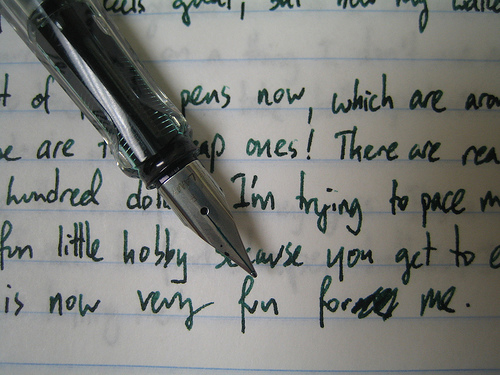 Once, I belonged to an amazing clutch of writers who met every week to explore writing through timed exercises. It was one of the best writing experiences I ever had, and it did more to develop my skills as a writer than almost anything I’ve done since. Twenty years later, I still miss meeting with that group of women. We shared a very important time, you might even say a sacred time, two hours each week, supporting one another and learning to develop our writing voices. Few things were allowed to interfere with our commitment to meet. We gathered faithfully each Friday at an outdoor table at the Bear Street Cafe in Orange County, California, and parked our individual cares at the door in order to be fully present and nakedly honest during our joumaling session. We wrote furiously, read aloud with quaking voices, listened respectfully, and grew as writers.
Now that I live in Northern California, I maintain virtual relationships with several of these fabulous women, and we see each other when we can. But the thing that remains one of the greatest gifts of my life is that even though whatwe mainly have in common is our passion for writing –no matter what, we support each other. We celebrate each others’ successes, and provide insightful comments to help make each other’s work the best it can be. Writing groups are an excellent way to develop as a writer -you can find or form a group by taking classes, getting to know other writers, and then meeting outside of the classroom setting to give yourself more honest writing time.
Back in the day when we met at Bear Street, we maintained a strict routine that went something like this:
One by one, the words were selected from the cup, and we wrote timed exercises based on them. After the time was up, we went around the table and read our work. This wasn’t easy at first, but our group was a safe place to put it out there. One unbreakable rule was that under no circumstances, could we comment on what we wrote -neither the writer not the listeners were allowed to comment. But let me tell you something: our writing got stronger and better and more deeply creative by just listening to each other. I think we secretly tried to out-compose each other, but the result was that we pushed each other to spiraling heights of creativity without so much as one well-intended criticism. It was amazing and illuminating, and a huge lesson in the art of paying attention.
So, dear writer, waht are you paying precious attention to? Where lies your genius? Leave a comment with a single word. What is it you find to write about — in a completly original way? Ooh. Do tell.
The time we’re most familiar with is a unit of measurement and the way in which we experience the advancement of our lives. Religious pundits have for centuries described time as a circle, ever evolving upward. Yet every year we experience a birthday, an anniversary, a holiday, making our perception of time both circular and linear. Confused yet? If so, then you need to read Fractal Time: The Secret of 2012 and a New World Age

Have you ever noticed how meetings run your life? Sometimes it seems that meetings have a life of their own and libraries of books have been written on the subject. But what if you had a crystal ball? Would that change how you show up at your meetings?

We like to say that if fundraising was easy, every princess could do it. This is why we rely on our friend The Fundraising-Strategist when it comes to dialing for dollars.
It may be August but it’s still summer and there’s plenty of good vacation reading left to do. Start with Rosecrans Baldwin’s debut novel. It’s a bright shiny star in the firmament of new fiction.

Charitable giving is always a good idea. According to one belief system we are all connected. If that’s true, giving to another is the same as giving to yourself.
Our sister site knows a thing or two about giving. Find out more here.

how would you feel if you could eat just one thing for the rest of your life?
yeah, check out our sister site and see why diversity has its advantages
How many times do you go about your business and then suddenly realize that you can’t remember the last ten minutes? That you had been on autopilot, with your body operating the family car, stopping at lights and pausing for pedestrians while your mind had zipped off to distant canyons and \ gullies of memory and illusion? You’ve arrived safely and no one was hurt thank goodness, but what would happen if you were fully embodied, fully present, each day of your life? Would you see the world differently?
My vote is yes. It’s a fact that we do not cultivate the practice of notice very well. We are bombarded by television, radio, the Internet, literally thousands of messages a day (the gist of which are of the most dire nature by the way, and another reason to unplug) and so it’s natural that we begin to shut down. In many cases, shutting down is a natural mechanism of survival. The trouble is, once you begin to shut out the ugly of the world, you inevitably begin to shut out the beautiful and remarkable and miraculous, too.
Almost no one I’ve ever talked to about it thought their story was interesting. But I’ll bet their story is remarkable. They just stopped noticing the details. They forgot that their life was miraculous in about a million ways. So here’s an idea, write about your life like you don’t own it.
Cultivate an appreciation for each Now that shows up. Now, I reach for my water bottle and the cool liquid slides down my throat. Now, my fingers pull away the skin of an orange. Now, call on inspiration, and she takes my hand and we walk.
Do you remember your first day of school? I remember that I was excited, but I can’ recall more detail than that. I imagine now that when I got home that day, I drove my mom mad with details about amazingly cool! things like chalkboards, desks, coat hangers, paint boxes. No detail was too small, too mundane to be spectacular!
What would it be like if you found everything around you to be new and amazing, if the world was an exciting place to wake up to every day?
We’ve become so conditioned to our habitat, our customs, that we’ve simply stopped noticing anything that appears less than epic. But to a child, a Cheerio is an act of magic! A school bus is a marvel! An artichoke spectacular! Do you sometimes wonder where the wonder went?
No, you are not too old, and unless you really insist, too stuck. You can retrieve it by tuning back in to your enormous and innate powers of observation. They’ve always been there, but over time you got busy, started to ignore them, and they went to sleep from lack of use. No worries, you can get them back by waking them up and putting them to work. Again, and again. Repeatedly.
Our brains have amazing aptitude for recording detail. We hear and see and smell things all the time. We are aware of temperature, texture, weight, balance, language, color, relative safety or danger, constantly. Your conscious brain may be focusing on having a conversation with your hair stylist, but your subconscious, the primitive part of the brain is calculating and recording every detail in a ten foot radius, from the height of the display shelves to the left and the colors of the bottles on them, to your proximity to the door, to the relative humidity of the cool air brushing your skin, to the inflection in your stylist’s voice and whether the smile on her mouth matches the smile in her eyes.
You must think like a reporter. Reporters are trained to see what’s going on, to put the evidence together like pieces of a puzzle, and draw conclusions. You need not come to any grand conclusion from your observations, but observe, you must. You must begin to see the world not in broad strokes; ‘oh, there’s a school,’ and ‘oh see, there’s a dog,’ but in very detailed specifics. Go overboard! Scrape as many details up as you can. You can never be too specific. While you’re looking at the world around you and may be tempted to get lazy and summarize the vista spread like a banquet before you, but don’t fall for that old game. You will surely regret it. You will regret it because you will forget it. You will not remember the exact butterfly pattern on the bobble-head girl’s dress who knocked into the boy at the park playground and made him cry. You will not remember that the scruffy grey dog that dropped a stick at your feet and smelled like week-old salmon and sported one blue eye and one brown. You will not remember that on that particular day, you savored a peach flavor popsicle and that the clouds marched like a row of cream puffs against a sky so blue it made your eyes ache. You will not remember these things and you will not develop a knack for populating your writing with a thousand details unless you begin to flex that muscle of observation and put it to work.
Journal keepers all agree; when you go back and read through the books stacked neatly on your bedroom shelf, when you randomly open a book to a page and scan, it completely brings you back to that day at that cafe in that town, and remember everything about it because on that sultry afternoon fifteen years ago, you sat over an iced coffee, threw crumbs to feed the sparrows, and you wrote in your journal. You took a snapshot of your life -not a fuzzy half-focused one, but an honest to God totally naked look at all the florid details that filled your life for just one miraculous day. You wrote it down as a gift to your future self, and oh my. The sensation of reliving a day you had completely lost track of While you were busy raising children, managing a career, writing a book, caring for parents, making lobster costumes for Halloween parties, baking cookies, loving a spouse, is pure; it is delicious.
Each day is miraculous in about a million ways, but we humans have a short memory. Then another day comes, and the previous day gets tossed into the comer. And then we get another one! And another one! Pretty soon, there are thousands of such days and I don’t care how good your memory is, how many synapses you’ve got firing, how Leica-like your brainpan is, you can’t remember it all. That’s what a journal is for. Grab your journal and before you open it, open your ears and open your eyes. Learn to observe. Be an anthropologist. Be objective. Be brave. Walk into a coffee shop with nothing but a smile and a journal and sit yourself down at a comer table. Situate yourself with your coffee or your tea, and peer into the room around you. I mean, really look. See things like you had never seen them before and you were taking notes to retreat back to your home planet and report on the customs of the natives in your neighborhood. The man at the next table may be wearing glasses and reading a paper. Okay, good details. But what color are his glasses? What shape? Is the paper he’s reading an international journal or a gossip tabloid? The details tell a story. You can say the girl wore a dress. Okay, many girls wear a dress. But ‘the girl word a red dress’ tells us that maybe she’s a little fiery, a bit of a firecracker. When you fill your journal with details, you bring your images alive.
So get out of your comfort zone. Take a vacation from the familiar. Stop acting like you’ve seen and done it all, because cynicism is just boring. Train yourself to see your world like you’ve never seen it before. Begin to pay attention to the details, at least some of the time. Fill your journal pages with the flavors of your exotic life. You may not think your life is anything special, but I bet you dollars to donuts someone on the other side of the planet thinks it’s gosh-darned amazing. So act like it. Act like your life is a rich stew of tasty details, and write them down.
C. Gregory
 persephone's step-sisters