 we blush and shop and fa la la la la

we blush and shop and fa la la la la
 Journal THAT
a guide to writing
Cynthia Gregory
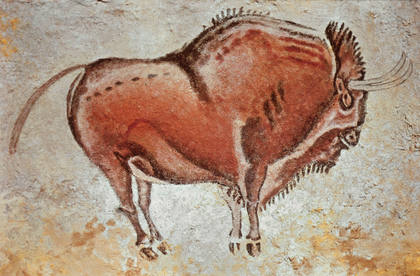
Like photographs, clichés are the shorthand of communication. If a picture truly is ‘worth a thousand words’ (a pretty cliché) it’s because its cash value rests on the fact that the ancient part of the brain, the primitive lizard brain, the dreaming brain, communicates with pictures. I mean seriously, think about it. Before written language, our ancestors drew pictures of actual horses to represent “animal” or “the hunt” or “wild and free” before there were actually spoken or written words to convey the ideas. Now, however, we are wildly sophisticated and have a language (or two) that we can manipulate to communicate otherwise free form ideas floating inside our cabezas.
Storytelling served as a history lesson before written language, and storytelling today is as popular around the campfire, board room table, or cafe four-top as ever. Stories are innately wired into us and as humans, we crave and respond to the story. The stories of our lives, our novels, movies, television and cable news, are a series of pictures – both visual and virtual. Actual photographs and pictures illustrate a narrative we may tell, as in “see? I was in Paris – here’s the Eiffel Tower,” or “here’s a photo of little Sophie Soo, ten years old.” In each case you may be telling a story, constructing a narrative and sharing information about your travels and your dog, backing your verbal story up with photographic evidence. So yes, pictures are worth thousands and thousands of words.
And if all those wonderful words at our fingertips were colors, original ideas are bright, clear fountains of rich hues, and clichés are dull as dirt.
The trouble with clichés is that they are so infused into our daily language, we hardly recognize them for their trite, frayed selves. Advertisers know this. They know that people are put off by formal language, fancy words, words that stand up straight and march with a snap in their step, so they dumb down marketing messages, intentionally inserting clichés so that their uber-sophisticated messages sound “down to earth” (cliché!) and “right as rain” (cliché!). Television programmer know this too, and make sure our televised stories don’t get too smarty pants, else run the risk of losing viewers –although because of the trance-like fog I fall into when I tune into a program I happen to enjoy, “viewing” isn’t exactly what I’d say I was doing. I’d bet a nickel that not one filter remains intact with all that bad, cliché loaded language comes washing over me. While some programs are brilliantly written, most programming I’ve observed seems to be no more than 30 minutes of tired ideas strung together. So when you think about all the hours of programming and bad language we’re exposed to, it’s no wonder we’re up to our eyeballs in clichés.
So, if everybody is guilty of crimes of language abuse, then it must be okay, right? In the words of mothers everywhere, “just because all the kids are doing something doesn’t’ make it right.” Clichés have their place, which is definitely not between the covers of your journal. You want your journal to be clear, concise, absolutely fecund with the rich details of your life, so absolutely pitch-perfect that with even a quick glance, you inspire yourself to write. Even. More.
So, once in a while work your language muscle a little harder. Avoid the flabby turns of phrase. Jettison the flaccid prose that comes so easily. Instead, read an amazingly genius writer and then journal. Turn the TV off, and journal. Instead of taking the easy way out and dropping in an over-worked and sad sad sad cliché and reach for something original. You may just surprise yourself with your own genius.
Journal THAT
a guide to writing
Cynthia Gregory
There are good adjectives and bad adjectives. There are the regular, hard-working-show-up-in-the-middle-of-the-night-but-go-unnoticed adjectives and then there are what I call the 25 cent adjectives. You know the kind, all flashy and shiny and bright, the kind you notice more than the noun that they’re describing. They’re like fast food; they temporarily distract you from the fact that there is nothing of substance behind them, they are the literary equivalent of a plate of whipped cream.
I know a lot about these razzle-dazzle kinds of describers, these peacocks of poetry. I used to scatter them around liberally, clever as I was. But what happened when I really got rolling, is that the point I was trying to make got totally buried under my ponderous prose. My meaning sagged under the weight of all that reckless description. My language got so pearly and polished that everything I wrote began to sound like a steaming, verdant jungle, packed with all the lush pomegranates, mangoes and papayas of meaning I could wedge in. I mean seriously, an old pair of scruffed sneakers with one broken lace is a perfectly respectable sort of description. But when I got done with it, those Keds sounded like Ritz Carlton glass slippers.
What happened when I began to excavate the core of my message, the humble meaning of my narrative began to emerge as I sliced away one fabulous phrase after another. Everyone knows by now the famous story of what Michaelango said when someone asked how he knew how to carve the statue of David – he said, “oh, I just got rid of what didn’t belong.” You need to do the same with your descriptive language. Pare it down, pare it the hell down. Make it lean and mean and dense. Never use a twenty-five cent word when a nickel will do.
Many people mistakenly think that a short story is easier to write than a novel, because it’s more compact. They think that a poem is even easier, because there are fewer words yet. But the exact opposite is true. Did you know that? The shorter the piece, the harder it is to write. This is because with fewer words, every one has to count. There is no room for extra padding, no place to hide. There are no long stretches of narrative, expeditions into expostulation. You have to say exactly what you mean. Every word, every verb, has to carry the weight of the sentence on its meager back, so it must be strong, and it must be absolutely true. The shorter the writing, the denser it becomes. Not dese heavy, just dense: full of meaning; ripe as a summer peach, juicy and succulent.
It’s easy to see why people fall in love with a flush of flabby, fatuous descriptions; because they mean nothing. We’re a TV culture after all, we’re used to that. Flamboyant descriptors are like a magician’s trick, a sleight of hand. Honest writing, writing from the heart, strips you naked. It’s much easier to hide your fragile heart behind a veil of words. But that takes no courage. If you want to journal, you must be brave. You must go into the room you’re afraid to enter and stay there until you have emptied yourself out. And the next day, you must go in there again. You can never completely empty yourself through journaling. There is always something more, something deeper, something rich and rare and precious because it comes from within you. It comes from a place beyond the glittery surface. It comes slick and dark and wet and you must love it. You must stay with it until your heart stops quaking in your chest and you must put it on the page, make it authentic. This is real courage. This is what true love is made of: entering into that place that terrifies you and staying there, listening, writing, watching, recording it all, until the quiet enters and the writing is complete.
Sometimes you will flow with a million thoughts, like droplets of water over Niagara Falls, and there is nothing wrong with that. I would like to suggest however, that there is a balance. If you can practice both ends of this particular writing scale, you will become a better writer. When you sit down to write, think simply. Don’t think you have to impress anyone, to show off. You have an audience of one, and its you.
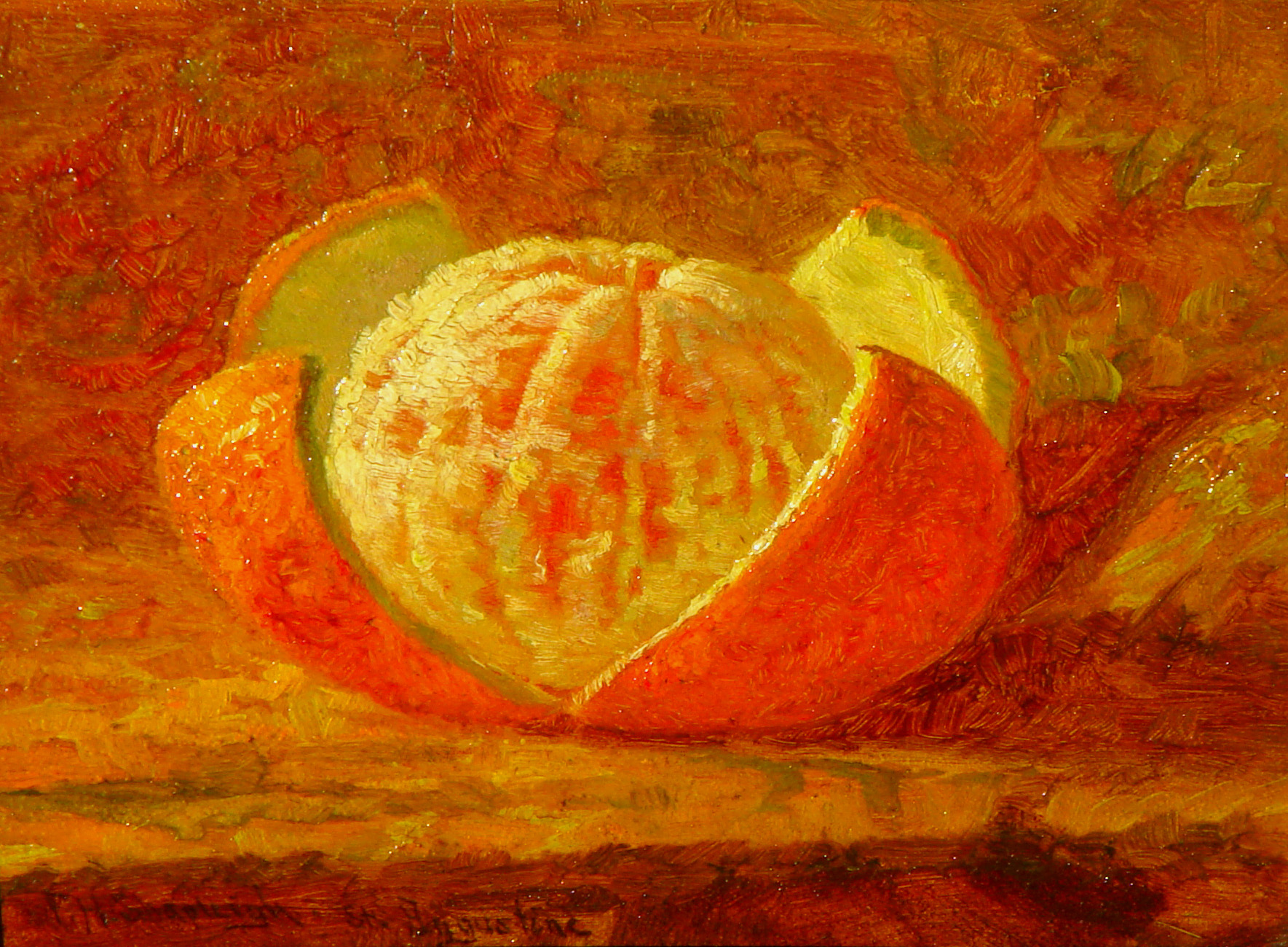
Here is an exercise that will illustrate what I’m getting at. Sit with your journal and an orange, in a quiet place. Write for fifteen minutes describing the dimpled orb of fruit without using the word orange more than once. Go into that room and stay there. You can riff on the orange if you want, start with the fruit, talk about the blossom or the orchard, or the hands that harvested the one you hold in your hand, but Don’t use the word orange more than once in your description. You can use another fruit if you wish, but the same rules apply. So chose a plum, but don’t use purple. Or choose an apple, but don’t use red or green. You get the point. Hold yourself apart from using the descriptor that is most obvious, and what you get in return is a whole new way to relate to description in general.
Be objective, be a journalist. Pick up the newspaper and read an article about an event. Journalists use the fewest adjectives than just about any writer, and most of those are worth a nickel. They don’t say “it was a stunningly sunny day with chalky clouds dotting the horizon.” No, they say, “the day was warm, with scattered clouds.” Period. There is an elegance in that kind of simplicity. Practice being a journal-ist. Practice simplicity with your journal. And be patient with yourself. This stuff takes practice.
 JOURNAL THAT
a guide to writing
Cynthia Gregory
Jounaling works if you’re just a baby writer and not sure where it’s going or what you want from it. Journaling works if you’re a seasoned writer and you need something to keep your writing muscles toned when you’re not working on a project. It’s even good when you are working on a project and need an avoidance tactic that can still work to your benefit event while you’re avoiding working on the actual thing you promised to do. What you may not know if you’re new to writing, is that there is nothing like an assignment or writing goal to make you think of all the things you’d rather be doing at that moment than actual writing.
You might think you’re the first to experience the avoidance factor, but no way, Auntie Mae. You can’t believe how sparkly clean my house becomes when I’m on deadline. And it isn’t that you don’t want to write, it’s just that sometime a writer needs to focus on something else for the ideas to become clear. You know how when you try really hard to remember something, like maybe the name of your third grade teacher, you can’t? And then the minute you let it go, it just floats up through your mind like a leaf in a stream: Miss Gerber.
Sometimes taking a break works. Other times, you just need to plant your tush on the seat cushion and write. One day I realized that I became bored with my own voice when I journaled. Granted, I bore easily – but hardly ever where my writing is concerned; good, bad, or mediocre. Nevertheless it began to seem . . .familiar. This of course is what happens when everything starts with me.
It all began to sound the same: I see, I feel, I want. I found that my writing was starting to become labored with too much “I.” This was troubling, especially since writing is almost always fun. I wondered what was up. Then, I developed a method that added some zing to my narrative and my journaling hasn’t been the same since.
You don’t eat the same food every day, and you don’t wear the same clothes, right? It’s important for the human spirit to express itself creatively – otherwise, we would all be dull as rocks. But we’re not. There is an infinite variety all around – from the stars in the sky to the blossoms on a tree. Variety is the pickle juice of life. And the nectar, and the sweet cherry on top. It seems completely logical, requiring no leaps of faith whatsoever, that if you enjoy variety in your non-journaling life, that your journaling process might benefit from mixing it up too.
It’s very true that you need guidelines in general writing and in journal writing too, because if there were no rules and guidelines, there would be complete anarchy and no one would know what anyone else was trying to say. I’m not advocating that you give up structure at all. The same rules apply to journaling that apply to any good writing, and this is as it should be. There are the rules of punctuation, grammar, and sentence structure. A system is necessary, or your journal becomes complete gibberish, and that serves no one, least of all, the journal-ist in you. But it’s possible to add variety to your method, one tweak at a time. So if you suspend one element, everything else stays in place and a sort of balance is achieved and your journal entries still exhibit a sort cohesive read-ability. You may have heard that good writers break rules. But here’s the truth of the matter: they know the rules they’re breaking. They’re not just randomly committing bad writing to the page and calling it creative.
So here’s a very cool way to add variety to your writing, to maintain a certain creative flexibility to your narrative without sending all the rules up in smoke: change your point of view. This doesn’t mean change how you essentially look at life (though that sometimes leads to a creative breakthrough), but it does mean that you get out of your own head. You look at a situation not from your dearest, most precious vantage point; you step aside and consider it from a slightly different angle.
I’m not sure when but at some point in time, I found that I could increase my interest in writing exponentially, when I changed my point of view from first person to second or third person. I began to refer not to “my thoughts” but “her thoughts.” She did this, and she said that. Suddenly, ZOOM! I felt a shift of perspective that allowed me to view my journaling as something not so intensely personal, and therefore allowed me to the freedom to go writing on a tangent if I felt like it. It allowed me the freedom to drift from my life up close, to a view of some one’s life not unlike my own, but because of the distance, it was infinitely more interesting. I became a voyeur in my own life. It sounds like crazy-talk, but it works.
Sometimes feelings are too intense to embrace. This is why people get addicted to a million things: yoga, chocolate, sour apple martinis, you name it. Anything to put a buffer between our hearts and our heads, because otherwise, life is just too real to deal.
I discovered that if I wrote “she came to the conclusion that she had to fire the boyfriend” it pinched a little less, and by the way, made for some slightly juicy “fiction.” We can split hairs about what is “memoir” and what is “made up,” but that is a debate that’s been raging for centuries. Really. And all fiction is at least marginally revisionist memoir at its most basic level. So what if you make your journal slightly fictionalized? Does it really matter? If it helps you get to the heart of what’s bugging you about what your sister said, or the fact that when you opened the door for the plumber expecting a soiled tee shirt and three day stubble but found instead Adonis’s younger and slightly hotter brother, slide that narrative into third-person and start writing.
Shifting point of view allows you to explore themes and ideas from a slightly higher vantage point, and so allows a roominess to enter into your writing that might just allow you to spread your wings and soar.
we’re blushing all over again. curious? you should be.

Journal THAT
a guide to writing
Cynthia Gregory
Dialogue is some of the most difficult stuff to write. Well, difficult if you want to do it really well and for it to sound both natural and powerful. It may seem like a paradox, but when dialogue sounds natural, it’s usually anything but. Good dialogue is a mix of craft, study, and a whole lot of understanding that some of the most important stuff is what you leave out. In other words, the back story; but I’m getting ahead of myself.
Have you ever walked away from an argument then hours later came up with the perfect rejoinder? Good dialogue is like that. Good dialogue contains all the spiffy, swift, snarky words you’d say the first time around if you had the chance to work it all out first. Good luck with that.
Developing a skill for dialogue is something that requires patience. . .and practice. How do you practice? Listen. Read. Write. Ernest Hemingway wrote some of the best dialogue in the history of the planet. His characters spoke with grit, pathos, and with bone crunching honesty, and yours should, too. Read his stories and novels with an eye toward dialogue and see what you find.
Papa was also brilliant at character, plot, and conflict. For the purposes of this conversation, I urge you to carefully study how his characters speak to one another. My particular favorite Hemingway story is “Hills Like White Elephants” which as a piece consists almost entirely of dialogue so brilliant I want to cry when I read it. The other wonderful story by E. Hemingway is “The Short, Happy Life of Francis Macomber.” Ee-yikes, that man could write dialogue.
Part of his strength in dialogue comes from the fact that he didn’t feel the need to connect every dot in the storyline; he assumed that the reader was reasonably intelligent, and could piece it together.
You don’t need to worry about connecting everything. Your amazingly powerful subconscious does it for you. To test the theory for yourself, rent a movie like Sliding Doors or The Golden Compass and watch it. If you’ve never see these movies before, enjoy the story the first time through, let it wash over you as pure entertainment. Then, watch them a second time, listening for dialogue. Notice how the characters speak the way real people do, but better. On the third time through, you should know the story well enough by now to take a step back, and look at how the scenes are woven together. Perhaps you notice that your own brain provided some of the connective tissue between scenes, that significant pieces of information were not actually there, that your own subconscious provided those bridges between scene, dialogue, and plot. It’s interesting how the brain works to make sense of what it sees and hears, providing those little leaps of logic between one frame and the next.
You can do this as a writer, too. Begin to notice how people speak to one another. Very often, they do not follow threads of conversation in a smooth and linear way. One person speaks, and maybe the other listens, maybe they just say what’s on their mind, like the following example:
Devon walked into the clubhouse and gravitated toward Elise. “How are you,” he asked. “I’ve been looking for you everywhere.”
Elise swept a fringe of bangs from her eyes. “It’s so hot today.”
“Did you see the Connollys won the golf tournaments? Figures.”
“I’d give anything for a lemonade.”
This may sound like an ersatz example, but I challenge you to prove me wrong. This will involve eavesdropping, so prepare to have some fun. Now, the first thing you do is take your journal down to the local café, burger joint, or java hut. Find yourself a table, place an order, then open your journal. Try to be subtle about it so your neighbors don’t realize you’re recording their conversation, but you’re going to do just that. Write down what they say. You don’t have to be looking at them, in fact it’s probably better if you don’t. Listen to the way they speak. Listen to the cadence, the word choices, idioms, the patterns of speech.
At the risk of sounding like a linguistics geek (yeah, yeah, whatev), I adore the way regional and cultural influences affect the way we speak to one another. When you realize that only 10 percent of our total communication is the words we use, and then you look at how the words we use influence meaning and nuance, you can see how important dialogue is. Forget about trying to write accents, that’s just annoying. But focus on the types of words that are used.
Words are worlds. Anyone with a teenager knows what it is to learn a new language, weekly, just to communicate with the people with whom you share groceries and a living space. Talk to anyone older than sixty, and you’ll be introduced to wonderful idioms that you may never have heard before. My personal favorite from a recent conversation is, “he couldn’t tell his butt from a hot rock.” I still chuckle when I think of that one.
Word choices contain emotional and cultural weight. Think about it. When you use the word “grenade” do you think, ‘oh, good’? Probably not. But if you use the word ‘bride’ it probably generates feelings of love and romance. Words carry weight.
Some idioms reflect a time in history, such as “Give me a ring.” This used to mean “Give me a call,” but since telephones now come equipped with ring tones and all kinds of sound effects, the term “ring” is just a piece of jewelry.
As a word geek, I am constantly amazed when nouns are used as verbs, as in “Jeff texted me last night We’re breaking up.” Once, ‘text’ was a noun meaning a compilation of words. Now, ‘to text’ means to send a clever message via any number of electronic devices. Our language is a living organism, changing all the time, as evidenced by how we speak to one another.
The best dialogue has the primary purpose of moving the plot or story, forward. Period. It isn’t used to describe what someone is wearing, it isn’t to provide a blow-by-blow description of last night’s fight. It’s a way to show your reader where they’re going next, but in, you know, shorthand.
So, pay attention. Listen. Eavesdrop. Hey – it’s for the sake of your journal! All I ask is that you be discrete.
 Journal THAT
a guide to writing
Cynthia Gregory
Journal writing got you down? Does the pen weight fifteen pounds, the paper cut you to ribbons? Does the shifting light hurt your eyes? Are you feeling totally uninspired, pooky? I have good news for you.
This may be the best ever secret weapon nearly guaranteed to make your journaling a pleasurable and inspiring experience. This information is so good it could be considered cheating – except it isn’t. It’s so good it should almost be illegal or sold with a special license. Nevertheless, here it is for you, the solid gold journaling tip of the year: pick up your journal and walk. Directly to the busiest coffee shop you can find. The kind of coffee shop is entirely up to you.
The place itself can be a youthful hipster java cave where a black tee shirt is very nearly the required uniform and where you are soo out of touch with the music, the cultural references, the technology. It can be a very groovy in a retro kind of place where the waitresses wear those polyester pseudo nurse outfits, with crisp white aprons tied in bow in the back and where the donut case is always stocked with powdered sugar sprinkled old fashioneds. Doesn’t matter.
Once you select your target, enter the writing zone with all the necessary tools and secure a table. So much is negotiable about this drill, but this part is not: you must order enough beverage and/or food to ensure a dependable cover. Your passage on this part of the journaler’s journey requires that you honor your host – the one who provides you with the context of all this rich material – with an offering that reflects appreciation for all the trouble he or she has gone to in order for you have a nice, clean, well-lit writing surface, a place to rest your iced tea, a den peopled with characters to sketch, a platform upon which to balance a snack while you go about your journaling duty.
Here is the question: how can you not find something to write about here? My goodness, there is so much material in this fabulous den it’s almost immoral to shrink from the duty to write. Did you know that in the archetypal studies of fiction, the coffee house, the bar, the watering hole is one of the most holy places in which a plots twist, where complications arise, transactions occur? The Mos Eisley Cantina, the bar in Star Wars, the Whistle Stop Café in Fried Green Tomatoes, the Tropicana where Ricky Ricardo occasionally allowed Lucy to perform as an outlet for her outrageous talent? The watering hole is where information is exchanged, a place that urges the hero to fulfill her next mission in the quest. In this context, the watering hole is wherever you choose it to be and the hero is you.
The bodega is like the telegraph office, where lessons are imparted, instructions delivered. By placing yourself squarely in the heart of your local cantina, you are putting yourself smack in the middle of the most strategically magnetic place in which to attract writing material. (I recommend against writing in an actual bar where alcohol is the beverage of choice, for the obvious reason that while it might make good fiction, it makes lousy writing practice).
So here you are in your café; look around. There are so many topics to bounce into and fill all those crisp empty pages. There is food. Check out that menu! There are customers you couldn’t make up on your best, most fecund day. The décor is an encyclopedia of material. The foot traffic going by outside the window is a screenplay waiting to happen. Maybe you’ve got a host of memories stirred up by the smell of grease, fantasies ignited by the sound of a steamer frothing up milk in a pitcher. Did you waitress your way through college and learn how to balance eight plates on your arms? What is your favorite café experience? Your worst? What about that woman you saw that firm morning in Paris when you finally made it there after so many years of promises to yourself, and found that café in the St. Germain de Pres just blocks away from the Pont Neuf? There she was, sitting in that sidewalk café looking like something out of central casting, with her black sleeveless dress, black, wide-brimmed hat, sunglasses, perfect blond chignon, sipping a glass of chardonnay at nine o’clock in the morning, sharing a table with a man who was maybe her nephew, her grandson, her lover? You savored your own cappuccino and croissant with a fabulous mysterious cheese and felt as if in that moment, you were somehow bigger than life.
You see where you can go with this?
So on those days when you know you should be journaling but just can’t find it in you to examine your own life? Get thee to a coffee shop. Let that java jolt seep into your blood and see where it carries you. This may just be the best tip ever. Use it, and then use it again.
 Journal THAT
a guide to writing
Cynthia Gregory
Every once in a while I get the feeling that I’ll crawl right out of my skin unless I clean out a closet. Nothing makes me happier than to fill bags and bags of unused stuff to haul off to the Goodwill store, where they always ask me if I want a receipt and I always say no. I have a theory is that everything ends up where it needs to be and if I don’t need it, it doesn’t belong to me, and how could I possibly take a receipt for someone else’s stuff?
Closet cleaning. It’s a useful skill. Some people like a clean stovetop or a clean floor; I like a tidy closet. This isn’t just me being obsessive – well maybe, but I like to think that I am not so much a collector as an experiencer. I am not so much interested in getting stuff as I am in having insights and impressions wash over me like high tide on a blue moon.
Once, when I lived in Pennsylvania, I tried to temp my Amish neighbor into letting me take photographs of her beautiful young sons with their straw hats and wide blue trusting eyes. “For later, when they grow up, to remember them by,” I said, and she turned me down flat. “It’s not our way,” was all she would say. And I got it. She didn’t need to take measure of the moment to save it for later. She wasn’t keeping a piece of now to reminisce; she was fully present. I liked that. I wanted to emulate that.
So, I like to throw/give stuff away. Make no mistake, I don’t exactly shun materialism, indeed, I find that a certain measure of pretty things make me happy and content. However, truth to tell, I find that I can’t quite think as clearly or creatively when things all around me are jumbled up and drowning in clutter and I can’t find my car keys.
Writing is like that, which is why I think I’s so important to write. A lot. If not every day, then several times a week, at least. It’s not because all that practice makes you a better writer, even though it does. It’s not because all the best writers do it and you’ll become a best seller by osmosis, because that’s just silly. No, writing every day is important because it gets all the clutter out of your head so that when you have something really important or profound or dazzlingly brilliant to say, it will be seen as diamonds sparkling on the sand, instead of dull objects half obscured beneath a verb-dump.
Timed writing exercises or list making exercises are great ways to purge the shrunken tee shirts and torn jeans of your brain. Oh sure, you think you’ll wear them again, but you’re just kidding yourself. They’re hanging out reminder you that the time is passing you by and those jeans will still be waiting there for you. Some day.
I used to think that I need to save my creative stuff up, like there was a limited supply of juicy ideas. You laugh, but it’s true. I thought, “well, I’ll just save that good idea for later, because then I’ll really have time to develop it and it will so rock.” It seems strange to think that now, but why else would I want to withhold my creative spark? Because, I thought, maybe that creative sliver of divine creative spark might be too good or not good enough to share with the world.
Let me just make one thing perfectly clear: there is no shortage of good ideas. If you use up one good idea, three will appear in its place. It’s when you stuff a good idea or ignore a good idea, that they stop flowing in through the open window of your mind. So use them up! Fast! And then use them some more!
And you know what else? When you use up all your good ideas, when you pour them onto the page like good maple syrup on homemade sourdough pancakes, you’ll get to a place much sweeter than the place you’re at now. I totally promise.
Do this: write a list of the 100 things you know for sure how to do. I bet you’ll dash off ten things you’re good at without breaking a sweat. You’ll push on to twenty and start to chug. Climbing up to thirty, a little voice inside your head will start to sound like The Little Train That Could. Forty? You may feel like giving up. But here’s what you get when you push past the point that you thought was the outer edge: the ideas dam has burst and they start to flow fast and frenetic and suddenly you see the wisdom in the 100. It’s not the first or second or even the fifth ten things, it’s the ones past where you thought you knew where you were going that are the really interesting ones.
You can do this for a year. Write about the 100 things you look for in a soulmate. The 100 things you learned in college. The 100 places you want to visit while you still inhabit the planet. This is important stuff. Not because of the things themselves, but because of the process of learning to open up to the place in your heart that exists beyond everything you think you know. It’s the stuff beyond that, that gets really good. Use it up! Use it all up as it comes in. You can never use it up completely. Unless you want to, and that’s an entirely different choice, baby.
we have a new post @ first blush. read, rinse, repeat.
 Journal THAT
a guide to writing
Cynthia Gregory
There are some conventions in writing that insist that you have a plan. For instance, back in high school when you had to write the dreaded five paragraph essay, there was a formula. Personally, I never understood the formula with its Roman numeral and abbreviated heading titles; it never made sense to me. How could you know what you were going to say before you said it? I quietly complied with the assignment and made an outline. And then I wrote whatever came into my head and aced the drill. Ha.
The idea of planning an essay is like reading a roadmap. Chances are, if you know that you’re going to drive from San Diego, California, to Lancaster, Pennsylvania, you will consult a map. You will choose one route or another, and more or less follow it. You’ll have a general idea of where you want to go, but will build in the flexibility to stop in Winslow, Arizona to see the Barrington Meteor Crater, or swing by Stanton, Iowa, to marvel over the giant Coffee Pot Water Tower.
I am told that there are some travelers who travel like it’s a race, speeding from the first rays of light until deep night – but I have never been that kind of traveler. I know writers, wonderful novelists in fact, who know every plot twist before they strike the first key on their laptop. There is a special place in heaven for these extremely organized and disciplined writers. The rest of us rely on bat sonar to get us where we want to go.
Journals do not generally have a plan. That is the great beauty of the process. You’re writing it pretty much for the satisfaction of the creative process. But what if you are journaling for a greater purpose? What if you are taking random notes with the hope that you will organize them into something more or less cohesive and useful? Maybe a plan will work for you.
If you need to have an outline, then write one. If you are the type of grocery shopper who carries an itemized list and ticks the products off one by one as they are dropped in the cart, you may need to make an outline. Go nuts. Use Roman numerals, capital letters, everything. If an outline will make you feel safe and satisfied that there is order in the universe, have at it. But if you are more of a right-brainer, someone more randomly creative – or a left-brainer with an appetite for adventure, you can safely forget everything your eight grade English teacher exhorted about the delicious conformity of the outline, the clear mesas of organization, and write without a road map.
I once had a (completely manic) writing teacher who said that creative writing does not need to conform to an outline because the issuer of thoughts and ideas, the subconscious brain, knows exactly what it is doing. It could be that if your subconscious has a plan, you should not mess with it. A journal does not need to proceed in a linear manner. That is, one thought need not link to the next thought and the next and the next after that. That’s the beauty of the journal.
For instance, say your vague, generalized plan for your journal is to write about childhood memories, a true and wonderful goal. You do not need to start with your first memory, move on to the birth of your little brother, then start working on the preschool years, graduate to primary school.
You can skip all over the place if you want. Write about that trip to the county fair. Pick up the trail of that summer vacation where the family hit all the national parks north of Bryce Canyon. Write about the winter you found out about the Tooth Fairy and Santa. Describe piano recitals out of sequence, your first love after the college years. Start at the end, finish in the middle.
Chronology doesn’t matter in your journal because your heart – arbiter of all that is true and good – knows how it all fits together and it is never, ever connected by a straight line. Creative juice likes backtracking. It adores leaps forward, sideways slides. Creative energy is a baby bird learning to fly – it swoops and swings, aims high and lands in the middle branches, totally content to have made it anywhere at all.
Carry your journal with you whenever possible. Pick it up spontaneously when you’re sitting at the gas station filling up your car. Bring it to your doctor’s appointment and write in it instead of reading six-year-old articles in a middling magazine. Keep it with you so that when you have those sweet, random, poetic moments, you can record them exactly the way they played in your head, sound by sound, because if you wait to write them down later, like a dream, you will find that the image have turned to vapor and faded.
Instead of sitting on the sofa watching TV at night, write in your journal. After you fold the laundry, write in your journal. Write at dusk. Write when Venus sits like a diamond on the tip of the setting moon. Instead of sitting at your desk at lunch, working, take a break and write in your journal. When you wake up in the morning and the house is still quiet and you haven’t so much as mumbled your first word of the day, write in your journal. Fill the quiet place in your mind between dream-time and day-time with filaments of creation so pure, so honest, you can almost taste the honey sweetness.
So many parts of our modern lives require control. We control our money, our electric bills, our newspaper subscriptions. We control how much access our children have to the Internet, how many ways they have of communicating with their friends. We manage what we eat, how much we exercise, and what kind of shampoo to use. We are dizzy with the need to control the million details of our modest lives.
So give up control in one area of your life. Give up control of your journal. Just give in to the spontaneous nature of your innate creative genius. That’s right: genius likes to be spontaneous. And play. And have fun. Just like you. Genius.
 persephone's step-sisters