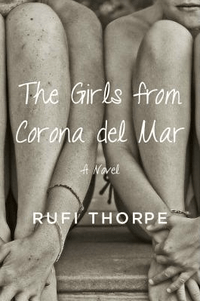
Girls and Other Mysteries

2014-07-27-girls_cover-thumb

::REVIEW::

That you can never truly know another person is the central truth of Rufi Thorpe’s debut novel, The Girls of Corona Del Mar, but the book is so much more than that. It is also a coming of age saga, one where the narrative begins with two golden-skinned teens in sun-drenched Corona Del Mar, and it ends years later and universes away.

 At the onset, best friends Mia and Lorrie Ann share lives as intertwined as any pair of young girls. So close are they, that they can’t see the stark difference between them as anything but symbiotic. Mia’s divorcee mom scrapes by in a second-rate apartment to make ends meet. Even after she remarries and Mia’s brothers come along, they remain planted in the same spot, as if by gravity. Lorrie Ann’s parents conversely, a divinely bohemian couple, sink roots steadfastly in love and music. To Mia, Lorrie Ann’s family represents the happy ideal of an intact family.

It turns out that Mia gets pregnant in high school, and naturally, it is to Lorrie Ann that she makes her confession. Seemingly chaste Lorrie Ann, the saint to Mia’s sinner, helps her through the subsequent abortion. At the end of high school, Mia is the one who goes to Yale to pursue a degree in the classics, while Lorrie Ann becomes pregnant herself, and chooses to give up on dreams of college to have the baby.

But Lorrie Ann’s baby is born horribly deformed and from then on, she can’t seem to catch a break. She marries her baby daddy, who when his restaurant job can’t cover the requirements of his special needs family, enlists in the army. Then he is deployed to Iraq and is killed. Poor and struggling, Lorrie Ann eventually loses custody of her son.

Alternately, Mia becomes a scholar. Fifteen years later, their two lives intersect in Istanbul, where Mia and her fiancé, Franklin, are transcribing ancient narratives about the Sumerian goddess Inanna. Lorrie Ann calls Mia out of the blue and Mia goes to the marketplace to meet her, only to find her old friend traveling with a clutch of jet-setters, and addicted to heroin.

The reunion is predictably strained. Mia is just beginning to realize that she may be pregnant. She confesses as much to Lorrie Ann, who promises to keep the secret until Mia comes to terms with which path she will ultimately choose. Mia is afraid to tell Franklin, who is the best thing that’s ever happened to her. She is afraid that he won’t be ready to be, much less want to be, a father. But Lorrie Ann betrays her confidence and reveals all. One could say that as her friend, Lorrie Ann does what she feels is in Mia’s best interest. She can clearly see how much Franklin loves Mia. One could also say that as friends go, it isn’t Lorrie Ann’s secret to reveal to the fiancé of a friend she hadn’t seen in a dozen years.

Friendship. Betrayal. The nature of love, and the powerful lure of ancient mythology. Thorpe’s novel is a deep and layered journey, and for anyone who has ever deeply loved a bestie, it is well worth the exploration.

–Cynthia Gregory

Watch for my upcoming book: An Inspired Journal; the Art and Soul of Creative Nonfiction. Available soon on Green Tara Press at Amazon.com
a novel to die for

murder

::REVIEW::

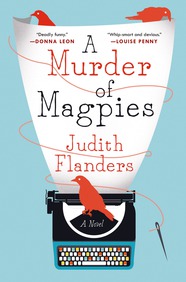
Who knew publishing was such a dangerous and glamorous profession? Though A Murder of Magpies is journalist Judith Flanders first novel, her whip smart bravura and droll sense of humor make this Murder a fun read.

          “Oh, just kill me now!”  I didn’t shriek that out loud, just clenched my teeth more tightly. It was eight thirty, and already the day couldn’t get much worse. I’m always at my desk by eight not because I’m so wonderful, although I am, but because it’s the only time of day when no one asks me anything, when I can actually get on with some work, instead of solving other people’s problems.”

Meet snarky book editor, Samantha (Sam) Clair. Sam has managed a fine career in the publishing business, working with a stable of writers, several of whom churn out predictably good best sellers. San is a sensible kind of gal. She’s the type of no-nonsense person who, when a meeting is disrupted by an unexpected visitor, will deal with it in her own sensible way.

“It was probably a friend of a friend, or someone who’d got my name somehow and was trying to flog a manuscript, no doubt about how his mother had abused him, or proving that his great-great-grandfather was Jack the Ripper. We don’t have to deal with real live members of the public often, but every now and again, one sneaks under the radar.”

One of Sam’s favorite writers, gorgeous Kit Lovell, is a reliably gorgeous writer. Kit covers fashion and can dish about the great design houses with the best of them. But this time, he’s written a potentially libelous biography of a fashion icon whose death appears to have been murder. While covering the human interest story about one of the largest and most respected fashion houses in Europe, Kit unintentionally uncovers an international money laundering ring. Big fashion is inextricably linked to big money and neither are pleased with Kit’s revelations.  

The manuscript proves incendiary. Before long, Sam finds herself embroiled in a hot mess. Kit vanishes, a copy of his manuscript is stolen, a courier is killed, and Sam’s flat is ransacked. This is quite a lot of excitement for a woman who spends her days reading books.

After the break in Sam begins to investigate her good friend and best author’s disappearance. Companions in her quest include her corporate lawyer mother, Helena–who is astonishingly adept at untangling the kinks of the criminal mind—and a hunky police detective, Jake Field.

As a single professional woman, Sam is aware of her options. She’s had relationships, and is currently satisfied with her quiet job, and her quiet flat, with its quiet upstairs neighbor, Mr. Ridigers. She tolerates her young coworkers with a thin layer of patience while plotting ways to get her authors placed on the best book club lists. A romantic entanglement with a cop isn’t exactly her cup of tea.

In the end, Sam and Helena and Jake solve the murder of Kit – and Helena uncovers hard evidence to corroborate Kit’s fashion house money laundering scheme. Sam takes Jake as a lover, much to Helena’s approval.

Murder of Magpies is a great, fun, smart read. Don’t miss it.

art + poetry

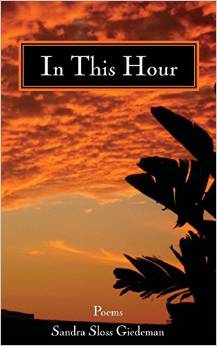
I can’t get enough of this book! Filled with images from the Ozarks to St. Louis, from Memphis to Venice Beach. Lush and bold, Sandra Giedeman’s prose takes the reader on unexpected journeys across emotional landscapes at once familiar and unexpected. In This Hour is filled with subtle reminders of the depth of small things. How can one who loves language not fall in love will lines like: Ten p.m. is when I think I could go mad in L.A. with a bird feeder and a barbecue outside my window. I wasn’t always like this. One thing I have learned. Everything in life is a metaphor for everything else.

SUPPORT THE ARTS::BUY THE BOOK

giedeman

back to zero

scribeI recently started journaling. Again. I have always been a faithful journalista. In fact, I’ve filled literally dozens of journals, and every once in a while I actually go back and review them. I’ve even created some of my best work by throwing words at my journal. Somewhere along the way, journaling morphed into my writing process. I created the structure of my short stories through my journal. Strange, right?

I once had a mentor who said: “Just write. Don’t expect it to make sense consciously. Your subconscious knows what it’s doing.”  Though I didn’t fully understand what she was saying, she was my mentor, so I did what she advised. And guess what? It worked and I created some amazing fiction as a faithful journalista.

Then I stopped journaling. I know! I took a hiatus, a rest, a break from the ritual of creation. I gave myself permission to not write, and guess what? The world didn’t come to an end. I did however, stop creating amazing stories. It was okay for a while, but now I’m back to journaling. Not everyday, mind you, but often. It’s like going back to yoga. I’m getting more agile, more flexy. I can feel a story starting to form, and it’s the most delicious feeling a writer can have.

So, I’m back to zero, which is exactly the right place to be.

word nerds

We writers are strange ducks. We have an almost obsessive love of language. We dance with verbs and all in love with nouns. Sometimes we use made up words because language is fluid and zesty and delicious. We even love to talk about words because like pictures, worlds can have color and texture and depth and dazzlement. 

read me

Miniaturist hc c

::REVIEW::

Set in 17th century Amsterdam, The Miniaturist is the story of young Nella, a country girl possessing an important name and no fortune, newly married to Johannes Brandt, a wealthy Amsterdam merchant. After a short introduction and even shorter courtship, Nella is quickly married to Brandt before he vanishes back to the city to conduct his important business, leaving his bride behind to follow him when she will.

With little beside an address to go by, Nella arrives in Amsterdam and finds Brandt’s grand manor in the best part of town, but she does not find her husband. Instead, she finds Brandt’s formidable sister, Marin, who is head of the household and manager of Brandt’s business affairs. There is the fiercely loyal household cook, maid, and chief snoop, Cornelia, who was rescued from an orphanage. There is also Brandt’s valet, Otto, a slave acquired on a trip to the East Indies, then freed and employed by Brandt himself. Nella takes her established place in her husband’s home and begins to discover the secrets that form the heartbeat of her new family.

Brandt is formidable and handsome, a respected member of Amsterdam’s merchant class and leader in the Dutch East Indian Company.  His business interests keep him far from home, and so do appetites that in Calvinist Amsterdam put the family squarely on a path of destruction. But he is generous and kind to Nella. As a wedding gift and to keep her occupied in her newly elevated role of married lady, Brandt presents Nella with a model replica of his house and instructs her to fill it as she will. Resourceful Nella discovers a miniaturist in the city who provides her with exquisitely detailed replicas to furnish her small house. Before long however, Nella discovers that the miniatures, which begin to arrive without having been commissioned, form premonitions of household events. Mysteries stack up. Increasingly, Nella feels herself being watched, and she herself begins to listen at keyholes. She feels as if she is working out a puzzle. No one will tell her the truth – or at least not all of it.

Austere Marin wears modest dresses of black wool. . .lined with ermine and silk. She is educated and vicious as a hawk, a grown woman who chooses spinsterhood over marriage for the freedom that it affords her. But surely there are lovers? No one seems to know for certain; or if they do, they are not talking.

In accordance with her very dignified position, Nella is introduced to Amsterdam society to great interest, the child-bride of the great Johannes Brandt. She is given an allowance and complete freedom to navigate the city at will. She learns the city’s sophisticated social customs of and grows into her position as a married lady.  In the end, Nella grows up quickly and manages to save herself, if not the Brandts.

The Miniaturist has all the appeal of an historical romance, except the romance is found in all the most unexpected places. As a pager-turner, The Miniaturist can’t be beat.

Cynthia G.

grace everywhere


Fireflies-in-a-Jar-59432The other night while eating Chinese and reading the winter issue of Ploughshares I discovered Lance Larson and his astonishing “Sad Jar of Atoms.”  I tumbled into a rabbit hole of language love that I haven’t felt since my first reading of Louise Erdrich’s Last Report of the Miracles from Little No Horse. This is true love. Deep love. Crush love.

“Life is a jar of maybe, of who knows, whereby we grow older and bones turn brittle as hope. Some jars live along time, like sea turtles, like Benjamin Franklin, a jar of genius filled with Poor Richard and flirting in French. . .”

Lance Larson, poet genius, poet laureate of Utah, I love you. I want to hold your prose babies in my prayerful hands. I am lost in cadence and find myself in a place where words are texture and all sound is a dazzle . . all because of your “Sad Jar of Atoms.”

Thank you for your Byronic reference. Thank you for “a jar made of sizzle and cordite.” Thank you for your “river and the eye of a bird.”


graceful language

Inspiration comes in the most interesting places. Donna Tartt talks about hers, and what it took to write The Goldfinch. Watch  the interview here and leave a comment!

love and time travel

Most of us have fallen in love with Jamie and Clare. In her own words, Diana Gabaldon talks about her process. It’s priceless. Enjoy . . .and let us know what you think!

bookly giving

There is no time for classics like the holiday season, and that includes books as well as music. We’ve noticed lately that the seasonal music is a little lighter, a little more fun. So herewith is a holiday classic book giving guide with a frothy little ditty to go with it. Happy shopping — and remember: used books need love too!

  1. One Hundred Years of Solitude, by Gabriel Garcia Marquez. Beginning with what is quite possibly one of the best first sentences in the history of literature, Garcia Marquez spins a yarn of love, redemption, war, and magic. “Many years later, as he faced the firing squad, Colonel Aureliano Buendia was to remember that distant afternoon when his father took him to discover ice.”
  2. The Sun Also Rises, by Ernest Hemingway. The poetic lilt of Hemingway’s dialogue is some of the best ever written and makes me fall in love with words every. Single. Time. “Everyone behaves badly – if given a chance.”
  3. The Diary of Adam and Eve, by Mark Twain. One of Twain’s lesser known works is nonetheless an enchanting lesson in love. “How I wish I could make him understand that a loving good heart is riches enough and that without it intellect is poverty.”
  4. Mrs. Dalloway, by Virginia Woolf. Not an easy read but a dazzlingly brilliant classic. Woolf delivers this Valentine of book in stream-of-consciousness prose and begins with another amazing first line: “Mrs. Dalloway said she would buy the flowers herself.”
  5. A Good Man is Hard to Find, by Flannery O’Connor. This is a collection of short stories that will scare the wits out of you as it nabs you by the collar and whips you around with a command of language that is both naked and forgiving. “She wouldn’t stay at home to be queen for a day.”
  6. The Bean Trees, by Barbara Kingsolver. It’s actually difficult to choose just one Kingsolver novel as a stand-alone but if you must choose, this is a good start: a story about love, friendship, abandonment, putting down roots, and a girl named Turtle. “I had decided early on that if I couldn’t dress elegant, I’d dress memorable.”
  7. Housekeeping, by Marilyn Robinson. There is a haunting quality in Robinson’s work as she writes about the small details of ordinary life. Her examination of the glue that holds our worlds together is at once pointed and astonishing. “You never know when you will see someone for the last time.”
  8. Last Report on the Miracles at Little No Horse, by Louise Erdrich. If you have any tender sensibilities at all, this writer will pierce your heart. Erdrich’s sense of irony, poetry, and social justice mingle in a tale that is at once outrageous and plain in about a million ways. “To love another human in all of her splendor and imperfect perfection, it is a magnificent task. . .tremendous and foolish and human.”
  9. Ragtime, by EL Doctrow. A literary classic in its own right, Ragtime reaches into the early 20th century to capture the hope and the optimism of immigrants and millionaires in America before the great wars changed everything. “And though the newspapers called the shooting the Crime of the Century, Goldman knew it was only 1906 and there were ninety four years to go.”
  10. Illusions, by Richard Bach. You can never go wrong with a book that contains both magic . . .and a barnstormer with a messiah complex. Deceptive in its simplicity, Bach’s story is an open door into a world beyond the ordinary. “Nothing good is a miracle, nothing lovely is a dream.”

There you have it: a short list of classics. Enjoy the season, and happy reading!