chalky clouds and purple prose

Journal THAT

a guide to writing

Cynthia Gregory

There are good adjectives and bad adjectives. There are the regular, hard-working-show-up-in-the-middle-of-the-night-but-go-unnoticed adjectives and then there are what I call the 25 cent adjectives. You know the kind, all flashy and shiny and bright, the kind you notice more than the noun that they’re describing. They’re like fast food; they temporarily distract you from the fact that there is nothing of substance behind them, they are the literary equivalent of a plate of whipped cream.

I know a lot about these razzle-dazzle kinds of describers, these peacocks of poetry. I used to scatter them around liberally, clever as I was. But what happened when I really got rolling, is that the point I was trying to make got totally buried under my ponderous prose. My meaning sagged under the weight of all that reckless description. My language got so pearly and polished that everything I wrote began to sound like a steaming, verdant jungle, packed with all the lush pomegranates, mangoes and papayas of meaning I could wedge in. I mean seriously, an old pair of scruffed sneakers with one broken lace is a perfectly respectable sort of description. But when I got done with it, those Keds sounded like Ritz Carlton glass slippers.

What happened when I began to excavate the core of my message, the humble meaning of my narrative began to emerge as I sliced away one fabulous phrase after another. Everyone knows by now the famous story of what Michaelango said when someone asked how he knew how to carve the statue of David – he said, “oh, I just got rid of what didn’t belong.” You need to do the same with your descriptive language. Pare it down, pare it the hell down. Make it lean and mean and dense. Never use a twenty-five cent word when a nickel will do.

Many people mistakenly think that a short story is easier to write than a novel, because it’s more compact. They think that a poem is even easier, because there are fewer words yet. But the exact opposite is true. Did you know that? The shorter the piece, the harder it is to write. This is  because with fewer words, every one has to count. There is no room for extra padding, no place to hide. There are no long stretches of narrative, expeditions into expostulation. You have to say exactly what you mean. Every word, every verb, has to carry the weight of the sentence on its meager back, so it must be strong, and it must be absolutely true. The shorter the writing, the denser it becomes. Not dese heavy, just dense: full of meaning; ripe as a summer peach, juicy and succulent.

It’s easy to see why people fall in love with a flush of flabby, fatuous descriptions; because they mean nothing. We’re a TV culture after all, we’re used to that. Flamboyant descriptors are like a magician’s trick, a sleight of hand. Honest writing, writing from the heart, strips you naked. It’s much easier to hide your fragile heart behind a veil of words. But that takes no courage. If you want to journal, you must be brave. You must go into the room you’re afraid to enter and stay there until you have emptied yourself out. And the next day, you must go in there again. You can never completely empty yourself through journaling. There is always something more, something deeper, something rich and rare and precious because it comes from within you. It comes from a place beyond the glittery surface. It comes slick and dark and wet and you must love it. You must stay with it until your heart stops quaking in your chest and you must put it on the page, make it authentic. This is real courage. This is what true love is made of: entering into that place that terrifies you and staying there, listening, writing, watching, recording it all, until the quiet enters and the writing is complete.

Sometimes you will flow with a million thoughts, like droplets of water over Niagara Falls, and there is nothing wrong with that. I would like to suggest however, that there is a balance. If you can practice both ends of this particular writing scale, you will become a better writer. When you sit down to write, think simply. Don’t think you have to impress anyone, to show off. You have an audience of one, and its you.

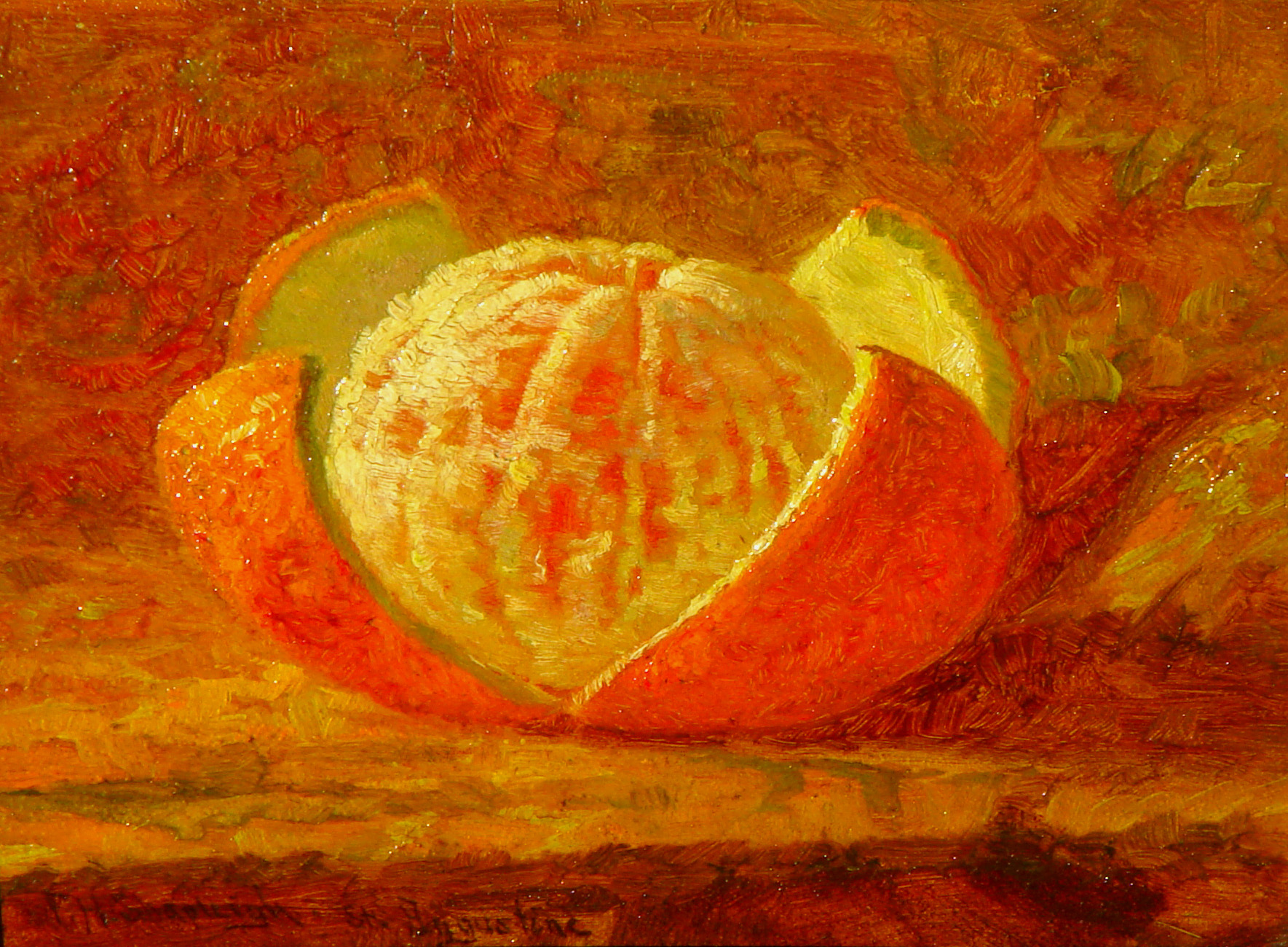
Here is an exercise that will illustrate what I’m getting at. Sit with your journal and an orange, in a quiet place. Write for fifteen minutes describing the dimpled orb of fruit without using the word orange more than once. Go into that room and stay there. You can riff on the orange if you want, start with the fruit, talk about the blossom or the orchard, or the hands that harvested the one you hold in your hand, but Don’t use the word orange more than once in your description. You can use another fruit if you wish, but the same rules apply. So chose a plum, but don’t use purple. Or choose an apple, but don’t use red or green. You get the point. Hold yourself apart from using the descriptor that is most obvious, and what you get in return is a whole new way to relate to description in general.

Be objective, be a journalist. Pick up the newspaper and read an article about an event. Journalists use the fewest adjectives than just about any writer, and most of those are worth a nickel. They don’t say  “it was a stunningly sunny day with chalky clouds dotting the horizon.”  No, they say, “the day was warm, with scattered clouds.” Period. There is an elegance in that kind of simplicity. Practice being a journal-ist. Practice simplicity with your journal. And be patient with yourself. This stuff takes practice.

we heart books oh yes we do

we couldn’t make it any easier for you so please just read it now.

eat the world

we have another blush-worthy post; read it here.


share the love


Thanks to Simonet7 for nominating Persephone’s Step Sisters for the Inspiring Blogger Award. We are so happy, we are blushing!

To comply with the rules of nomination, we are providing the following information, here are seven fact about Cynthia, followed by seven facts about Pam:

  1. West Coast, baby!
  2. This morning I woke with the lyrics of a song in my head
  3. I am a vegetarian not because I am philosophically opposed to eating anything with a face, but because I prefer not to dose myself with steroids and antibiotics
  4. I believe (rightly or wrongly) that coconut water makes me faster at Scramble
  5. Thanks to Gonzaga U and Mills College I am a certifiable smarty-pants
  6. Numerologically, I am 5 personality, and an 8 life path
  7. There is the possibility I could be mistaken for Susan Sarandon
  1. East Coast resident; West Coast in my soul
  2. Some day I’d like to meet Steven Spielberg and ask him to teach me what he knows
  3. Family first
  4. I prefer a beach and a good book to just about anything else there is to do
  5. Spending time in nature rejuvenates me while writing balances my soul
  6. Sometimes I prefer the dream space to waking reality
  7. I need some form of exercise everyday, otherwise I’m loopy

We herewith nominate the following bloggers for this wondrous award:

Source of Inspiration

20 Lines or Less

Super Tucks Mama

The Right Mood

You Jivin’ Me Turkey?

Raxa Collective

Neo Alchemist

Lady Romp

Writer Michael Burge

The Sand County

SKEdazzles

Airports Made Simple

Plant Based Diet Adventures

Seth Godin

Pioneer Woman

outside looking in

JOURNAL THAT

a guide to writing

Cynthia Gregory

Jounaling works if you’re just a baby writer and not sure where it’s going or what you want from it. Journaling works if you’re a seasoned writer and you need something to keep your writing muscles toned when you’re not working on a project. It’s even good when you are working on a project and need an avoidance tactic that can still work to your benefit event while you’re avoiding working on the actual thing you promised to do. What you may not know if you’re new to writing, is that there is nothing like an assignment or writing goal to make you think of all the things you’d rather be doing at that moment than actual writing.

You might think you’re the first to experience the avoidance factor, but no way, Auntie Mae. You can’t believe how sparkly clean my house becomes when I’m on deadline. And it isn’t that you don’t want to write, it’s just that sometime a writer needs to focus on something else for the ideas to become clear. You know how when you try really hard to remember something, like maybe the name of your third grade teacher, you can’t?  And then the minute you let it go, it just floats up through your mind like a leaf in a stream: Miss Gerber.

Sometimes taking a break works. Other times, you just need to plant your tush on the seat cushion and write. One day I realized that I became bored with my own voice when I journaled. Granted, I bore easily – but hardly ever where my writing is concerned; good, bad, or mediocre. Nevertheless it began to seem . . .familiar. This of course is what happens when everything starts with  me.

It all began to sound the same: I see, I feel, I want. I found that my writing was starting to become labored with too much “I.” This was troubling, especially since writing is almost always fun. I wondered what was up. Then, I developed a method that added some zing to my narrative and my journaling hasn’t been the same since.

You don’t eat the same food every day, and you don’t wear the same clothes, right? It’s important for the human spirit to express itself creatively – otherwise, we would all be dull as rocks. But we’re not. There is an infinite variety all around – from the stars in the sky to the blossoms on a tree. Variety is the pickle juice of life. And the nectar, and the sweet cherry on top. It seems completely logical, requiring no leaps of faith whatsoever, that if you enjoy variety in your non-journaling life, that your journaling process might benefit from mixing it up too.

It’s very true that you need guidelines in general writing and in journal writing too, because if there were no rules and guidelines, there would be complete anarchy and no one would know what anyone else was trying to say. I’m not advocating that you give up structure at all. The same rules apply to journaling that apply to any good writing, and this is as it should be. There are the rules of punctuation, grammar, and sentence structure. A system is necessary, or your journal becomes complete gibberish, and that serves no one, least of all, the journal-ist in you. But it’s possible to add variety to your method, one tweak at a time. So if you suspend one element, everything else stays in place and a sort of balance is achieved and your journal entries still exhibit a sort cohesive read-ability. You may have heard that good writers break rules. But here’s the truth of the matter: they know the rules they’re breaking. They’re not just randomly committing bad writing to the page and calling it creative.

So here’s a very cool way to add variety to your writing, to maintain a certain creative flexibility to your narrative without sending all the rules up in smoke: change your point of view. This doesn’t mean change how you essentially look at life (though that sometimes leads to a creative breakthrough), but it does mean that you get out of your own head. You look at a situation not from your dearest, most precious vantage point; you step aside and consider it from a slightly different angle.

I’m not sure when but at some point in time, I found that I could increase my interest in writing exponentially, when I changed my point of view from first person to second or third person. I began to refer not to “my thoughts” but “her thoughts.” She did this, and she said that. Suddenly, ZOOM! I felt a shift of perspective that allowed me to view my journaling as something not so intensely personal, and therefore allowed me to the freedom to go writing on a tangent if I felt like it. It allowed me the freedom to drift from my life up close, to a view of some one’s life not unlike my own, but because of the distance, it was infinitely more interesting. I became a voyeur in my own life. It sounds like crazy-talk, but it works.

Sometimes feelings are too intense to embrace. This is why people get addicted to a million things: yoga, chocolate, sour apple martinis, you name it. Anything to put a buffer between our hearts and our heads, because otherwise, life is just too real to deal.

I discovered that if I wrote “she came to the conclusion that she had to fire the boyfriend” it pinched  a little less, and by the way, made for some slightly juicy “fiction.” We can split hairs about what is “memoir” and what is “made up,” but that is a debate that’s been raging for centuries. Really. And all fiction is at least marginally revisionist memoir at its most basic level. So what if you make your journal slightly fictionalized? Does it really matter? If it helps you get to the heart of what’s bugging you about what your sister said, or the fact that when you opened the door for the plumber expecting a soiled tee shirt and three day stubble but found instead Adonis’s younger and slightly hotter brother, slide that narrative into third-person and start writing.

Shifting point of view allows you to explore themes and ideas from a slightly higher vantage point, and so allows a roominess to enter into your writing that might just allow you to spread your wings and soar.

carrying prayers to heaven

sometimes we find reasons to blush. sometimes they find us.

journal this

Journal THAT

a guide to writing

Cynthia Gregory

Photography is amazing to me, something bordering on magical.  Imagine freezing a moment in time on a small square of paper (or on the viewing panel of a telephone), to slide into your pocket and carry with you wherever you go. There is something mythic about a photograph. I like nothing better than to wander through antique fairs and spend long moments flipping through boxes and boxes of photographs.  There’s nothing like it.  On my first trip to Paris, I found the famous Montmartre flea market and was in ecstasy to find vendors with bins and bins of dusty old photos, studying the faces in those pictures, imagining the lives that were lived beyond, before, after, the images were captured and through magic and alchemy, printed in sepia tones on thick paper. Oh, I understand  the chemical process of photography well enough; I still consider it borderline magic.

I once taught a writing workshop and asked participants to bring with them photographs or postcards of  sentimental  value, something to write from. Everyone seemed excited by this idea – then their excitement faded to dismay and then marginal alarm when I asked  them to retrieve and exchange them with their fellow workshoppers.

“I brought this picture of little LuLu and I was going to writer about her birthday.”

“But this is Barney, my dog. No one else knows him like I do; I want to write about him.”

I’m sure my darling protégées thought it a nasty trick to switch them up like that, but I had my reasons. What I was aiming at was to get them to write about the feelings that were evoked from someone else’s photo, not to write from the matched luggage of associations, memories, delights, and dark secrets that led them to choose their specific photos and postcards in the first place. I wanted them to reach back to the archetypes that we’re all hard-wired with. I wanted them to find the promise that backs every fairy tale and myth and operatic legend that we consider imaginary and yet give our lives meaning.

Things are charged with the emotions we attach to them. You might think this is a radical idea, or sounds a little too close to the far edge of woo-woo for your taste, but think about it. Words are charged with emotional impact. For instance, the words beard, tea cup, and mandolin evoke feelings, which give rise to meaning, which stirs up emotions based on memories you associate with these items. We attach words to things so we know what to call them – otherwise we’d say, “pass the tangy little granules of crystalized sea water” instead of “pass the salt.” So the words we attach to things have an emotional charge, too. Especially things that have to do with deep emotion, like family.

I would venture that an old black and white photo of your father as a young bot sitting on a pony wearing chaps and a cowboy hat, peering into the camera, stirs up a whole score of emotions for you. Of course it does. There are stories, lifetimes, imaginings, family legends, tragedies, celebrations attached to everything we own – or that owns us – and this is as it should be.

Journaling from this stew of material is easy. And, I’m sorry to say, somewhat predictable. But if you’re aiming for a family chronicle, go for it! Distribute  photographs to everyone in the family, and ask them to write about what a particular photo means to them.  While you’re at it, ask them to throw in a family recipe, too. If you cast your net wide enough, you will amass a collected family history, suitable to finding for an epic family album.

But what you get when you write from someone else’s photographs is access to a collective memory, a collective pool of archetypes that belong to our extended family – the human race. After all, we most of us have mothers, fathers, ancestors, siblings, children. We most of us have lived in a series of varied family homes, have traveled some, gone to church, gone to school, fallen in love, borne great tragedy, been moved to tears by a beautiful object, failed at something trivial, thrived at something meaningful, eaten strange food, dipped our feet in a mountain stream, watched a shooting star on a summer’s night, confided in a stranger, given something to someone who needed it more than we did, discovered the searing pain of betrayal, held a child’s hand, believed a lie, broke a rule, floated in absolute joy; in other words, have lived a slice of life. We all have this in common.

So when you look at a photograph of people you do not know, or you study a postcard that was not addressed to you, you have the potential to access a deeper story, sensations and passions buried more deeply than you ever thought possible. This in interesting territory.  I am always enchanted by the cryptic messages on the backs of old postcards – were they in St. Louis ever again, after that trip? How was the train ride? Did they ever find love in that lifetime?  Stories spin out of my imagination and I envision children and pets and automobiles long since grown or gone.

You obviously can’t write from a literal perspective by this method, but your journaling can become enriched by the subtle meanings telegraphed to your ancestral brain, where memories are stored, where legends are kept, fables are cataloged for future reference. These are jumping off places. Write from photographs – someone else’s, and stir memories you didn’t even know you had.

finding Shangri-La

we have a new review. some reading required.

bending time

we’re blushing all over again. curious? you should be.

bon mots and sparkling prose

Journal THAT

a guide to writing

Cynthia Gregory

 Dialogue is some of the most difficult stuff to write. Well, difficult if you want to do it really well and for it to sound both natural and powerful. It may seem like a paradox, but when dialogue sounds natural, it’s usually anything but. Good dialogue is a mix of craft, study, and a whole lot of understanding that some of the most important stuff is what you leave out. In other words, the back story; but I’m getting ahead of myself.

Have you ever walked away from an argument then hours later came up with the perfect rejoinder? Good dialogue is like that. Good dialogue contains all the spiffy, swift, snarky words you’d say the first time around if you had the chance to work it all out first. Good luck with that.

Developing a skill for dialogue is something that requires patience. . .and practice. How do you practice? Listen. Read. Write. Ernest Hemingway wrote some of the best dialogue in the history of the planet. His characters spoke with grit, pathos, and with bone crunching honesty, and yours should, too. Read his stories and novels with an eye toward dialogue and see what you find.

Papa was also brilliant at character, plot, and conflict. For the purposes of this conversation, I urge you to carefully study how his characters speak to one another. My particular favorite Hemingway story is “Hills Like White Elephants” which as a piece consists almost entirely of dialogue so brilliant I want to cry when I read it. The other wonderful story by E. Hemingway is “The Short, Happy Life of Francis Macomber.” Ee-yikes, that man could write dialogue.

Part of his strength in dialogue comes from the fact that he didn’t feel the need to connect every dot in the storyline; he assumed that the reader was reasonably intelligent, and could piece it together.

You don’t need to worry about connecting everything. Your amazingly powerful subconscious does it for you. To test the theory for yourself, rent a movie like Sliding Doors or The Golden Compass and watch it. If you’ve never see these movies before, enjoy the story the first time through, let it wash over you as pure entertainment. Then, watch them a second time, listening for dialogue. Notice how the characters speak the way real people do, but better. On the third time through, you should know the story well enough by now to take a step back, and look at how the scenes are woven together.  Perhaps you notice that your own brain provided some of the connective tissue between scenes,  that significant pieces of information were not actually there, that your own subconscious provided those bridges between scene, dialogue, and plot. It’s interesting how the brain works to make sense of what it sees and hears, providing those little leaps of logic between one frame and the next.

You can do this as a writer, too. Begin to notice how people speak to one another. Very often, they do not follow threads of conversation in a smooth and linear way. One person speaks, and maybe the other listens, maybe they just say what’s on their mind, like the following example:

Devon walked into the clubhouse and gravitated toward Elise. “How are you,” he asked. “I’ve been looking for you everywhere.”

Elise swept a fringe of bangs  from her eyes.  “It’s so hot today.”

“Did you see the Connollys won the golf tournaments? Figures.”

“I’d give anything for a lemonade.”

This may sound like an ersatz example, but I challenge you to prove me wrong. This will involve eavesdropping, so prepare to have some fun. Now, the first thing you do is take your journal down to the local café, burger joint, or java hut. Find yourself a table, place an order, then open your journal.  Try to be subtle about it so your neighbors don’t realize you’re recording their conversation, but you’re going to do just that. Write down what they say. You don’t have to be looking at them, in fact it’s probably better if you don’t. Listen to the way they speak. Listen to the cadence, the word choices, idioms, the patterns of speech.

At the risk of sounding like a linguistics geek (yeah, yeah, whatev), I adore the way regional and cultural influences affect the way we speak to one another. When you realize  that only 10 percent of our total communication is the words we use, and then you look at how the words we use influence meaning and nuance, you can see how important dialogue is.  Forget about trying to write accents, that’s just annoying. But focus on the types of words that are used.

Words are worlds. Anyone with a teenager knows what it is to learn a new language, weekly, just to communicate with the people with whom you share groceries and a living space. Talk to anyone older than sixty, and you’ll be introduced to wonderful idioms that you may never have heard before. My personal favorite from a recent conversation is, “he couldn’t tell his butt from a hot rock.” I still chuckle when I think of that one.

Word choices contain emotional and cultural weight. Think about it. When you use the word “grenade” do you think, ‘oh, good’? Probably not. But if you use the word ‘bride’ it probably generates feelings of love and romance.  Words carry weight.

Some idioms reflect a time in history, such as “Give me a ring.” This used to mean “Give me a call,” but since telephones now come equipped with ring tones and all kinds of sound effects, the term “ring” is just a piece of jewelry.

As a word geek, I am constantly amazed when nouns are used as verbs, as in “Jeff texted me last night We’re breaking up.” Once, ‘text’ was a noun meaning a compilation of words.  Now, ‘to text’ means to send a clever message via any number of electronic devices.  Our language is a living organism, changing all the time, as evidenced by how we speak to one another.

The best dialogue has the primary purpose of moving the plot or story, forward. Period. It isn’t used to describe what someone is wearing, it isn’t to provide a blow-by-blow description of last night’s fight. It’s a way to show your reader where they’re going next, but in, you know, shorthand.

So, pay attention. Listen. Eavesdrop. Hey – it’s for the sake of your journal! All I ask is that you be discrete.