A is for Artist. and Anomaly. and Ahhhhhh.
We review what we love. Read all about it here.

We like to think of our bodies as amazingly sophisticated eco-systems.
It’s enough to make a rational person blush.
is it possible to excerpt from your own short story without blushing? This is
from a story in three parts, making something
of a mess of the traditional story arc. tsk.
this is for my pals in Portland.
we blush and we know it. you can know it too.
 Journal THAT
a guide to writing
Cynthia Gregory
Like photographs, clichés are the shorthand of communication. If a picture truly is ‘worth a thousand words’ (a pretty cliché) it’s because its cash value rests on the fact that the ancient part of the brain, the primitive lizard brain, the dreaming brain, communicates with pictures. I mean seriously, think about it. Before written language, our ancestors drew pictures of actual horses to represent “animal” or “the hunt” or “wild and free” before there were actually spoken or written words to convey the ideas. Now, however, we are wildly sophisticated and have a language (or two) that we can manipulate to communicate otherwise free form ideas floating inside our cabezas.
Storytelling served as a history lesson before written language, and storytelling today is as popular around the campfire, board room table, or cafe four-top as ever. Stories are innately wired into us and as humans, we crave and respond to the story. The stories of our lives, our novels, movies, television and cable news, are a series of pictures – both visual and virtual. Actual photographs and pictures illustrate a narrative we may tell, as in “see? I was in Paris – here’s the Eiffel Tower,” or “here’s a photo of little Sophie Soo, ten years old.” In each case you may be telling a story, constructing a narrative and sharing information about your travels and your dog, backing your verbal story up with photographic evidence. So yes, pictures are worth thousands and thousands of words.
And if all those wonderful words at our fingertips were colors, original ideas are bright, clear fountains of rich hues, and clichés are dull as dirt.
The trouble with clichés is that they are so infused into our daily language, we hardly recognize them for their trite, frayed selves. Advertisers know this. They know that people are put off by formal language, fancy words, words that stand up straight and march with a snap in their step, so they dumb down marketing messages, intentionally inserting clichés so that their uber-sophisticated messages sound “down to earth” (cliché!) and “right as rain” (cliché!). Television programmer know this too, and make sure our televised stories don’t get too smarty pants, else run the risk of losing viewers –although because of the trance-like fog I fall into when I tune into a program I happen to enjoy, “viewing” isn’t exactly what I’d say I was doing. I’d bet a nickel that not one filter remains intact with all that bad, cliché loaded language comes washing over me. While some programs are brilliantly written, most programming I’ve observed seems to be no more than 30 minutes of tired ideas strung together. So when you think about all the hours of programming and bad language we’re exposed to, it’s no wonder we’re up to our eyeballs in clichés.
So, if everybody is guilty of crimes of language abuse, then it must be okay, right? In the words of mothers everywhere, “just because all the kids are doing something doesn’t’ make it right.” Clichés have their place, which is definitely not between the covers of your journal. You want your journal to be clear, concise, absolutely fecund with the rich details of your life, so absolutely pitch-perfect that with even a quick glance, you inspire yourself to write. Even. More.
So, once in a while work your language muscle a little harder. Avoid the flabby turns of phrase. Jettison the flaccid prose that comes so easily. Instead, read an amazingly genius writer and then journal. Turn the TV off, and journal. Instead of taking the easy way out and dropping in an over-worked and sad sad sad cliché and reach for something original. You may just surprise yourself with your own genius.
Journal THAT
a guide to writing
Cynthia Gregory
There are good adjectives and bad adjectives. There are the regular, hard-working-show-up-in-the-middle-of-the-night-but-go-unnoticed adjectives and then there are what I call the 25 cent adjectives. You know the kind, all flashy and shiny and bright, the kind you notice more than the noun that they’re describing. They’re like fast food; they temporarily distract you from the fact that there is nothing of substance behind them, they are the literary equivalent of a plate of whipped cream.
I know a lot about these razzle-dazzle kinds of describers, these peacocks of poetry. I used to scatter them around liberally, clever as I was. But what happened when I really got rolling, is that the point I was trying to make got totally buried under my ponderous prose. My meaning sagged under the weight of all that reckless description. My language got so pearly and polished that everything I wrote began to sound like a steaming, verdant jungle, packed with all the lush pomegranates, mangoes and papayas of meaning I could wedge in. I mean seriously, an old pair of scruffed sneakers with one broken lace is a perfectly respectable sort of description. But when I got done with it, those Keds sounded like Ritz Carlton glass slippers.
What happened when I began to excavate the core of my message, the humble meaning of my narrative began to emerge as I sliced away one fabulous phrase after another. Everyone knows by now the famous story of what Michaelango said when someone asked how he knew how to carve the statue of David – he said, “oh, I just got rid of what didn’t belong.” You need to do the same with your descriptive language. Pare it down, pare it the hell down. Make it lean and mean and dense. Never use a twenty-five cent word when a nickel will do.
Many people mistakenly think that a short story is easier to write than a novel, because it’s more compact. They think that a poem is even easier, because there are fewer words yet. But the exact opposite is true. Did you know that? The shorter the piece, the harder it is to write. This is because with fewer words, every one has to count. There is no room for extra padding, no place to hide. There are no long stretches of narrative, expeditions into expostulation. You have to say exactly what you mean. Every word, every verb, has to carry the weight of the sentence on its meager back, so it must be strong, and it must be absolutely true. The shorter the writing, the denser it becomes. Not dese heavy, just dense: full of meaning; ripe as a summer peach, juicy and succulent.
It’s easy to see why people fall in love with a flush of flabby, fatuous descriptions; because they mean nothing. We’re a TV culture after all, we’re used to that. Flamboyant descriptors are like a magician’s trick, a sleight of hand. Honest writing, writing from the heart, strips you naked. It’s much easier to hide your fragile heart behind a veil of words. But that takes no courage. If you want to journal, you must be brave. You must go into the room you’re afraid to enter and stay there until you have emptied yourself out. And the next day, you must go in there again. You can never completely empty yourself through journaling. There is always something more, something deeper, something rich and rare and precious because it comes from within you. It comes from a place beyond the glittery surface. It comes slick and dark and wet and you must love it. You must stay with it until your heart stops quaking in your chest and you must put it on the page, make it authentic. This is real courage. This is what true love is made of: entering into that place that terrifies you and staying there, listening, writing, watching, recording it all, until the quiet enters and the writing is complete.
Sometimes you will flow with a million thoughts, like droplets of water over Niagara Falls, and there is nothing wrong with that. I would like to suggest however, that there is a balance. If you can practice both ends of this particular writing scale, you will become a better writer. When you sit down to write, think simply. Don’t think you have to impress anyone, to show off. You have an audience of one, and its you.
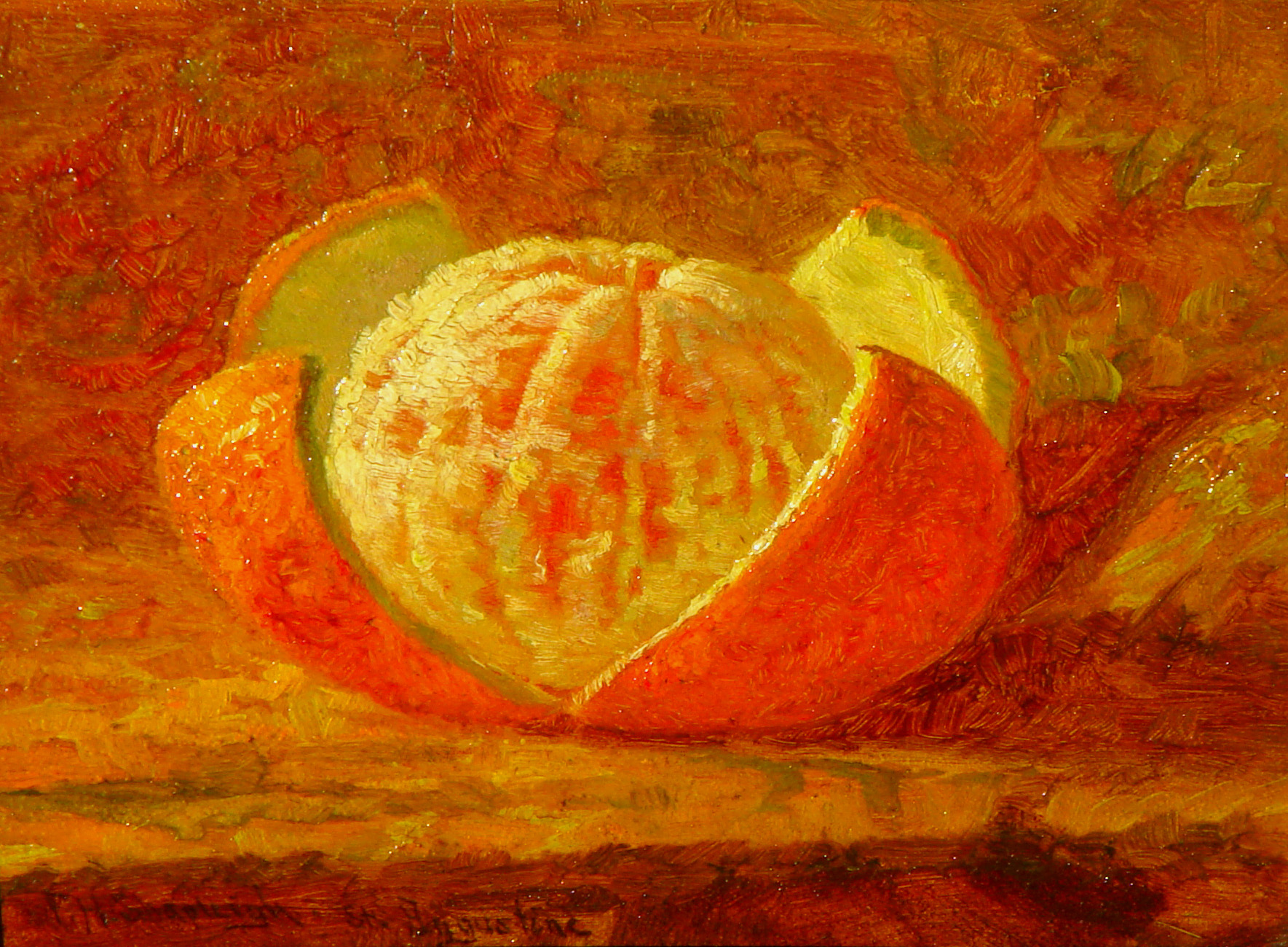
Here is an exercise that will illustrate what I’m getting at. Sit with your journal and an orange, in a quiet place. Write for fifteen minutes describing the dimpled orb of fruit without using the word orange more than once. Go into that room and stay there. You can riff on the orange if you want, start with the fruit, talk about the blossom or the orchard, or the hands that harvested the one you hold in your hand, but Don’t use the word orange more than once in your description. You can use another fruit if you wish, but the same rules apply. So chose a plum, but don’t use purple. Or choose an apple, but don’t use red or green. You get the point. Hold yourself apart from using the descriptor that is most obvious, and what you get in return is a whole new way to relate to description in general.
Be objective, be a journalist. Pick up the newspaper and read an article about an event. Journalists use the fewest adjectives than just about any writer, and most of those are worth a nickel. They don’t say “it was a stunningly sunny day with chalky clouds dotting the horizon.” No, they say, “the day was warm, with scattered clouds.” Period. There is an elegance in that kind of simplicity. Practice being a journal-ist. Practice simplicity with your journal. And be patient with yourself. This stuff takes practice.
 Thanks to Simonet7 for nominating Persephone’s Step Sisters for the Inspiring Blogger Award. We are so happy, we are blushing!
To comply with the rules of nomination, we are providing the following information, here are seven fact about Cynthia, followed by seven facts about Pam:
We herewith nominate the following bloggers for this wondrous award:
 JOURNAL THAT
a guide to writing
Cynthia Gregory
Jounaling works if you’re just a baby writer and not sure where it’s going or what you want from it. Journaling works if you’re a seasoned writer and you need something to keep your writing muscles toned when you’re not working on a project. It’s even good when you are working on a project and need an avoidance tactic that can still work to your benefit event while you’re avoiding working on the actual thing you promised to do. What you may not know if you’re new to writing, is that there is nothing like an assignment or writing goal to make you think of all the things you’d rather be doing at that moment than actual writing.
You might think you’re the first to experience the avoidance factor, but no way, Auntie Mae. You can’t believe how sparkly clean my house becomes when I’m on deadline. And it isn’t that you don’t want to write, it’s just that sometime a writer needs to focus on something else for the ideas to become clear. You know how when you try really hard to remember something, like maybe the name of your third grade teacher, you can’t? And then the minute you let it go, it just floats up through your mind like a leaf in a stream: Miss Gerber.
Sometimes taking a break works. Other times, you just need to plant your tush on the seat cushion and write. One day I realized that I became bored with my own voice when I journaled. Granted, I bore easily – but hardly ever where my writing is concerned; good, bad, or mediocre. Nevertheless it began to seem . . .familiar. This of course is what happens when everything starts with me.
It all began to sound the same: I see, I feel, I want. I found that my writing was starting to become labored with too much “I.” This was troubling, especially since writing is almost always fun. I wondered what was up. Then, I developed a method that added some zing to my narrative and my journaling hasn’t been the same since.
You don’t eat the same food every day, and you don’t wear the same clothes, right? It’s important for the human spirit to express itself creatively – otherwise, we would all be dull as rocks. But we’re not. There is an infinite variety all around – from the stars in the sky to the blossoms on a tree. Variety is the pickle juice of life. And the nectar, and the sweet cherry on top. It seems completely logical, requiring no leaps of faith whatsoever, that if you enjoy variety in your non-journaling life, that your journaling process might benefit from mixing it up too.
It’s very true that you need guidelines in general writing and in journal writing too, because if there were no rules and guidelines, there would be complete anarchy and no one would know what anyone else was trying to say. I’m not advocating that you give up structure at all. The same rules apply to journaling that apply to any good writing, and this is as it should be. There are the rules of punctuation, grammar, and sentence structure. A system is necessary, or your journal becomes complete gibberish, and that serves no one, least of all, the journal-ist in you. But it’s possible to add variety to your method, one tweak at a time. So if you suspend one element, everything else stays in place and a sort of balance is achieved and your journal entries still exhibit a sort cohesive read-ability. You may have heard that good writers break rules. But here’s the truth of the matter: they know the rules they’re breaking. They’re not just randomly committing bad writing to the page and calling it creative.
So here’s a very cool way to add variety to your writing, to maintain a certain creative flexibility to your narrative without sending all the rules up in smoke: change your point of view. This doesn’t mean change how you essentially look at life (though that sometimes leads to a creative breakthrough), but it does mean that you get out of your own head. You look at a situation not from your dearest, most precious vantage point; you step aside and consider it from a slightly different angle.
I’m not sure when but at some point in time, I found that I could increase my interest in writing exponentially, when I changed my point of view from first person to second or third person. I began to refer not to “my thoughts” but “her thoughts.” She did this, and she said that. Suddenly, ZOOM! I felt a shift of perspective that allowed me to view my journaling as something not so intensely personal, and therefore allowed me to the freedom to go writing on a tangent if I felt like it. It allowed me the freedom to drift from my life up close, to a view of some one’s life not unlike my own, but because of the distance, it was infinitely more interesting. I became a voyeur in my own life. It sounds like crazy-talk, but it works.
Sometimes feelings are too intense to embrace. This is why people get addicted to a million things: yoga, chocolate, sour apple martinis, you name it. Anything to put a buffer between our hearts and our heads, because otherwise, life is just too real to deal.
I discovered that if I wrote “she came to the conclusion that she had to fire the boyfriend” it pinched a little less, and by the way, made for some slightly juicy “fiction.” We can split hairs about what is “memoir” and what is “made up,” but that is a debate that’s been raging for centuries. Really. And all fiction is at least marginally revisionist memoir at its most basic level. So what if you make your journal slightly fictionalized? Does it really matter? If it helps you get to the heart of what’s bugging you about what your sister said, or the fact that when you opened the door for the plumber expecting a soiled tee shirt and three day stubble but found instead Adonis’s younger and slightly hotter brother, slide that narrative into third-person and start writing.
Shifting point of view allows you to explore themes and ideas from a slightly higher vantage point, and so allows a roominess to enter into your writing that might just allow you to spread your wings and soar.

 persephone's step-sisters