me write pretty

writing-sample2Once, I belonged to an amazing clutch of writers who met every week to explore writing through timed exercises. It was one of the best writing experiences I ever had, and it did more to develop my skills as a writer than almost anything I’ve done since. Twenty years later, I still miss meeting with that group of women. We shared a very important time, you might even say a sacred time, two hours each week, supporting one another and learning to develop our writing voices. Few things were allowed to interfere with our commitment to meet. We gathered faithfully each Friday at an outdoor table at the Bear Street Cafe in Orange County, California, and parked our individual cares at the door in order to be fully present and nakedly honest during our joumaling session. We wrote furiously, read aloud with quaking voices, listened respectfully, and grew as writers.

Now that I live in Northern California, I maintain virtual relationships with several of these fabulous women, and we see each other when we can. But the thing that remains one of the greatest gifts of my life is that even though whatwe mainly have in common is our passion for writing –no matter what, we support each other. We celebrate each others’ successes, and provide insightful comments to help make each other’s work the best it can be. Writing groups are an excellent way to develop as a writer -you can find or form a group by taking classes, getting to know other writers, and then meeting outside of the classroom setting to give yourself more honest writing time.

Back in the day when we met at Bear Street, we maintained a strict routine that went something like this:

  • write nouns or phrases on a slip of paper
  • drop the paper slips in a cup
  • draw a word and write like the devil

One by one, the words were selected from the cup, and we wrote timed exercises based on them. After the time was up, we went around the table and read our work. This wasn’t easy at first, but our group was a safe place to put it out there. One unbreakable rule was that under no circumstances, could we comment on what we wrote -neither the writer not the listeners were allowed to comment. But let me tell you something: our writing got stronger and better and more deeply creative by just listening to each other. I think we secretly tried to out-compose each other, but the result was that we pushed each other to spiraling heights of creativity without so much as one well-intended criticism. It was amazing and illuminating, and a huge lesson in the art of paying attention.

So, dear writer, waht are you paying precious attention to? Where lies your genius? Leave a comment with a single word. What is it you find to write about — in a completly original way? Ooh. Do tell.


thanks, man

gratitude

This is such a fun writing assignment it hardly seems like work at all. Well, that’s not entirely true; it is challenging. I love this exercise because it opens all the doors and windows in my mind to let the cool breeze of appreciation blow through. This exercise will make you happy –after it makes you a little nuts. It will grow your sense of appreciation, right after it seemingly shrinks your capacity to grow creatively. It will teach you how to count not only your blessings, but your mother’s blessings, your dry cleaner’s blessings, and that guy’s on the corner, too. It will challenge you in ways you didn’t know were possible, but by the end of it, you will have developed a new-found appreciation for your writing prowess.

This exercise is a process of developing awareness for the details that comprise your life. It is about learning to look beyond the surface of things, to become like Superman, able to see in and through the ordinary facets of your life. It’s about tapping in and turning on, which is about 181 degrees from what we do on an ordinary basis. We work our daily lives into routines because it simplifies things. You take the same route to work every day because you don’t have to think about which street go down, the speed of the flow of traffic, what detour to take because the road has been torn up by the city crews. By following the same route to work each day, it frees your mind up to traipse after other thought balloons, work out other puzzles like what you want for dinner tonight, whether you’ll get the roses trimmed this weekend, the tattoo your darling daughter wants to get on the small of her back, your dream vacation to Galapagos.

Routine driving patterns are just one example of how we engage in activity, and disengage our attention. Personally, I like to devise new routes to get to the same old destinations for the adventure of it…but that’s just me. The trouble with routine is that we stop noticing the details of the world when we go on auto-pilot. Life goes by in a blur while we’re busy thinking about yesterday, dreaming about tomorrow. Right Now gets pushed off to the side as. uninteresting or unimportant. This couldn’t be further from the truth.

Some sages assert that Now is the only thing we know for sure. We can touch Now, we can taste Now. Where is the future physically located? Where is the past? Can you touch it? Can you slide it over your skin like a fine silk scarf? Now is the only tangible thing that matters and we’re busy pushing it away in our rush to be somewhere else. It’s sad. We spend so much of our time anticipating the future and replaying the past that the present slips by unnoticed. The Amish have it down. They don’t keep photographs of their beautiful, clear-eyed children because it’s against their conservative religious tenants. But as a side benefit, it anchors them firmly in the right now. Right now their girls are lovely. Right now their boys are strong. There’s something liberating about that kind of limitation. For this exercise you must anchor yourself firmly in your Now. No escaping to yesterday, no slipping off to next week. Take a deep breath and let it out slowly. Look around you, study your surroundings. If you’re in a cafe, count the people who occupy the tables around you. If you’re on the deck at home, notice the temperature of the air on your skin. Be present. It’s Now baby! Embrace it, shake it around, drink it up.

Take out your journal and put this heading at the top of a nice, clean page with the date on it; 100 Things I’m Grateful For. And there you go, that’s it. Now before you start scratching around the idea that this is too simple and too trifling, let me I can assure you, it is neither. A list of one hundred things may seem like an easy task, a task for a fool; and maybe it is. If you get to one hundred without breaking a literary sweat, bump it up to two hundred just to make it interesting.

The big stuff is easy: love, family, a comfortable life. What about the small matters? Lentils. Air conditioning. Sandals. The list really is endless, so get creative. How about guppies and bright green parrots? Make a list of 100 things –I guarantee you that the interesting stuff doesn’t even begin to show up until somewhere after 25. Generally, this is what you can expect. You’ll start at one, and streak blithely along, passing ten things you really appreciate without so much as lifting your pen from the page. Twenty will come and go. Shooting round the bend of forty may slow you down a little, scratching for ideas and then you see fifty up ahead. The incline before you has become swiftly steeper, slightly more hazardous. You’re not taking the corners as rapidly as before, maybe you’re having trouble catching your breath. Maybe this isn’t as easy as you thought it was. Panic might get you in its grip: What? Can’t think of 100 things? Approaching the summit, the forest thins and the air is vaporous and you passed all the obvious details of gratitude ages ago. Just when you think of giving up this stupid useless quest, something happens. Your minds slows its spinning, the sharp edge of your cunning softens, and what slips in, is a quiet knowing. There is so much more, more than you could ever fit into the list of 100. The thoughts pick up speed now. Suddenly the ideas rush at you and you smile knowingly. You found those things; all of them. And you found them not yesterday, not tomorrow; you got them all.  

You’re welcome.

first day

champion

Do you remember your first day of school?  I remember that I was excited, but I can’ recall more detail than that. I imagine now that when I got home that day, I drove my mom mad with details about amazingly cool! things like chalkboards, desks, coat hangers, paint boxes. No detail was too small, too mundane to be spectacular!

What would it be like if you found everything around you to be new and amazing, if the world was an exciting place to wake up to every day?

We’ve become so conditioned to our habitat, our customs, that we’ve simply stopped noticing anything that appears less than epic. But to a child, a Cheerio is an act of magic! A school bus is a marvel! An artichoke ­spectacular!  Do you sometimes wonder where the wonder went?

No, you are not too old, and unless you really insist, too stuck. You can retrieve it by tuning back in to your enormous and innate powers of observation. They’ve always been there, but over time you got busy, started to ignore them, and they went to sleep from lack of use. No worries, you can get them back by waking them up and putting them to work. Again, and again. Repeatedly.

Our brains have amazing aptitude for recording detail. We hear and see and smell things all the time. We are aware of temperature, texture, weight, balance, language, color, relative safety or danger, constantly. Your conscious brain may be focusing on having a conversation with your hair stylist, but your subconscious, the primitive part of the brain is calculating and recording every detail in a ten foot radius, from the height of the display shelves to the left and the colors of the bottles on them, to your proximity to the door, to the relative humidity of the cool air brushing your skin, to the inflection in your stylist’s voice and whether the smile on her mouth matches the smile in her eyes.

You must think like a reporter. Reporters are trained to see what’s going on, to put the evidence together like pieces of a puzzle, and draw conclusions. You need not come to any grand conclusion from your observations, but observe, you must. You must begin to see the world not in broad strokes; ‘oh, there’s a school,’ and ‘oh see, there’s a dog,’ but in very detailed specifics. Go overboard! Scrape as many details up as you can. You can never be too specific. While you’re looking at the world around you and may be tempted to get lazy and summarize the vista spread like a banquet before you, but don’t fall for that old game. You will surely regret it. You will regret it because you will forget it. You will not remember the exact butterfly pattern on the bobble-head girl’s dress who knocked into the boy at the park playground and made him cry. You will not remember that the scruffy grey dog that dropped a stick at your feet and smelled like week-old salmon and sported one blue eye and one brown. You will not remember that on that particular day, you savored a peach flavor popsicle and that the clouds marched like a row of cream puffs against a sky so blue it made your eyes ache. You will not remember these things and you will not develop a knack for populating your writing with a thousand details unless you begin to flex that muscle of observation and put it to work.

Journal keepers all agree; when you go back and read through the books stacked neatly on your bedroom shelf, when you randomly open a book to a page and scan, it completely brings you back to that day at that cafe in that town, and remember everything about it because on that sultry afternoon fifteen years ago, you sat over an iced coffee, threw crumbs to feed the sparrows, and you wrote in your journal. You took a snapshot of your life -not a fuzzy half-focused one, but an honest to God totally naked look at all the florid details that filled your life for just one miraculous day. You wrote it down as a gift to your future self, and oh my. The sensation of reliving a day you had completely lost track of While you were busy raising children, managing a career, writing a book, caring for parents, making lobster costumes for Halloween parties, baking cookies, loving a spouse, is pure; it is delicious.

 Each day is miraculous in about a million ways, but we humans have a short memory. Then another day comes, and the previous day gets tossed into the comer. And then we get another one! And another one! Pretty soon, there are thousands of such days and I don’t care how good your memory is, how many synapses you’ve got firing, how Leica-like your brainpan is, you can’t remember it all. That’s what a journal is for. Grab your journal and before you open it, open your ears and open your eyes. Learn to observe. Be an anthropologist. Be objective. Be brave. Walk into a coffee shop with nothing but a smile and a journal and sit yourself down at a comer table. Situate yourself with your coffee or your tea, and peer into the room around you. I mean, really look. See things like you had never seen them before and you were taking notes to retreat back to your home planet and report on the customs of the natives in your neighborhood. The man at the next table may be wearing glasses and reading a paper. Okay, good details. But what color are his glasses? What shape? Is the paper he’s reading an international journal or a gossip tabloid? The details tell a story. You can say the girl wore a dress. Okay, many girls wear a dress. But ‘the girl word a red dress’ tells us that maybe she’s a little fiery, a bit of a firecracker. When you fill your journal with details, you bring your images alive.

So get out of your comfort zone. Take a vacation from the familiar. Stop acting like you’ve seen and done it all, because cynicism is just boring. Train yourself to see your world like you’ve never seen it before. Begin to pay attention to the details, at least some of the time. Fill your journal pages with the flavors of your exotic life. You may not think your life is anything special, but I bet you dollars to donuts someone on the other side of the planet thinks it’s gosh-darned amazing. So act like it. Act like your life is a rich stew of tasty details, and write them down.

C. Gregory

earth day (h)

Unknown-1

WINTER [notes from montana]

        “It was early September and I was driving, literally, to the last road in the United States, a gravel-and-dirt road that paralleled the Canadian border, up in Montana’s Purcell Mountains. It was like going into battle, or falling in love, or walking from a wonderful dream, or falling into one: wading into cold water on a fall day.” –                    Rick Bass, Winter

      Can Rick Bass help it if his Soul’s been on a nature walkabout for all of his life? In Winter [notes from montana], Bass’s wandering spirit is alive and well and living in the Yaak Valley in Montana without electricity, without heat, other than the wood-fired variety, and without much contact with civilization… To read more of this post, go here

love your mother

budding-tree1For the last week, we excerpted ourselves, from our First Blush files. Why, you may well ask? Because we have so much to say about our home planet, and we love her too much to let her languish while we stand idly by. Read more here — and join the revolution.

There are sonnets and sonatas that our Mother has not written yet, complex plant life that She has not yet evolved to produce, future medicines found in the leaves of Her favorite plants that She has not yet decided to share. Should we wipe this all out before we see what She has in store for us? As we evolve, She evolves, not one without the other, but both in tandem for we are part of Nature and that is its essence, a lyrical dance where She and We constantly reveal ourselves to ourselves. Why would we ever want to stop the dance of so much possibility?


seedlings to saplings

seedling (2)As a writer, I don’t just like paper, I adore it. Yet, what if I had to pay the real cost for paper? It takes 3 gallons of water to make a sheet of paper. Then there’s the cost of the land and logs, the cost of the fuel to run the equipment to cut the tree down, the cost of getting the tree to the paper mill, of packaging and distributing the paper, of labor, and other costs I’m not thinking of, and the most hidden cost, the increased CO2 emissions because of the loss of the tree. If I had to pay, say $3 for a piece of paper, would I squander it or use every precious inch? (Hint: pay and conserve.) We have oversimplified many an environmental argument by hiding the true cost of bringing the product to market.

Perhaps if we stopped, took a breath and a pay check, i.e., tally our resources. We live in a time where denial has become de rigueur. It’s not effecting me today, so let tomorrow’s people deal with it. Yet our children are tomorrow’s people and what are we leaving them except a set of problems that have become near impossible to unravel, like the Gordian knot. If we have to whack it off and start fresh — given the intractability of some of these issues — it’s not likely that fresh is going to comport with easy-peasy. Somewhere in the muck of logging and deforestation is a solution, probably a more expensive one, yes, but one where people get to keep a job and the planet. It may not be the same job so flexibility is a bonus. However, without flexibility and thoughtful discussion, as opposed to the high octane verbal sparring you see on talk shows, there can be no consensus, and without consensus, how will the riddle of supplying ourselves with sufficient resources to fuel our modern lifestyle without overtaxing our very generous Mother ever be solved, but badly? Often it’s only in the absence of something that people finally recognize its brilliance. Unfortunately for us, there may be no one left to see the light.

There are healthy ways to harvest the planet’s resources while allowing Her to thrive. In the Pacific Northwest in the early1990s, clear-cutting was slowly being replaced with more sustainable harvesting techniques. That was because residents got a clear picture of what the future looked like with erosion and sedimentation runoff from the naked hillsides, extinction of both plant and animal species, and the degradation of watersheds and reduced water quality, to name a few, so they started speaking up, and more importantly, they voted — with their wallets. You think you are just one person, but you are wrong. You are a global force and what you think and say and intend matters. More than anything, it is the consumer that drives the marketplace and if consumers are clamoring for sustainably harvested forests, then that’s what they shall have. It takes a forest to house a complex community of macro and microorganisms sufficient to support not just life, but growth and it takes READ THE REST HERE.


getting past the gatekeeper

Light-bulb1Journal THAT

Cynthia Gregory

Resistance is a funny thing. You may have heard the adage: what you resist persists. In the same way you know that if you resist writing in your journal ­for maybe one of a million reasons -it doesn’t simply go away. Oh, no. It sits on your desk all poised and proper, waiting patiently for your return. It sits there all quiet and nonjudgmental, not saying anything but oh what it is not saying. Its cover is so beautiful, its pages so crisp. It haunts you. It mocks you. It’s no use, the journal cannot be ignored. The journal will have its way. You may avoid it for a day or two, or even a week. Sometimes a month will go by, but if you are attuned to your inner journalista, you will return to the journal, you will write. As the Borg insist, “Resistance is futile.” So go ahead, surrender.

Resistance is the gatekeeper in your mind, the lonely id, the unpopular kid in kickball, who doesn’t want you to enter into the place where all the creative ideas, fond memories, and vivid dreams are stored. Because if you did that, then what would happen? Contentment? Bliss? What on earth would you do with all that? On that side: big ideas, big dreams, gumdrop and fudge ripple pleasure domes. This side: a steady diet of leafy greens. That side: Ferris wheels of ingenuity, zipper rides of imagination. This side: a rope swing. The gatekeeper lives between this side and that side. The gatekeeper occupies the margins of can’t do and done. The only thing wedged between you and your untamed imagination is the gatekeeper. You must devise ways to slip past the gatekeeper and get to the fecund spaces of your vast interior.

There are so many ways to give in to journaling if the inspiration is temporarily MIA. The simplest way is to make it jolly and fun. You infuse your journal time with a sense of whimsy, of literary whipped cream and frosting. Write each entry with a different color of pen. Doodle. Treat yourself to a cupcake for each ten pages you complete. This is the easy way to slip past the gatekeeper. Essentially, its bribery, but we’re not above enticements, and besides: yum.

Another way to get past the gatekeeper is by accident. Say for instance that in order to fulfill your journaling goals, you need to write four journal entries per week, but on the third day you meet up with resistance, and don’t feel like spilling your guts. You have the sniffles or had trouble sleeping last night or your favorite song hasn’t played on the radio all day, whatever. So you pick up your journal and sigh. You look out the window. You tap the pen against your teeth, make up snappy little rhythms.

So just when you’re ready to give in, cajole yourself by telling yourself something like this: Okay, just one page. Write one dumb page and get it over with. Write about the funny thing the dog did with your slipper. Or write about how when the neighbor went out to retrieve the morning paper, he leaned over to pick it up and unintentionally mooned you. Start with something small and maybe it will lead to something bigger, and before you know it, you will have written a full blown journal entry by accident. You didn’t mean for it to be so big and so interesting and so conversationally spellbinding, but you did it. You started out with mediocre intentions and wound up at the intersection of Genius Ideas and Good for You. You can now give yourself permission to feel superior.

Then of course, the most aggressive way to get by the gatekeeper is to straight-out push your way through. I personally endorse this method because it is energizing, and empowering. It’s also the most fun, in case that matters, because it yields the most surprising results.

To establishing ‘the push’ for your journaling exercise, you need to set up a goal that is challenging enough, but that somewhere in the back of your mind you don’t think you can accomplish. Maybe it’s something you haven’t done before; something you suspect may be beyond your skill level. Give yourself a goal of: write ten pages on why I like blue cheese. Or list seventy five things to do with popcorn. Or: the one hundred qualities I most appreciate in my mate. You see where I’m going with this. It’s easy to make a short list of just about anything. But a little longer list is tougher, and this is where the magic comes in. Maybe you’re rolling merrily along and just when you get to the point where the gatekeeper steps in and says, ‘oh, I think you’re done here. That’s quite enough out of you, madam.’ And you begin to think that maybe you’ve run out of gas, that maybe that’s all the ideas you’re capable of.

Hint: this is the exact place where you should not give up. This is place where you’ve almost reached what I call the stage of the absurd. This is where you just start writing any old bald idea down, just slap it down to fulfill your goal. You stop trying to be clever, you stop trying to be brilliant, you’re just dropping ideas on the page like hot rocks one after another after another. You stop trying.

At this point in the process, you blow out all the carbon residue in your creative engine and enter into a whole new creative zone. And then you’re off like a hotrod. It’s an exhilarating, thrilling, goose-pimple-y ride, because you’ve just shot past the point where you suspected you might stop, where you feared you’d fail, where you couldn’t see your way out of that fix, and then the ideas just bubbled up into your head and flowed out through your pen like a pure stream of imagination, and it is better than good; it is delish.

You slipped past the gatekeeper like a superstar. And you know what? You’re dazzling, darling. You’re a journalista.

2014 baby!

Thanks for sharing the love with us in 2013. It was amazing!

assault the page

dancing poodleJournal THAT

Cynthia Gregory

Here is a writing challenge that is completely over the top: write with your non­-dominant hand for one page. No more. More than one page is just torture.

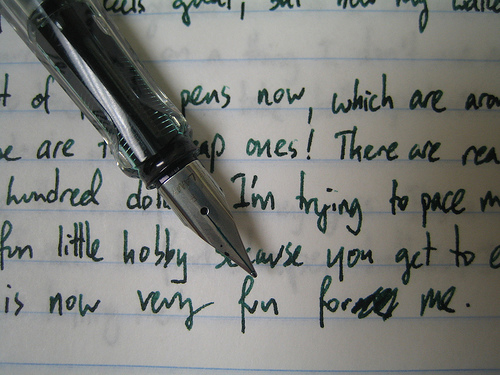
The reasoning behind this exercise is similar to the logic behind writing by hand and not relying on the computer keyboard for one hundred percent of your writing output. Writing with your dominant hand allows your thoughts to flow unimpeded from your dazzling brain, down your graceful arm and onto the page in a liquid script. You learned to do this type of writing so long ago that the muscular memory is well established and you no longer need to think about how to grip the pencil, focus like a mountain lion, rear back, and assault the page. This type of writing is automatic, never requiring a second thought to secure a type of fluency, and elegance of process. You pick up the pen, you write.

When you write with a computer, you access both parts of your brain and manage a fairly linear process of calculating thought, interpreting electronic impulses, dashing off messages with lightning speed. You are capable of producing great amounts of written material quickly; if you are an accomplished enough typist, your fingers can almost keep pace with your thoughts. Likely however, you are able to dash off great tracts of prose produced at a formidable rate, interspersed with small interludes of calm while the thinking apparatus generates more material, whereupon the typing commences at high speed.

Alternately, writing by hand slows you down by a least half. The statelier pace of recording thoughts on the page also slows your mind down, and everything relaxes. Your brain has time to linger over thoughts, to meander down lanes of memory and drowse in the dapple shade of summer trees. You can write quickly, but you are still operating at about half-throttle, and there is a more reflective quality to your thoughts and ideas. You can immerse yourself into an idea, you may actually visualize it, take it in with your senses, spend some time with it, date it, get to know it’s quirks, understand the sweetness of it, savor each nuance of meaning before moving on to the next idea. Writing by hand is a tactile and timely experience. You feel the gravity of each word, pushing your pen around the paper. You smell memories; you taste nouns. The idea in your mind merges with your heart and produces lines on a page that more or less mean something. Writing by hand actually means writing by body. It’s not as if your hand is a separate unit from your shoulder, elbow, neck, or heart. You write with it all; because it’s all connected.

If writing by hand is a physical experience, writing with your non-­dominant hand is meta-physical. It requires a concurrent focus just to grasp the pen, to align yourself with the paper, figure out at what slant to approach a line of dictation, how firmly or lightly to squeeze the pen. Suddenly, words with billboard-sized letters loom in your mind, waiting, while you work out the downward loop in your cursive f and move on. What an accomplishment!  

Don’t try to be perfect –you’ll frustrate yourself– unless you were born a leftie and a well-intended but completely disconnected nun forced you to be normal by learning how to write and color and cut paper chains with your right hand. If this is the case, allow me to apologize on behalf of teachers everywhere. You were perfect the way you were, and no one had the slightest right to alter your natural impulses.

Write with your weaker hand –and as you do, you will notice that you have to loosen up. At first you’ll be all stiff and stilted, which will be of no discernible help at all. Struggle less, write more. It’s almost as if with less effort your writing becomes more legible, and the mess of spaghetti on the page begins to resemble actual letters connected to convey meaning. Start by practicing writing your name, then the names of the ones you love. Then gradually, work your way up to words and sentences. A paragraph becomes a grand achievement. Once you master the paragraph, work your way up to a page. Don’t worry about speed, it takes as long as it takes, and it isn’t a competition.

As you write with your weaker hand, you may begin to notice simplicity of thought emerging in your writing. As your neural pathways struggle to fire and connect, you may find your writing taking an intuitive leap, a creative catapult toward new meaning. While writing with your non-dominant hand is awkward, difficult, unseemly, unruly, undignified, it is also as unimaginably liberating as a good walk in the summer rain, as a slice of pizza for breakfast.

We all walk around with a virtual circus playing in our heads and hearts. We carry a lifetime of memories, and a universe of potential. We are at once a young child, and a wise mentor. We are co-workers, and doting grandparents. We are friends and dog-trainers. Vegetarians and comparison shoppers. We are none of us completely and one hundred percent just one thing or even the face we show the world. This is maybe just one of the things that make us such interesting and complex individuals. When we write with our dominant hand, our worlds remain intact, there is no color outside of the lines; all personalities more or less behave as expected. When you write with your non-dominant hand, buried thoughts may rise up to the conscious level, may veer outside the lines in splashes of magenta and vermilion. It becomes messy and a trifle chaotic, but it becomes something beautiful, too.

Writing with your non-dominant hand is a bit of a magic trick; now you see it, now you don’t. While you focus on your inelegant claw struggling to grasp a pen, hidden thoughts may trickle in; tiny hairline fractures may appear in the wall you’ve built around the creative juices; the wall itself may start to crumble just a little, and ideas you’d forgotten you had may just trickle in. Et voila! A dove materializes from a handkerchief.

I believe in magic. I believe in illusion. I believe that coloring outside the box is not just fun; it’s an innate responsibility of the creative heart. So get out there and write with your less popular, ugly step-sister, non-dominant hand. You won’t like it at first. In the beginning it will be as difficult and awkward as a poodle in a tutu. But once you relax and flow with the process, you’ll learn to know yourself in a whole new way, chances are pretty good you’ll like the other, less dominant you.