be home more

headlightsOIL IN WATER

Pam Lazos

Chapter Seventy

Kori walked in the back door and dumped a pile of mail and the Sunday paper on the kitchen table. She shot Avery a dirty look which he didn’t catch because he didn’t bother to look up from his magazine.

“Hi to you, too,” she snapped. Avery took a bite of his cereal.

Kori got close to his face: “Hi!” she yelled.

Avery pulled the honey pot over, forcing Kori out of his immediate space. She crossed her arms and stared at him as he rolled the honey dipper around inside the pot. He pulled up a ball full and drizzled honey over his Cheerios, making little swirly patterns with the sticky golden liquid.

“Are you going to say something?” Kori asked.

He replaced the lid and pushed the honey jar away before turning his full attention to his sister. He scowled, contemplating his options.

“Yeah. I’ll say something. Don’t you think you’re behaving outside the scope of what constitutes a good role model?” He took a sip of his juice and rather than waiting for an answer, turned back to his magazine. Kori watched him, mouth agape.

“What the hell’s that supposed to mean?” she shot back.

Avery pushed his chair back and crossed his legs. In that moment, he felt he’d become one with his father. He felt agitated and fatherly, a lecture for the child’s latest transgression poised on his tongue.

“It means, you’re acting like a….” His mouth formed a “w,” but no sound came out. Avery’s face felt hot. He dropped his chin and looked at his stockinged feet.

“What? Go ahead and say it.” She threw a piece of junk mail at him. “Say it!” The envelope bounced off his shirt and fell to the floor. “Say it, you little dweeb.” She threw a stack of napkins at him. They fluttered to the floor like baby birds falling from the nest. “Who the hell are you to judge me? Huh? Do you know how hard it is being me? Keeping all this together?” She waved an arm behind her, a gesture so dramatic it may as well have encompassed the entire world, not just the pots and pans.

Avery rubbed the bridge of his nose, exactly the way Marty used to do to hide his smile.

“Stop it, you little bastard.” Kori lunged at her brother, intent on strangling him.

Avery had a good deal of upper body strength to his credit despite his lanky frame. He grabbed Kori with ease, stopping her in mid-lunge, holding both arms, their faces inches apart. He looked closely at her now, at the worry lines on her face, at the dark, puffy circles below her eyes, and he softened. He released her and she sat down opposite him, looking pitiful and embarrassed. Avery returned to his magazine and pretended he wasn’t moved.

“Just say it, would you?” Kori choked out the words.

“Okay. You need to be home more. Not just for Gil. For me, too.” He pushed his cereal bowl away. “I can’t remember everything. I have school, you know? And there’s laundry everywhere and grocery shopping and Gil’s homework to check and I got my own homework. I mean, look at that.” He waved his hand in the direction of the gargantuan pile of mail. “I think subconsciously I didn’t pick it up because I know there are bills due and I’ve got no money to pay them with. I never know if there’s going to be enough and I keep hoping that Social Security will make a mistake and send us two checks so I can pay off some of these credit cards that I’m using, not to buy fun stuff, but to buy groceries.” He dropped his head to his hands and stared at the floor.

Kori rubbed his back, but he shrugged her off and pulled himself together.

“You gotta get back to work. You have jobs waiting. Clients who can be tapped for other clients. Otherwise we’re gonna drown here, Kori.”

“Avery,…. I’m sorry. I didn’t realize.” Avery rolled his eyes.

“Alright, I did. But I was trying to hide from it, too.” She flopped down in the chair next to him. “Sorry.”

“It’s all right. Let’s just get back on track, okay?”

“Okay.” Kori slumped in her seat. “Anyway, I broke up with Chris.”

“You’re kidding. You and Mr. Wonderful are through?”

“He wasn’t so wonderful.”

“That’s not what you said last week.”

“Yeah well, last week my head was in a bubble of love and this week the bubble’s burst. Life’s much clearer without the filmy soap residue.”

“What happened?”

“Same old, same old, I guess. My “last man on the totem pole” complex. He’s so wrapped up in his work. I didn’t see that much of the time he was dedicating to me had to do with the story he was unearthing. His interests have been waning ever since the story ran on Gil. I got tired of ignoring it.”

“What did Chris say?”

“Nothing.”

“So you didn’t tell him.”

“I don’t think I need to.” Kori sighed. “Please don’t beat me up about it.”

Avery shrugged. “What good’s it do to beat the animal that pulls the plow?”

Kori wacked him on the back. “Are you calling me a cow?”

“If the yoke fits,” he said.

“Bastard.” She smacked him on the back again.

“Hey. Mr. Right’ll come along. What did Mom say? For every pot there’s a lid?”

“Are you calling me a pot now?”

“Jesus, you’re a bitch,” Avery said. “Now leave me alone, please so I can finish my gourmet breakfast.” He pulled his cereal bowl over and took a bite, but spit it out. “Uch. I hate soggy cereal.”

He dumped the mush in the sink and poured a fresh bowl. The doorbell rang.

Kori looked at the kitchen clock. “Who’s coming over at 9:30 on a Sunday morning?”

“Could be your new Prince Charming,” Avery said, pouring milk into his bowl. Kori scrunched her nose, looking distraught.

“What?”

“What if it’s Chris?” Kori asked, doing her deer in the headlights impersonation.

Avery laughed at the look on her face. “What if it is? You broke up with him, right?”

Kori didn’t budge.

“You better answer the door before the bell wakes Gil up.”

“Will you get it? If it’s for me, just say I’m not here.”

Avery drizzled more honey into his bowl. “No. In case you haven’t noticed, I’m eating.”

“Fine,” Kori huffed, and stomped from the kitchen.

to be continued. . .

go backwards to the start

copyright 2013

a way out

gateOIL IN WATER

Pam Lazos

Chapter Sixty-Seven

Robbie and Amara lay on a tightly woven reed mat beneath an open window, the spare light of the crescent moon casting the faintest of shadows. His arm rested protectively on her belly. The thin blanket that had covered them lay crumpled on the floor, thrown off in the dead of night and heat. A cool, light breeze blew off the water through the open window, washing over their sleeping bodies in an undulating rhythm that kept time with the passing centuries. Waves lapped against the quonset hut’s foundation.

Robbie drew a deep, choking breath as one coming up for air after too long underwater. He coughed and it woke him. He bolted upright in bed and Amara woke, too.

“What is it?” Amara put a hand on his back and felt through the well-toned muscle and bone the panic that lay buried inside. “Your heart is beating very fast.”

Robbie took several breaths in rapid succession then pulled her to him.

“You’re cold,” Robbie said.

“So are you.” Amara grabbed the blanket and pulled it up over them. Robbie relaxed and they both lay down on the reed mat again. A rustle just below the hut refocused Robbie’s attention and he was out of bed in an instant.

“It’s only a mouse,” Amara said.

“We’re surrounded by water.”

“Not everywhere is water. Much is just mud. The water is high now because of the spring rains.”

“Well, how will he get out?”

“There’s always a way out,” Amara said. “Besides, mice are excellent swimmers. Please.” She held the blanket up, an invitation for him to join her.

Robbie lay down next to her. “Sorry. Just a little jumpy.”

“It is because no one has been here for so long. You do not see this well because we come in the middle of the night. I’m sure it is very dirty in here.”

“I thought you said it was a little fishing hut.”

“Yes. It belonged to my grandfather’s father. Of course, when he left he had no more use for it, but my uncles still came here.” Amara’s voice stumbled. “Now there is no one to use it.” Robbie hugged her closed and smoothed her hair.

She nestled in. “Tell me about your dream.”

“I dreamt that American troops were driving their jeeps through the marshes. They were coming from Baghdad on their way to Basra and the most direct route was straight through the middle. The jeeps had these pontoons on them that kept them afloat when the water got deep. There was a place in the water where it rose about six inches like it was going over something massive below. The lead jeep got stuck on it. It turned out to be a remnant of one of Saddam’s dams. Everyone had to get out and figure another way across. They unloaded their mashufs and troops started fanning out across the marshes in their canoes. I was watching from the reeds. Somebody came up behind me and grabbed me by the throat. I started choking.  That”s when I woke up.” Robbie rubbed Amara’s arm and gazed into her penetrating eyes.

Amara placed her hand over his heart. “You are safe now. They will not find you until you are ready to be found.”

Robbie kissed the top of her head. She kissed his lips.

“Dawn will soon come,” Amara said. “Let us sleep until it does.”

“Then you can show me where we are.”

➣➣➣

At dawn, Robbie and Amara climbed into the mashuf they had borrowed from her uncle, a boat builder whose shop sat at the tip of what remained of the Al Hariz marsh. A mullet, small and bony by any standard, rose to the surface in search of breakfast. Robbie jumped at the splash that signaled its return to safe water.

“It is just a fish,” Amara said, handing Robbie a paddle. “And a small one at that. They are returning now that the dam has been destroyed.”

“Well, that’s good, isn’t it? I mean, about the dam.” Robbie started to paddle in time with Amara.

“Yes, it is very good. But it is not enough. The Minister of Irrigation estimates that when the dam was breached over one hundred and fifty quadrillion gallons of water flooded back into the channels. This was only enough to return the water to the two closest villages. At one time, there were hundreds of these villages. At this rate it will take a thousand years.”

“Well, can’t they just open another dam?”

“They have opened all the dams. The water is no longer here.”

“Where is it?”

“Still in Syria, and Turkey, being diverted for many types of projects. Agricultural, hydroelectric. Who knows what else? Saddam gave them this water. He stole it from his own people.”

“We’ll get it back.”

“It is much more complicated than that. Here people fight over the right to use the water. It is not so in your country. But still you see the beginnings of it in your American west. I think that one day, people in America will fight over water just as we do.”

The marshes were silent but for the lapping of the water on the shore and the slight rustle of the bulrushes. A fog had settled over the marshes and Robbie wiped at the drops of water that collected on his face. A bullfrog croaked. Robbie jumped, then relaxed.

Amara smiled and turned briefly to look at him. “You never fully get used to the noises that the marshes make. To live here is to constantly be on alert. So my grandfather has told me.”

They rowed together in silence until Amara directed the mashuf through vegetation so dense and intertwined that Robbie felt they were inside a tunnel. When they emerged on the other side, the first rays of the day had filtered through the reeds, creating a mosaic pattern across the surface of the water. A blue heron caught breakfast and retreated to safer ground, flying directly overhead.

“A most beneficent sign,” Amara said, bunching her fingers together and touching them first to her heart, then her lips and finally her forehead. She stopped paddling momentarily and squeezed Robbie’s leg. “There it is. The house of my uncle, Sayyid. We will be safe here.”

➣➣➣

Robbie and Amara docked their boat on the small island where another hut stood.

“Who’s there?” said a voice groggy with sleep. Inside the occupants of the house stirred, the first rustling of the day. Amara tied the canoe and grabbed Robbie’s arm just as Sayyid Sahain appeared in the doorway wearing the conventional robe and turban, but no sandals. In the misty morning light, Amara couldn’t clearly see the face of her uncle, still pressed with sleep, his hastily donned turban slightly askew, but she recognized the proud and encompassing stance of her father, and for a moment she believed he walked among them again. The sound of her uncle’s voice, so like her own father’s, did nothing to lessen her joy.

“Who is there?”

“It is me, uncle. Amara.”

“Amara! Is it you? I had word, but I did not dare hope…. God be praised.” Amara’s uncle scrambled down to the dock and grabbed Amara by both elbows before crushing her to his chest in a warm embrace. “God has blessed me once again,” Sayyid said. He held her at arm’s length. “To look at you is to look again upon my brother’s face.” He wrapped an avuncular arm around her and patted her back before releasing her, then turned to Robbie, a question in his eyes.       “And who is it that assures your safe travel?” he asked, sizing Robbie up.

“This is my friend, Robbie, Uncle. He is an American. He wishes to help our people. But first, Uncle, we must assure his safety. He has left his captain without permission.” Sayyid raised his eyebrows in disapproval.

Amara continued. “The Americans believe he is dead. There was a car bombing and…. they did not find him.” Amara bowed her head and clasped her hands together. “I’m sorry, Uncle. I do not mean to bring you trouble.” Sayyid studied Robbie’s face then looked to his niece’s bowed head.

“Amara. You could not bring more trouble than that devil, Saddam, has brought to his own people. Every day I ask God why he has allowed this. But God has turned his face away from us.” He lifted Amara’s chin that she might look him directly in the eyes. “You were always the impetuous one. By the grace of Mohammed, had you been born a boy I believe you would have stopped the devil himself.”

Amara smiled at her uncle and he stroked her cheek.

“Time has taught me many things,” Sayyid continued. “For the memory of your father, but more important, for you, I swear I will keep your friend safe among us until the time he chooses to leave.”

Sayyid turned to Robbie. “Welcome, sahib.” He took Robbie’s hand in one of his and with the other clapped him on the back. “You are safe here.”

“Thank you. . .”

“Call me Uncle as my niece does,” Sayyid said.

“Uncle,” Robbie repeated. Following Amara’s lead, he bowed his head slightly to indicate his respect.

“Come, come,” Sayyid said. “Let us go inside. You will be hungry, yes? We will take a meal together and you will tell me of your plans.”

➣➣➣

Inside Sayyid’s wife, Fawzia, was already grinding coffee. Sayyid made the introductions and Amara embraced her uncle’s new wife before the woman retreated to the hearth to prepare a meal worthy of visitors.

“Fawzia is a good woman,” Sayyid said. He directed them to several cushions scattered around a small round table barely a foot off the floor.

“I am sorry for you, Uncle. For my aunt. We had heard, but were unable to make the trip.”

“Thank you, niece.” Sayyid bowed his head and touched his bunched fingers to his heart, mouth and forehead. “She was a very good woman, dead now these five years.”

“How did she die?” Robbie asked.

“From Saddam’s poison water.”

“Saddam poisoned the water? But why is everything not dead?”

“He is the devil,” Sayyid said.

“I thought it was because of the dams,” Robbie said. “I didn’t know he used poison, too.

“He did not poison it with chemicals, but with ideas,” Sayyid said. “And revenge. Revenge for the part my people played in the Shiite uprising in Iran. We are Shiite Muslims. Saddam is Sunni. So he tries to kill us by taking away our water. When the water is not fresh, it dies.”

“You mean it becomes stagnant?” Robbie asked.

“Yes. Stagnant. This water breeds cholera. We have no cure for this disease.” Sayyid’s voice assumed a distant quality.

“When I see the problem, I take her by tarrada.” Sayyid turned to Robbie. “This is my large canoe, much bigger than my mashuf. It is more than thirty-feet. I have six people paddling while I hold her head in my lap. But it is not enough. By the time I see the doctor, he can do nothing. I am too late.” Sayyid wiped at his eyes as if he had an itch. Robbie looked at Amara who put her hands in her lap and bowed her head.

“Saddam made this. He killed my beloved wife when he stops the water with his dams. With his evilness. If he is not the devil himself then he has made a deal with him. This I know.” Sayyid adjusted his turban and straightened his robe. “My people lived here from the beginning of time. Now they live in refugee camps on the borders in Iran.”

“That’s why we’ve come, uncle,” Amara said.

Fawzia appeared with a tray containing three demitasse cups, sugar, spoons, and an ebriki, a small brass pot with a long handle, used to cook the coffee directly over the stove. Steam wafted from the narrow opening of the pot. Fawzia set the tray down and smiled at Amara and Robbie.

“You are hungry?” She brought her fingers to her lips to indicate eating with one’s hands. “You eat now?”

Amara nodded and smiled. Fawzia squeezed Amara’s hand and left.

“She speaks only a little bit English, my wife,” Sayyid explained to Robbie.

Robbie nodded. “I’m sure we’ll manage.”

 to be continued. . .

start with this and we how we got here

copyright 2012

she might catch fire

icebergOIL IN WATER

Pam Lazos

Chapter Sixty-Six

The will had been on file in Kitty’s attorney’s office for years and Bicky had full knowledge of it. He was well aware of the provisions it contained and had pestered Kitty relentlessly after Sonia’s death for her to update the document. Otherwise, he’d argued, the disposition of more than a fortune would be left to the vagaries of Sonia’s will. Bicky was reasonably sure that Sonia’s will left everything to Hart, but he saw no reason to take the chance. Besides, Hart wasn’t blood, and the events of the last few weeks had born that out in crystalline form. Unfortunately for Bicky, Kitty had ignored him, or so he thought, and soon after became sick and since his suggestions angered her so, he ultimately let the whole matter drop. At the time Bicky reasoned that with a little finagling he could fund a buyout of PGWI’s stock using his own assets as collateral and thereby retain ultimate control of Akanabi. But now? The stakes were a good deal higher and though he hated to admit it, there may not be a way to do this deal.

Bicky’s father, that bastard, had set it up so Sonia and Kitty, operating together, could overrule Bicky’s business decisions. Knowing Bicky’s relationship with his wife and what the senior Coleman perceived to be Bicky’s indifference toward his daughter, Bicky’s father made it impossible for him to leave his wife and child without risking the loss of everything. For some reason, Sonia and Kitty never took advantage of their monopoly. Even more amazing, they stayed with him all those years when, had the tables been turned, Bicky would have taken his fifty-one percent and left.

Bicky ran a hand over his stubbled chin and rubbed his bloodshot eyes. The codicil was executed three months after Sonia died. Since Kitty possessed all her faculties up until the end, it would be difficult to argue that Jerry had put her up to it.

“Christ, there’s got to be a way around this mess,” he said out loud. He punched the intercom for Phyllis.

“Yes?”

“Can you come here, please?”

“Certainly.” Phyllis was in the door in moments. “What’s up?”

“I don’t know.” He eyed Phyllis for a moment. “I think I need help.” Bicky slumped back in his seat looking older than Methuselah.

“Do you want me to call your doctor.”

“No. Not that kind of help.” Bicky dropped his head to his hands and rubbed his face. His voice cracked. “I just need a friend, is all.”

“Do you have any friends?” Phyllis asked, smiling. Bicky didn’t return the gesture.

“Do you know anything about Kitty and Jerry?”

“You mean, for instance, Kitty was your wife and Jerry has worked for you for about as long as I’ve worked for you, but now he doesn’t?”

“How did you know?” Bicky asked. His face had assumed its mask-like qualities.

Phyllis’s eyes grew wide, but if she had a quip, she kept it to herself, limiting her retort to the obvious. “With so much cabling in this place word travels fast.”

Bicky tossed a copy of Kitty’s will across the desk. “Did you already read this?”

Phyllis stepped forward, reviewed it quickly, and nodded. It was her turn to put on the mask.

“Did you know?” Bicky asked.

“Know what?”

“That they were having an affair?”

“Well, if the question is have I ever see them hiding behind the water cooler, locked in an embrace, then no, I didn’t.”

“C’mon, Phyllis. Cut the sarcasm,” Bicky replied.

“What’s it matter now, Bicky? Kitty’s gone. What would you do with the information?” Phyllis picked at a loose thread on her suit jacket.

“I just want to know, is all.”

“Well, you’re going to have to draw your own conclusions.” She looked at him with an expression that relayed it to be her final word on the matter and stood to go.

“I just want your opinion.” There was a remote quality to his voice, as if he were speaking into a fierce wind that blew all around him,  sending his words to far off places. “Do you know you are the only person in my entire life that’s never judged me,” Bicky said. “Or at least if you did, you kept it to yourself. If I’ve never thanked you before, I’m doing so now.” The words had the desired effect. Phyllis sat down.

“Why did you torture her so much?”

Bicky responded in a voice that belied years of unrequited love. “Because she didn’t love me. And I was too proud to show her why she should. And now, well, all that crap about it being too late would be appropriate here.” Bicky coughed and rubbed his eyes dry. When he spoke again, his voice was level.

“This could ruin me, you know. A hostile take-over. I’ve not made many friends in this industry. I’d be out on my ass faster than stink. And if Jerry and Hart got together….”

“Ah, the truth comes out,” Phyllis said. “Maybe it’s time to take early retirement.” The sarcasm was notably absent.

“Maybe. Just let go of it all.” He traced his finger over the beautiful mahogany desktop. “That’s been my problem all along, you know. Ever since my mother died, I spent my life with my arms wrapped tight around everything I owned, squeezing the air out of it. Even my own wife.”

Phyllis reached across the desk and patted Bicky’s hand.

“I know I wasted a lot of time. Time I can’t get back.” He pulled his hand free and walked to the window. He stared out across Houston’s skyline for several minutes before continuing. “But what am I supposed to do? Roll over and die? Do you really think anyone will remember me?” Bicky slumped back in his chair looking frail and pathetic. Phyllis spoke softly, with tenderness.

“You have resources. Plenty of friends. People with fat checkbooks.”

“Is that supposed to make me feel better?” Bicky snapped. Phyllis recoiled as if stung, all the goodwill of the last moments evaporating with a word.

Phyllis stood up and said in ice blue tones: “It’s just an observation.”

“Yeah, well keep your observations to yourself.” Phyllis focused on the back of Bicky’s head.

“I could fight this for years, but he’s still going to win. He’ll bring on witness after witness that says my wife was of sound mind and body when she executed that codicil. Witnesses that will say I was a lousy husband. Hundreds of pages of briefs will be filed and they’ll have life expectancy charts and police testimony and psychological exams. My life will be on complete display for the gossip columnist and at the end of the day, he still wins.”

Bicky rested his forehead against the cool glass and stood as if cast in bronze.

“Well if you have nothing else to say, I have something,” Phyllis said. Bicky didn’t bother to turn around. “I’m tendering my resignation. As of today. I’m giving you two weeks notice.”

Bicky was stricken, a look Phyllis couldn’t see. “Why?” he croaked.

The standard line.  “I want to spend more time with my family.”

He wanted to say to say something to change her mind, tell a joke, rehash the past, anything, but words had abandoned him. He felt the weight of Phyllis’ stare, but the profundity of his misfortunes rooted him to the spot: he couldn’t even turn around. Finally, Phyllis left.

And for the first time in over thirty years, Bicky Coleman was suddenly and completely alone.

 ➣➣➣

Phyllis sat in front of the computer reading her email when Jerry walked into the office, looking drawn. She smiled, stood and walked around to the front of her desk. They hugged, a bit stiff, like old friends who had served in the same war, but hadn’t seen each other since experiencing all the pain and suffering they had learned to forget. When they pulled away, they both looked sad. Jerry nodded toward “the big door,” but Phyllis shook her head.

Jerry walked back out into the hall and returned with a cardboard box filled with keys. “My instructions were to leave these with you.” He set the box on the desk and backed away as if it were something extremely fragile. “Guess that’s it. Thirty years of loyal service,” Jerry said in a voice redolent with sarcasm. He laughed, a dry mirthless sound emanating from his throat, and stared at the box to see if some part of those years would replay before him.

Phyllis touched him on the shoulder and he stared at her so intently she thought she might catch fire. She bristled and looked away, breaking the connection. Jerry laughed, at first a small chuckle which grew into a giggle and then a full-fledged belly laugh, ultimately careening into complete hysteria. Phyllis stared at him in mute horror, then turned and walked to the other side of her desk, her hand on the hidden button underneath. Jerry’s laughter died down until he, too, became silent. If he noticed Phyllis’ hand on the button, he didn’t say.

“I guess you heard about Kitty’s will,” he asked.

Phyllis nodded.

“I didn’t ask her to do that, you know. I never asked her for anything. Except to just leave with me.” Jerry stared at his well-manicured nails, his tone flat and even. “She couldn’t do it. Never could bring herself to leave that son-of-a-bitch. Now she’s gone and left us both.” He looked up at Phyllis without emotion.

“I’m sorry for you.”

“You think I was wrong, don’t you? To love her like that.”

“It’s not for me to say, Jerry. Everybody has to live by the dictates of their own conscience. Otherwise you’re not living, just going through the motions. But since you asked, no, I don’t think you were wrong. Love is never wrong.”

“Maybe if I would have tried harder to convince her.” Jerry shook his head. “It was always because of Sonia, you know. That she would never leave. She didn’t want Sonia to lose out on what Kitty thought was rightfully hers and if the truth came out that…” Jerry stopped, his mouth still open, the unspoken words still on his lips.

“What?”

“Nothing.” Jerry dropped into a chair as if he were suddenly very tired. “Right now it feels as if my whole life’s been one giant lie.”

“So make it right.”

Jerry nodded, leaving Phyllis with the impression that the words were reaching him only after covering a great distance.

“How do I do that?” he finally said.

Phyllis shrugged. She’d said her peace.

After a minute, Jerry turned to stare at Bicky’s door. “You’re right.” He sighed and heaved himself up. The young, virile man was gone. An old, regretful man had taken his place.

“Thanks.”

“For?”

“Always being an ally in the war against tyranny.”

“You’re welcome.”

 ➣➣➣

Hours later, Bicky sat in front of the fire, stone-drunk. He paced the room like a caged animal, wringing his hands in despair. He wailed, a deep, mournful, bellowing sound that started in the pit of his stomach and ascended, higher and higher, until it reached a screeching pitch that even he couldn’t abide. He fell to the floor, covering his own ears, thrashing and hissing at the unseen demons that surrounded him, a man possessed. He banged his head on the floor, a rapid succession of syncopated rhythm. He pulled his body in close and fell over on his side into the fetal position, wrapped his arms around his knees and began to rock like a baby. He cried, using the tears he’d stockpiled for the last thirty years, until he’d drained enough of the agony from his body that he no longer felt like throwing up. Hopelessness was quick to fill the void, however, and he succumbed to the fresh onslaught.

When his body grew tired, he sat up, dried his eyes and cast an appraising glance around a room that for years had been shrouded in egotism and greed. He walked over to the side table and picked up a framed photograph of himself and Kitty on their honeymoon. The tears were back and he was about to scratch them out with his own fingers, but rubbed his eyes sharply instead, and with so much pressure that he experienced a stab of pain, causing him to stumble backwards. He shook his head to clear his vision and Hatred, Anger’s nimble first cousin, flew in, replacing the light. He screamed, raised the photo above his head and threw the picture into the fire. The glass in the metal frame shattered when it landed. Bicky stared after it, momentarily stunned, ready to accuse the perpetrator.

“Aaaaahhhhh,” he yelled, and ran to the fire. The edges of the photograph had begun to singe and without thinking, Bicky reached into the fire with his bare hand, his skin melding with the hot metal. He screamed again, this time from the burns, but he wouldn’t let go of her, never let go . The skin on his fingers began to melt so he dropped the frame. It clattered as it landed on the hardwood floor. He grabbed a pillow from the couch and blotted at the photo. His raw hand had already started to blister. He looked at the appendage as if it belonged to someone else, shook it twice then knelt down, hovering over the photo. He pushed aside the remaining pieces of broken glass with a pen from his pocket and pried the picture free, shoving the ruined frame away with his good hand. He knelt down on the floor, his chest to his legs and leaned in to kiss Kitty’s face. He traced her body with his good fingers, the lovely creme taffeta dress flowing around her like a breeze, and kissed her now browned visage before starting to cry again.

 ➣➣➣

At his apartment, Jerry packed one suitcase with winter clothes and a second one with shorts, T-shirts, suntan lotion and other summer weather sundries. He walked over to the bookshelf and took down a dozen of his favorite titles along with a few he hadn’t read yet and tossed them in the “warm” suitcase. He glanced around the room. Other than the floor-to-ceiling book case that lined one entire wall of his bedroom, there was nothing in this room he wanted.

He sat down on the bed and called Kitty’s lawyer giving him instructions to sell half the Akanabi stock Kitty had left him once the will was probated and to put that money in trust that named PGWI as the recipient. The fund was to be placed under the direction of David C. Hartos with specific instructions to invest the money in either a private or publicly traded company as long as Hart had an affiliation with it. Each year, the dividends earned on such a phenomenal amount of money were to be turned over to PGWI, used to drill wells and build wastewater treatment plants in developing countries all in memory of Kitty Coleman and Jerry Dixon. Should the principal devalue in any given year, the dividend was to be reinvested, thus assuring the principal remained intact.

What to do with the rest of the Akanabi stock was the more difficult question and one he’d have to deal with Bicky directly on. For now he’d instructed the lawyer to hold the stock certificates and gave him power of attorney so Jerry could access the revenue, should it be necessary, from anywhere in the world. Jerry himself had no use for the money. He’d lived a Spartan existence all these years and saved a ton of his own money, because if nothing else, Bicky paid well. And other than the gobs of money he spent on books, Jerry had no real hobbies. For him to get this kind of money now in his life meant nothing. Had he had it when she was alive, well, it may have made a difference. He shook his head. It didn’t help to think about it.

He placed two firearms in the “cool” suitcase. He’d have to notify airport security and show them his permit. Likely it would be no problem as long as the guns were stowed in the cargo hold. He snapped the suitcases shut. Leather bound and heavy, they once belonged to his father. He knew today’s models didn’t take much in the way of coordination to carry and many came on wheels, but he like the weight of them, the feel of the strength in his arms as he hefted them off the bed. He set one down, took a last look around the room, shut the light and headed out to put things right.

 to be continued. . .

start with this and move on

copyright 2012

trickle down theory

as blushing guardians of Gaia we could do better. . .and that’s a hard pill to swallow.

pass a glass of water, would you?

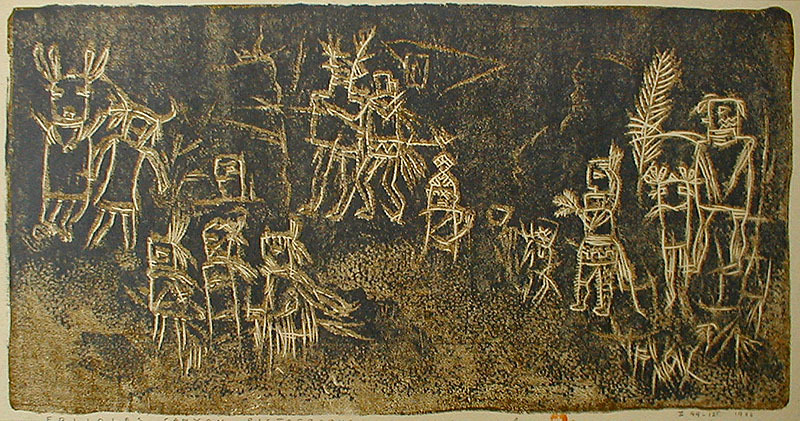
Frijoles-Canyon-Pictographs-by-Gustave-Baumann

Midlife Crisis

Image

I clip shoots from my rosemary plant and sauté the spiky, needle-like leaves with onions, butter and wine to make a mushroom barley soup my family loves.  The scent, fragrant and alluring, makes inroads to heaven.  We eat it all, every bite.  I grew up in the “clean your plate” era, raised by parents who themselves were children of depression-era children.  My grandparents were familiar with the demoralizing nature of such demanding times, and maybe because of this collective consciousness, I abhor wasteful habits.  As kids, we didn’t question, we just cleaned our plates.  I don’t force my own kids to do this, but I ask that they take only what they think they’ll eat.  Leftovers aren’t a problem, a staple of the next day’s school and work lunches.  Most days I pack a lunch and even give my kids incentive money to pack instead of buying which serves the twin purposes of bolstering their savings accounts and assuring me they’ll eat well.  Plus they learn the value of food.

Perhaps this is why the other day my daughter brought home bags and bags of hoagie rolls.  The nationwide franchise sandwich shop where she works tosses their leftover bread and starts fresh each day.  Understandable, yet wasteful.  Fretful and disillusioned, my 17-year old couldn’t understand her employer’s policy so she rescued the bread before it took a dumpster dive, intent on giving it to someone who could benefit.  Her employer agreed to look the other way, but required that there be no mention of the bread’s origins.  We’d welcome a few loaves, but four dozen would fill our freezer to bursting.  We considered the list of places that would be good candidates while the liability issues ran an endless loop in my brain.  Today’s litigious society is fierce even where good intentions abound, but my daughter was adamant so we brainstormed.  The homeless shelter?  Day care center?  Women’s shelter?  Church?  All suggestions led back to the same quandary:  how to get the food, once debuted, from place to place before it went bad, and the trickier question, what if someone got sick?  Silly because it was bread, but lawsuits have been won over less (spilled hot coffee comes to mind).

When I was a kid, my parents had a delicatessen at the shore and we often gave the leftover food to the local nunnery.  A few times a week I’d carry the spaghetti sauce and meatballs, pasta and tuna salads, and other prepared foods possessed of a limited shelf-life the few blocks to the nuns.  They gave profuse thanks, and never once complained about the food’s second run.  Today, over 30 million tons of still usable food is landfilled each year, left to rot and turn to methane.

I later discovered organizations in neighboring Philadelphia, Philabundance, and one in Northeast New Jersey, Table to Table. The latter is a self-characterized “food rescue” program.  Five refrigerated trucks, and a partnership with local businesses that have good quality, no longer salable food form the core business plan. The company picks up and delivers fresh foods to non-profit organizations with a needy clientele all in the same day, marking the difference between them and a local food bank.  Imagine if such an organization existed in every community — the end of leftover food’s mid-life crisis!  Lacking a nearby equivalent, we distributed our stash to friends and family.  Maybe next time I’ll drive to Jersey.

a hundred years from Monday

budbreakOIL IN WATER

Pam Lazos

Chapter Fifty-Five

A few days later, Kori was pulling out in Ruth’s minivan when Jack cruised up the driveway, forcing her to slam on the breaks to avoid a head-on collision. He stepped out of his car, an impish smile on his face, and walked over to the driver’s side. She looked beautiful.

“Better watch where you’re going,” Jack said. “You could hit somebody.”

“Better you than me.”

“Nice to see you, too.” Kori stared straight ahead, ignoring him.

“How come you haven’t returned my calls?”

“You called?”

“Very funny, Kori. What the hell’s going on?”

“Nothing. Why do you ask?”

“I’ve been calling you all week, is why I ask, and I know you haven’t been home because I’ve driven by a dozen times. Then last night one of my buddies says he saw you and some flunky out having dinner.”

“We’re just friends.”

“Oh yeah? When was the last time you lip-locked a friend?”

Kori shrugged.

“Answer me, dammit.”

Kori stared at the woods to the side of the house. Jack yanked open the driver’s side door and pulled her out by the arm.

“Ow….”

“Oh, now I have your attention….”

Kori shook loose from his grip and stalked off across the lawn. Jack ran ahead, hampering further progress.

“What in God’s name has gotten into you? Why are you so angry?”

“Because you’re a self-centered bastard. You waste your time watching sports when you could read a book. You prefer a night of drinking with your friends to the movies with me. You have no interest in my work. But most of all, because you wouldn’t go to the Goddamn public meeting with me!” She said the last with such venom that Jack thought she was going to strike him to hammer the point home, but she just turned on her heel and walked back toward the car. He stared after her, dumbfounded, before running to catch up.

“I’m sorry. If I’d have known it meant so much I would’ve gone with you.”

“You did know.”

“I didn’t. I swear. Come here.” Jack pulled Kori in and hugged her to his chest. “I miss you. Please don’t do this.”

Kori raised her face to him.

“Besides. Robbie told me to take care of you.”

Kori grimaced and shoved Jack as hard as she could. He lost his balance and fell backwards.

“And Robbie told me to watch out for you,” she said, “but not the way you think. Anyway, Robbie’s dead. Gone. Just like you. Just like everybody.”

Jack jumped up and grabbed the back of her neck. He pushed her chin up and kissed her gruffly. “It would be a shame to lose what we have.” He wound his arms around her and whispered in her ear. “To walk away just so you can be the first to leave is a horrible waste of time. Sometimes there are things bigger and more satisfying than an indulgence of your pride.”

“Like what?

“Like happiness.”

“Oh, pull-ease”

Jack released his grip and took a step back, putting air between them. “Are you afraid to be happy with me?”

“I was happy with you until I saw what an egotistical prick you are.”

“C’mon, Kori. This is stupid.” He kissed her again and this time she responded with her mouth and her body. After a minute, she released him. He was electrified.

“Alright. You win.” She reached out and gave his dick a little squeeze. He shivered at the touch. “Call me, say, a hundred years from Monday. That should put us squarely in the next lifetime.” She strode to the van, slamming the door after her.

Jack watched as she put the transmission into all wheel drive and drove through the small forested grove to the side of the driveway, pulling out onto the road before he even registered what happened.

➣➣➣

Jack walked around to the back of the house and, hearing music, followed it to the barn. He banged on the door, but Gil didn’t hear him over the bass. He peeked in the window and saw Gil holding Max up by his front paws and dancing to the Bacon Brothers, Philadelphia Chickens. Jack knocked on the window and when Gil saw him, he screamed and dropped Max to the ground.

Gil lowered the volume on the stereo and opened the door. “You can’t sneak up on a person.”

Jack laughed. “It’s not like it was hard.”

“Where’ve you been?” Gil demanded.

“Home. At work. Out. You want a list?”

“Why not here?”

“Your sister’s not talking to me.”

“So what? I’m talking to you.”

Jack tilted his head, shrugged his shoulders and gave Gil a lopsided smile. “Gilly.”

Gil looked askance at Jack, set his lips in a grim straight line, and closed the door.

“Gil, come on,” Jack said, knocking again.

Gil locked the door and turned up the music.

to be continued. . .

to get caught up start here

copyright 2012

little secrets

foolOIL IN WATER

Pam Lazos

Chapter Fifty-Four

Three nights later, the doorbell rang and Gil and Max ran to answer it. Chris Kane stood at the door with a bouquet of flowers in one hand and a small bag of gourmet dog treats in the other. Gil turned toward the stairs and yelled: “Kori! Time to go.” He turned back to Chris, hand on the knob, body blocking the doorway. He did not invite him in, just stared at him while Max sniffed the bag.

“Oh, yeah,” Chris said. “These are for Max.”

Gil opened the bag and without taking his eyes off Chris, tossed a biscuit in a high arc. Max made a mad dash across the room, snatching it from the air. One corner of Gil’s mouth quirked up when Max took the first crunching bite, but his gaze didn’t waver.

Kori appeared and Chris sighed from relief and appreciation. Kori smiled, waved and disappeared into the kitchen. After a few more moments, Gil took the flowers and went to join his sister, but when Chris took a step to follow, Max ceased his crunching and growled.

“Oh, they’re beautiful,” Chris heard her say from the kitchen. “Do me a favor and put these in water?” He heard the smacking of lips as cheeks were kissed.

“Avery should be home by ten. Gil needs to go to sleep by then.”

“Awww, Kori,” Gil whined.

“Alright. Ten-thirty.” Apparently that pleased Gil because Chris heard no argument.

“You be careful now.”

An older female voice. One Chris couldn’t identify.

“I will.” Another kiss. “Thanks, Aunt Stella.” Ah, yes. The neighbor.

“Well, whether you’re early or late, you know where you’ll find me.”

“Asleep on the couch and pretending not to be.” More laughter and then she was standing before him, smiling.

“What are you doing in the doorway?” Kori asked, the smile brightening.

“Waiting for you. What else?”

Kori laughed and he grabbed her arm and led her away.

➣➣➣

“The more you delve into this stuff, the more that comes up,” Aunt Stella said. She and Gil sat at the kitchen table each with the remnants of a glass of milk and the cookie crumbs to go with it. Aunt Stella shuffled a deck of Tarot cards, tapped them tight and placed them in front of Gil. “That’s why people keep all their little secrets and don’t want to bother with them. It’s just too much for some to think about.” She smiled at Gil. “You’re still young, though. How many secrets could you possibly have?”

“Now what do I do?” Gil asked, impatient.

“Cut the cards three times to the left and then stack them up again on the pile to the right.” Gil did as instructed and waited on Aunt Stella’s next move. “We’re just going to do a short past, present, future reading right now rather than go through the whole song and dance of a lifetime reading. Although…” She placed a hand under her chin and played with an errant whisker, something her eyebrow tweezers had missed. She furrowed her brows, further accentuating the small, almost scar-like indentation that had formed over the years in the center of her eyebrows as a result of this exact facial expression. “Nah, let’s just do this.” Waving a pudgy hand to erase all contrary thoughts, she placed it on top of the cards, fanning them across the table before Gil. Although Aunt Stella had several Tarot decks at home, she preferred Aleister Crowley’s Thoth Tarot Deck as it conveyed more of a feeling of beneficence on the reader than say, the Egyptian Tarot which was to her mind overly preoccupied with the twin themes of death and destruction.

“Pick three cards and place them right to left facing down.”

Gil acquiesced and looked up, doe-eyed at Aunt Stella, waiting for the next instruction. She pushed the remainder of the deck together in a pile and set it aside. Had any of the clergy members, all males, of the Greek Orthodox Church to which Aunt Stella belonged been here to witness such adroit familiarity with the work of Satan they would have blushed crimson and then blue for lack of oxygen. But despite the ecclesiastical indoctrinations of the church, it could not, for all its gumption, usurp such traditions, steeped in mysticism and superstition, that had survived among Greek women since the seers and high priestesses of the temple brought to light the oracles at Delphi.

“You know, my mother had the Sight. She could tell you who was on the phone the minute it rang.”

“Wow. Really?” Gil asked. “I wish I could do that.”

“You can. You just need focus. And some training.” Aunt Stella tapped the first of the three cards Gil had turned over. “My sister inherited my mother’s gift. She can read the cards just by looking at them. Not me, though. I need the book.” She flipped through The Tarot Book, by Angeles Arrien, its pages worn and rounded from overuse. She placed her hand reverently on the cover and closed her eyes. “My second bible,” she said, opening her eyes. “Shall we start?”

Aunt Stella picked up Gil’s first card. “This is your recent past.”

“Why didn’t you get your Mom’s gift?”

“It only goes to one woman in the family, usually the first born, but that varies. The others get some things, sympathetic leanings and what not, but usually only one gets the whole enchilada.”

The enchilada reference triggered a visceral reaction and Gil’s stomach grumbled loudly. Aunt Stella pushed her basket of treats his way and looked up the first card in the Angeles book. Gil pulled out a white-chocolate chip and macadamia nut cookie, so loaded with nuts that there was barely enough dough to hold the cookie together.

“What happens if there’s no girls?”

“Sometimes it skips a generation. Although boys can get it, too, if that’s what you’re asking. And sometimes it does run through the male line. Your father’s told me more than once about your grandmother. Apparently she had it. I think he was always a little disappointed that he didn’t have a full-fledged dose of it, although he was very intuitive, especially for a man. Still, he didn’t rise to your level.” Aunt Stella reached across the table and squeezed Gil’s hand. “He was so proud of you.”

Gil pulled out another cookie.

“That’s enough now. You’re not going to be able to sleep.”

“Yes I will.” He bit into it while Aunt Stella read Gil’s first card.

“The Six of Swords. Excellent. And not surprising, actually. The Six of Swords represents science.” She showed Gil the page in the book depicting the card as if that were sufficient to prove its meaning. “Objective communication is represented by the planet Mercury. See it there at the top. Then there’s Aquarius at the bottom, and it’s associated with ‘originality, innovation and pioneering work.’” She squeezed Gil’s arm and smiled. “This is good, Gilly. It symbolizes the creative mind that pulls ideas from unexplainable sources of inspiration and communicates them in a way people can understand without feeling threatened.”

“It’s the TDU! You see the TDU in the cards!”

“Right there in a full-color spectrum of light,” Aunt Stella said. Gil allowed himself a moment’s smile, but replaced it with a stern countenance.

“Does it say how it’ll do?” He bounced the heel of his foot up and down, the ball of his foot stationary on the floor, a habit born of nervousness.

“Hhmmmm. I’m surprised.” Aunt Stella raised her eyebrows at him. “You usually don’t care about those things.”

Aunt Stella locked eyes with him, a penetrating gaze; he looked down and studied the lines on his hands. She moved over to his side of the table, turned his face to hers.

“You’re not your father. You can only do what you can. I know you feel the burden of trying to save the world for him. And your mother. You can’t help but get that from your parents. But Gilly, you’re only ten, honey, and practically still a baby.” She squeezed Gil then released him so she could look in his eyes. “He’ll be proud of you no matter what you do.” Aunt Stella placed Gil’s head on her massive chest and he shed a few silent tears.

“I thought you said you weren’t psychic?” Gil said, sitting up to wipe his eyes.

“Well, maybe just a little.” Aunt Stella blushed and smiled. Gil reached for another cookie then stopped in mid-swipe and looked up at Aunt Stella first, the question in his smile.

She sighed. “Alright, but that’s it.”

Gil stared at the Six of Swords as he chewed. “What else does it say?”

“I don’t know. Why don’t you turn over another one?”

He flipped a card to see a man hanging upside down, bound at the ankle by a snake hanging from an Egyptian Ankh. He dropped the card. “Am I going to die?”

“Ah, the Hanged Man,” Aunt Stella said. “No, you’re not going to die, but you have to forget about everything you are if you want to move past the ego to a place where things really start happening. Break old habits. Release your fear. You’ll do great things.”

“But I don’t feel afraid of anything. I mean, sometimes I’m afraid of ghosts, but only the ones I don’t know, and sometimes the dark, but only if Max isn’t around.” At the mention of his name, Max raised his head, opened his mouth, revealing a full set of molars, and yawned. Gil scratched him behind the ears. Max put his head down and went back to sleep.

“How about this? The only limitations on you right now – since this card deals with the present – are those you put on yourself. Capice?”

Gil nodded. “What’s the last one say? The future card?”

“Turn it over.”

Gil popped the last bite of cookie in his mouth and flipped the card.

“The Seven of Wands. Excellent.”

“What’s that mean?”

“It means stand by what you believe. Don’t compromise and trust your intuition.”

Gil sighed, folded his hands on his lap and looked at the cards. “Do they say anything else? Because I’m not sure I understand.”

Aunt Stella smiled and reached for the deck. She handed them to Gil who wrapped his hands around them. “Concentrate,” she said. He closed his eyes for several moments and then put the cards on the table. “Now fan them out and pick one.”

Gil flipped over a card from the middle of the deck, “The Star,” a card from the major arcana. Aunt Stella smiled.

“More of the same, Gilly. Get out there.  Do something wonderful. Be the gateway for the light to come through you and out into the world. And don’t be afraid to shine.”

“Is that it?” Gil put his hands under his chin and slumped in his chair. “Aunt Stella, how can I do this by myself if I’m only ten?”

“What about Avery? Can’t he help you?”

“Yes, but…” Gil looked around behind him to make sure Avery hadn’t suddenly appeared out of thin air, and whispered to Aunt Stella, “I think I need more help than that.”

“I don’t know, Gilly. Let’s see.” Aunt Stella pointed to the cards. “One more.”

Gil scanned the row of cards, his eyes running up and down, his fingers barely touching them until of their own volition they seemed to stop and hover about one card. Aunt Stella nodded and Gil turned over the card.

“Ah, that’s what you were looking for.” Gil stared at the card: “The Prince of Disks” depicted a man with a strange helmet sitting in a chariot being pulled by a bull. “The architect has arrived.” Aunt Stella consulted the Arien book. “See that double helix right there? It indicates an ability to build new worlds.” She stopped and smiled. “Gilly, meet your new partner.”

Gil stared back and forth between Aunt Stella and The Prince of Disks for a full minute before speaking: “Thanks, Aunt Stella.” He threw his arms around her, kissed her on the cheek, and went upstairs to bed.

to be continued. . .

start by reading this

copyright 2012

contaminated water

VOIL IN WATER

Pam Lazos

Chapter Fifty-Two

Twenty-five years ago, when Ruth and Marty Tirabi purchased a ten-acre plot in the middle of bucolic farmland, they thought they’d landed in heaven. Unfortunately, the realtor who sold them the property neglected to tell them that beyond the tranquil, bucolic edge of their horizon, a toxic stew was brewing. At that time, no one thought much about the environmental hazards associated with home buying. But then the intermittent smell wafted in, the one hundred and fifty-seven single family dwellings rose up like a tsunami, and carloads of benzene, toluene, and perchloroethane joined truckloads of mercury, lead, nickel, perchloroethate, and a whole host of other hazardous substances with equally unpronounceable names, forming car pools and organizing marches to the aquifer below. The caravan traveled slowly, inch by careful inch, undiscovered until a quarter century later.

And water being what it was – ubiquitous by any standard – the contamination did not confine itself to any legal borders, but spread throughout the entire aquifer, a massive thing that provided water to the Stahl’s, the Tirabi’s and their neighbors in the new Hickory Hills development. Hickory Hills attracted wealthy city dwellers who pined for pristine country air and didn’t know most farmers’ propensity not only to sell what they grew, but to rent what they owned to cover the spread. Jim Stahl, Sr. had covered his spread by renting a portion of his property to the County to be used as a landfill. And since there were few, if any, instances where one person’s actions failed to affect the lives of others, Jim’s contaminated water spread to his neighbors’ homes and discreetly took up residence there, finding permanent quarter in the kitchens and bathrooms of all one hundred and fifty-seven single family dwellings.

Lawyers advised clients in hushed, confidential tones to get a blood test and a wave of pandemonium spread through the development as test after test came back positive for cancer. Children with their developing immune systems were hit especially hard. The local newspapers did their part to raise the level of hysteria. Gossip spread rumors like a middle-aged waist-line, forcing the EPA to mount a public awareness campaign. EPA went door-to-door, offering all the neighbors of Hickory Hills bottled water until the in-house filtration systems could be installed. But in many instances, it was too late.

Jim Stahl Sr. had started landfilling in 1975, thirteen years after Rachel Carson wrote Silent Spring, one year before Congress passed the Clean Water Act, and eleven years before they would enact CERCLA, the Comprehensive Environmental Response Compensation and Liability Act, also known as the Superfund. Rivers were catching on fire, leaded gas was leaving a smoke screen out on U.S. highways, and Love Canal had exploded into public awareness. At that time, there was more to worry about than a few hundred thousand pounds of unprotected trash. But if the Senior Stahl had complied with even the most primitive dumping laws in effect at the time he started landfilling, the Hickory Hills development might not be on the National Priorities List today, and Jim Stahl, Jr. would not be mired in the muck that his father’s landfill had become. The National Priorities List or NPL was a list of the nation’s most contaminated Superfund Sites. Making that list was not something to write home about.

Over the years, corrective measures were put into place – a bit of cover here, some plastic to act as leachate collection there – but no one anticipated the rapid growth of the surrounding communities or looked at the scheme of the landfill in its entirety. Jim’s father retired, passing the whole problem on to his son – the sins of the father, as it were – and Jim took to greeting government inspectors at the door with a shotgun.

Several months and meetings later, EPA dispatched an OSC, On-Scene Coordinator, who directed two dozen people dressed in hazmat suits, moon suits as Vera, Jim’s wife, called them, to construct a temporary cap over the landfill. The cap was like a big Rubbermaid mat comprised of heavy-duty geosynthetic material. For three weeks, backhoes, trackhoes, bobcats, bulldozers and cranes dotted the landscape. When the temporary cap was complete, the contractors fenced the front half in, packed up and drove away, leaving the seething menace to percolate below and promising to send the culpable parties along to finish the job soon. Two years later, the temporary cap, held in place by used tires strung together with rope, had begun to show its age.

to be continued. . .

this is how we got here

copyright 2012

Seven Miles per Hour

snowberriesOIL IN WATER

Pam Lazos

Chapter Fifty-One

Gil lay fast asleep on the hammock in the barn, his face pillowed against Max’s smooth, thick coat. The lights were off, and in the late-afternoon dusky, winter light, the figures entwined on the hammock looked like some monstrous, hibernating snow beast. Someone had turned the heat off, most likely by accident; the heat thermostat and the alarm system were side-by-side on the same wall. Gil’s breath, that is, the breath that escaped the confines of Max’s coat, rose in wispy tendrils mingling with the cold ambient air before dispersing its atoms at random. Gil breathed strong and steady and with purpose; the area of Max’s coat surrounding his nose and mouth was heavy with droplets of condensation. It was the breath of one knee-deep in REM sleep, working through the day’s problems with the help of divine guidance. Gil’s face bore an intense look which supplanted his usual innocent countenance and his eyebrows furrowed in concentration. He twitched as if throwing off some distasteful thought and buried his hands and face deeper in the folds of Max’s warmth. Max had grown considerably in the months since they’d rescued each other — Max from life as a vagabond, and Gil from loneliness and despair — giving Gil all the more surface area to burrow beneath.

Gil tossed his head vigorously from side-to-side.  His dream angels must have been working overtime and what they revealed must have sat squarely on his chest, for he groped and clawed at it as if to eradicate some pain. The behemoth beside him did not jump, simply looked back at his master to see if all was in order, yawned, then laid his head down again. He returned to doggy dreamland just as Gil opened his eyes to see his brother staring at him.

“I didn’t hear you come in,” Gil said.

“That’s cause you don’t pay attention,” Robbie said. Max lifted his head and barked. He and Robbie cast appraising glances at each other. Gil patted Max’s hindquarters and, satisfied there was no threat, Max went back to sleep.

“Where were you?”

“Inside. Doin’ stuff.” Robbie inclined his head toward the house.

Gil stared at Robbie as if he were a mirage. He blinked his eyes hard and watched as Robbie strolled over to Marty’s drawings on the table. He thumbed through, studying them with intense curiosity before turning his attention back to Gil. “It’s a few days worth of work, you know.”

“I know.”

“Then why don’t you finish it?”

Gil shrugged. “It’s not that.”

“What, then?”

Gil sat up and studied his brother’s face. He looked thinner than Gil remembered and his uniform hung limply on his frame.

“Was it hard?”

Robbie nodded, a grave look momentarily alighted on his handsome face.

“Are you home for good now?”

Robbie shook his head, barely perceptible. “I still have some things to do.”

Robbie sat down on Marty’s swivel chair and pushed off hard. The chair spun. Robbie pulled his legs in close and coasted to a halt. Since they were children, the Tirabi kids played this game, seeing who could spin the most times around with one push. Being the smallest, and the lightest, Gil got the most out of his spin and held the all time record at just under four complete revolutions. Robbie pushed off again – two revolutions.

Gil watched him as happy and sad duked it out in his belly. “Do you still love us?”

Robbie abruptly placed both feet on the ground and focused on his brother: “I’ve never loved anything more in my life.”

They eyed each other a moment and then Gil smiled, his lips set in a tight thin line. He thought he might cry.

“Get to work, little brother,” Robbie said, and pushed off as hard as he could. He tucked his knees in and was spinning around once, twice, three times, when the door opened and a cold blast of arctic air preceded Avery into the barn.

Avery stood, dressed for skiing, his nose dripping. He reached for the box of tissues on the table by the door and blew profusely. Gil bolted upright and, flush with excitement, barked at his brother.

“I can’t believe you’re blowing your nose at a time like this.” Gil pointed to the chair and stared at Avery incredulously.

“You have a better time?” Avery responded, following Gil’s finger pointing to the empty chair. “Maybe I should wait until it drips down the front of my coat and then do it.”

Gil looked at the empty chair before lying back down on the hammock. He blinked and stared at the ceiling drawing quick, raw breaths.

“Hey, what’s the matter?” Avery was at his side in a flash.

Water ran from Gil’s eyes, cascaded down to form small pools in his ears. Gil plunged a finger in each side to stop the deluge. Avery sat down on the edge of the hammock upsetting the equilibrium. Max groaned, but shifted his weight.

“Did you see something when you walked in?” Gil asked.

Avery looked around the room then shook his head.

“You didn’t notice anything strange?”

“No.” He felt the edge in Gil’s voice and a chill ran up his spine. He looked around uncomfortably, the breath from his mouth coming forth like giant billows of white smoke.

“I do notice the heat’s off,” Avery said. Gil shivered involuntarily and huddled closer to Max for warmth. “Are you going to tell me what happened?”

Gil looked at his brother for a moment and buried his head in Max’s fur.

“I’m not sure.” The voice emanating from the fur was timid and full of uncertainty.

Minutes passed and Avery was beginning to wonder whether Gil had fallen asleep, huddled beneath a blanket of fur, when without warning, Gil bounded from the hammock, dropping Avery to the floor and leaving Max to swing in the breeze.

“Stay, Max.” Max whined, but Gil stifled him with a look. The dog put his head down on his paws and watched as his master zipped up his coat and donned his gloves and hat, the one with the jingle bells on it.

“Let’s go skiing,” Gil said. And before Avery could answer, he was out the door.

 ➣➣➣

The tractor ran at a cruising rate of seven miles per hour through the woods. Gil and Avery arrived at the back side of the landfill in ten minutes. The Stahl’s had never put a fence around this side of the fill, a trash picker’s mecca, if there was anyone interested in picking trash.

Avery cut the engine, set the brake and hopped off. He grabbed a shovel and handed Gil one. Avery groaned. The thought of digging through trash made his stomach queasy. For some strange reason, it had relaxed his father.

Avery pulled a pair of leather work gloves from his back pocket and dug a few test holes, looking for buried treasure. Some worthy items lay scattered on top: a computer monitor, a box of clothes, a pair of sneakers. This was the newer part of the landfill that Jim Stahl, Jr. had worked toward the end of his reign – before EPA shut him down last year – and much of the trash still retained its original shape. In some of the older parts the refuse had already turned to sludge. Gil said the TDU could handle the sloppy mess, but Avery wasn’t sure if his nose were up to the task so he stuck to things that looked like earlier versions of themselves. He loaded trash with speed and dexterity, musing over the potential the TDU had to eliminate landfilling in his lifetime and thinking about Jim Stahl, Jr., their neighbor, and the son of the man unwittingly responsible for providing them with this bonanza of refuse.  Like a miniature volcano, the landfill burped, releasing a pocket of foul-smelling methane gas into the ambient air.  Avery jumped, coughed and covered his nose. Gil giggled.

Gil could feel rather than see the aquifer, bubbling as it flowed beneath the landfill, a toxic soup thick with carcinogens as unpronounceable as they were hazardous to the health.  He stood up, stretching the last hour’s hard labor from his chicken wings. He planted the shovel in the ground and gave the area another cursory view. The trailer was already heaping, but Gil spied a box of recyclables, plastic bottles and aluminum cans, and couldn’t leave without them. Made from petroleum themselves, recyclable plastics were the TDU’s gold bullion. They yielded the highest quantity and best grade of oil. And Marty’s oil, already of superior quality, bumped up a notch each time the TDU ate a batch of recyclables. He tossed the shovel in the trailer, grabbed the box, and took a seat, hesitating a moment before setting it on his lap, the only free space left.

“What a waste of time,” Gil said.

“What’s a waste of time?” Avery asked tossing his shovel in the trailer.

“People spend hours every week recycling. And it ends up in a landfill.”

“That’s cause there’s no market. You can’t make food grade plastic out of lesser grades. We need a federal law and mandatory labeling. Then a milk container could be a milk container again. And a cat litter container could be a cat litter container again,” Avery said, getting behind the wheel of the tractor. “Right now they don’t know what’s what. Besides,” he said, starting the engine, “it would be political suicide to declare recycling a failure. It makes people feel like they’re doing their part.”

“So even if your SUV only gets eleven miles to the gallon, you can still feel good?”

“Right.” Avery grimaced at the slime now on Gil’s pants. “Hey, now when I call you a slime ball, I won’t be lying.”

Avery turned the tractor around and headed for home.

 ➣➣➣

Kori sat at the kitchen table, cordless phone in hand, rifling through Ruth’s telephone book. Up to the F’s, she thumbed down the list, then dialed. Avery and Gil walked in, the twenty degree air on their heels. They stamped their feet, flinging snow off their boots and leaving it to puddle on the kitchen rug. Kori scowled at both the intrusion and the mess, throwing a dishtowel at Avery’s head. Avery wiped up the floor.

“Mrs. Friedler? Hi. This is Kori Tirabi. I’m calling to remind you about the public meeting tonight at the high school. Are you going?”

“Hey, Gil,” Avery said. “You want some hot chocolate?”

Kori waved Avery away, shooting him a take your conversation elsewhere look.  Avery asked Gil the question again, but silently as he pantomimed liquid being poured into a cup and someone stirring. Gil responded in kind, rubbing his belly with huge circular motions and Kori giggled.

“Oh no, I wasn’t laughing at you, Mrs. Friedler. I know hemorrhoids can be dreadfully indisposing, well actually, I don’t have first hand knowledge, but my brother Avery suffers from them periodically.”

Avery’s eyes shot up and he threw the soggy dishtowel back at her. She ducked and it missed. Avery bowed low, making a sweeping motion with his arm indicative of a good loser.

“C’mon, Gil. Let’s see what’s on T.V. We’ll deal with her later.” He grabbed Gil by the shoulder and steered him in the direction of the living room.

“Well that’s great. We’ll see you tonight,” Kori said. She hung up and flipped Ruth’s directory to the G’s.

there’s more to the story if you start here

copyright 2012

long way home

snow mandallaOIL IN WATER

Pam Lazos

Chapter Forty-Nine

Snow blanketed the fields, barren, but for the odd bale of rolled hay. The wind whistled through the leafless branches, and left them creaking and moaning with its passing. With only a week until the winter solstice, the mornings rose dark and still and laden with the musings of Morpheus, still lost in the labyrinth of the dreamy night. Today, the lingering full moon cast just enough light on the earth for a trail to be visible. A lone cross-country skier glided across the top of the hill at the horizon, dipped down below on the opposite side, then resurfaced.

Avery stood at the back door watching Gil ski up and over the top, disappearing only to intermittently reappear, a small, barely distinguishable figure in the shadowy dawn. Gil wore Marty’s headlight and Avery watched the light shine and recede, shine and recede.

Avery wore his ski pants and an unzipped jacket. His gloves dangled at his side, his ski boots propped in the corner. His stockinged feet curled at the sudden gust of wind that shot through the door.

“Either in or out, huh?” Kori shuffled in, still crunchy from sleep, and clutched her robe tightly to her chest, an impenetrable shield against the wintry gust. She headed straight for the coffee pot. She had a long crease down her right cheek where the side of her face had lain, smashed into a rumpled pillow for too long.  Avery closed the door and watched out the window.

“How’d you sleep,” Kori asked, her own eyes red and swollen.

“I don’t think I did.” He turned his haggard face to her. “Or if I did, I don’t remember.”

“How long’s he been out there?”

“Since about four this morning.”

“Are you going out?” she asked. Avery shrugged, but didn’t answer.  Kori stood and grabbed a mug from the cabinet. “It’s pretty hard core to go out into below freezing weather at 6:30 in the morning just to get an hour of skiing in.”

“Gil’s out there.”

“If he’s been out since 4 o’clock, it’s not exactly like he needs you.” She sat down at the table and fiddled with a stray napkin, rolling it up and unwinding it again and again. “Why’d you let him go out so early? It’s so dark.”

Avery watched the horizon where his brother had just reappeared on the surface of the world. “It’s not like I have complete control over him, Kor. He went out before I got up. I heard him clanging around in the garage trying to get the skis down, is all.” He turned back to her. “He left mine on the deck.” Avery sighed, zipped up his jacket and grabbed his boots. “Did you know we were supposed to get snow?”

Kori yawned and covered her mouth, nodding her head. “School’s canceled. I saw it on the news.”

Avery laced up his boots and stood. “Bonus.” He drew a deep breath before asking his next question. “Do you think it’s true?” Concern had etched lines in his face that weren’t there the day before. He knew Kori didn’t know, that it was pointless to ask, but she was older, and therefore, wiser and Avery was looking for confirmation or consolation, anything but resignation.

Kori picked up the dog tags that were lying in the middle of the kitchen table, pulled the chain out to its full length and rested her fingers upon them. She closed her eyes as if divination could be had by mere touch. She shook her head, slowly at first, and then with more vehemence.

“Me either,” Avery said. “I just have this feeling. I hope I’m not making it up.” He put on his gloves, pulled his hat down over his ears and eyebrows, and opened the door.

Avery?” Kori walked over and stood behind her brother.

“Did Gil have any dreams?” She shrunk and inch into herself as if bracing for a blow.

Avery touched Kori’s shoulder and smiled. “I guess I’ll find out now,” he said, grabbed his skis and was gone.

Kori watched until he vanished over the hill.

➣➣➣

The moon, low in the sky and paling more with each creeping minute of dawn, looked like a magnificent deity bestowing blessings upon all who gazed at her. The last of her beneficence left a light touch, a shimmering wake across the snow-covered fields. Even the landfill looked beautiful: a white, proud mountain of refuse. Avery caught up to Gil as he approached the backside of it. They skied together in silence for the last hundred yards until Gil stopped at the foot of the landfill’s fence, flicked off his headlamp and jammed his poles into the ground. He stared at the mound of trash, deftly hidden beneath a cloud of white, and began to hum.

“Only you could hum while looking at garbage,” Avery said.  He stuck his own poles in the ground and watched the trash pile intently, waiting for something to shatter the tranquility.

“I was thinking about Daddy.” Gil said.

“Really? About Dad? Not about Robbie?”

Gil shook his head, slow and deliberate, like a metronome.

“Well, what about Dad?” Gil turned Marty’s headlamp on again and focused it on a specific spot in the center of a frozen mound.

Avery followed the light and thought he could see a computer monitor, but he was only guessing. He looked at Gil’s nose, dripping profusely. Gil didn’t seem to notice. Avery grabbed a clean, but crumpled tissue from his coat pocket and pushed it toward his brother who ignored the gesture. Avery held the tissue up to Gil’s nose and Gil blew, releasing more than a single tissue full of his own goopy refuse. Avery fumbled for another tissue while still holding the first to Gil’s nose and brought it to the aid of the first. He wiped Gil’s nose and grimacing slightly, jammed the soggy remnants back into his own pocket  “Anything else I can do for you?” he asked.

“He wouldn’t answer me when I asked about Robbie. I kept asking, ‘Daddy, where’s Robbie? Is he okay?’ and he just kept smiling at me. Then he took me into the barn and showed me the TDU. He fiddled around and made a few adjustments….” The trash pile still showed no signs of movement. “I think he wants me to finish it.”

Avery’s eyebrows shot up. “Did he say that?”

“He didn’t say anything. But I just thought that was what he wanted.” Gil pulled a single pole out of the snow and drove it back into the ground. “Do you think maybe Dad doesn’t know about Robbie? Like maybe, if Robbie’s alive that he can’t see him very well or something?” Gil looked at his brother. “Or maybe Robbie doesn’t want to be seen. Like maybe he’s hiding.”

Avery had contemplated this same theory, but had not voiced it. His brother was canny, knew how to live in the woods off of nuts and berries and roots and other queer stuff, knew how to build a fire from two tiny little sticks, a veritable boy scout geekazoid. He would be a great guy to have around in an apocalyptic, end-of-the-world kind of event. But disappearing without a trace from a crowded market in the middle of a suicide bombing attempt leaving nothing behind but a set of dog tags, well, things seemed a little convoluted, even for Robbie. Still it was a relief to hear Gil voice the opinion.

“I don’t know. If he is still alive, he’ll be in touch soon.”

Gil nodded. “Will you help me?”

“Absolutely. With what?”

“With the TDU?”

“I thought you didn’t want to work on that anymore?”

“Well, I don’t because of Dad, you know. But I think…” Gil’s words tumbled out in a jumbled, yet coherent flurry. “I really don’t, but what if that’s what he wants, Dad, I mean, and if I didn’t do it well then he might be mad at me and maybe he wouldn’t visit me anymore so I really should do it but it really gives me the creeps I mean what if those creepy bad guys come back so I need some back up which is why I’m asking if I did would you help me? I’d need, you know, to get the TDU up and running and help get the feedstock from the landfill and…. I guess, well maybe it’s okay, cause I think Dad wanted it….actually, I don’t know what he wanted, but he kept showing me the drawings, and some newer ones that he’d worked on for the refining part. I don’t know what he was saying since I never really looked at the refining drawings – I was more interested in the TDU – so we didn’t talk much about it, but….why do you think he just didn’t come out and say what he wanted?” Gil said finally, frustrated.

Gil’s nose was running again and this time he ran his gloved hand underneath it catching most of the watery mucus. Avery grimaced and made a mental note to wash Gil’s gloves. He stamped his ski-shod feet on the ground to tamp down the cold creeping up his legs, cold to which Gil seemed impervious.

“I don’t know. It’s near Christmas time. Maybe he was trying to be the ghost of Christmas future.”

“The one with George C. Scott?” Gil smiled. “That one was my favorite.”

“C’mon. Let’s get moving before my legs freeze off.”

“Let’s go this way,” Gil said, turning toward the woods, the long way home.

 to be continued. . .

to read what came before jump here

copyright 2012