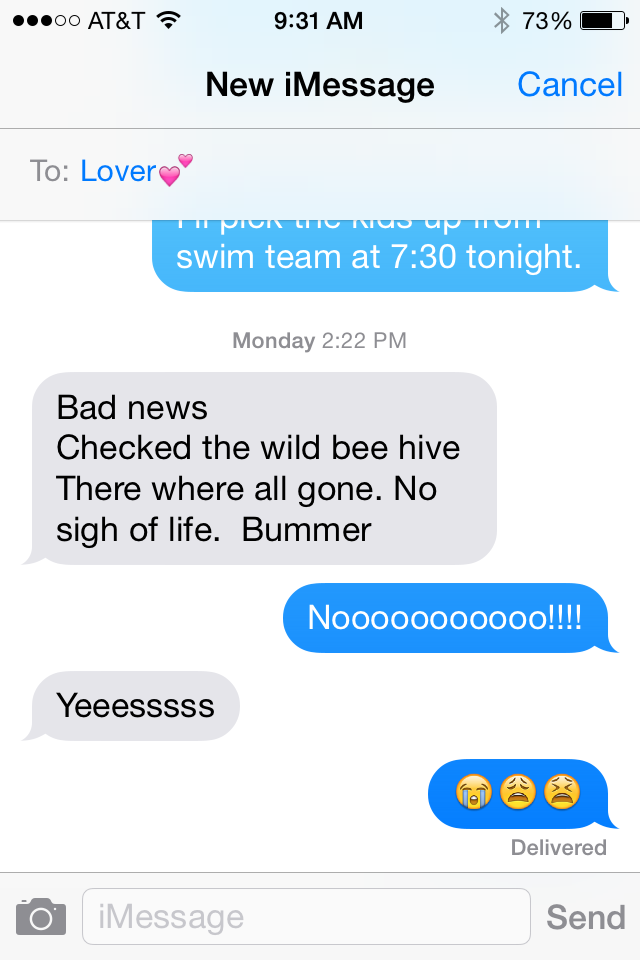
A recent text conversation between my husband and I went something like this:
First of all, ignore the typos. I blame the smartphone. It gets a little too involved. Second, there were not enough of those little crying emoticon thingees to portray the appropriate degree of sadness, despair, and outright terror I felt about the bee situation. The honey bees, our fuzzy four-winged friends responsible for pollination of about 70% of the foods we eat are dying by degrees and we, seemingly, are powerless to stop it. The story with the wild honeybees is this: READ MORE HERE…
I’m on vacation and and have been exposed to more television than one would think possible but then there is the time factor (lots of it) and the the guilty pleasure factor (also lots of it). During the usual course of work and life it hardly makes sense to squander precious time sitting in front of the hypnotic eye. But here I am on vacation, and find myself triggered into watching one of the dozens of food based productions so readily available on TV. Back in the protozoan era of television programming, of say, the GallopingGourmet or The FrenchChef, with Julia Child, the subject was cooking. Or good food. Or discovering what the French did with food that made it so freaking amazing (spoiler alert: it’s the sauce, cherie). Now, however, it seems that it is a competition about which nasty character can win the prize for the least disgusting dish whichincidentallylookstheprettiest. A show in particular caught my eye because it was all about pork. Pork belly, pork shoulder, pork haunch, bacon. Pig, pig, pig! It made me wonder: what is it about our love affaire with all that is porcine?
So okay, full disclosure, I’m a theoretical vegetarian. This means I mostly don’t eat meat which, by the way, isn’t easy. And I don’t ever want to be that person…you know, the one who will force the entire office to redesign the annual picnic to accommodate their very special diet restrictions because goddess forbid they should just shut the hell up and eat macaroni salad and be grateful to be included. But I digress. Back to the issue of pork. Honestly, I prefer fish but will indulge in duck or lamb if it’s locally sourced and not the product of a factory farm.
DOYOUKNOW HOWYOUROINKER MET ITS FATE?
I am pro-food. You’ll have to trust me on this. However, and increasingly, I am also pro-sustainability. Which factory farming is not. Just one hog produces 17.5 pounds of poo and pee per day. A theoretical farm of 1,000 theoretical hogs will produce 6 million theoretical pounds of waste per year. Most factory farms have more like 35,000 hogs…and honey, that’s a lot of poop to process. Factory farms keep pig waste in “lagoons” which sounds lovely, unless you live downwind or factor in oceans of antibiotics or gazillions of gallons of growth hormones swimming around in there. Or course, this chemical stew leaks and leeches into the local soil and eventually into the ground water, creating a bio-hazzard so so toxic on so many levels my heart spasms just to ponder it.
As animals go, pigs are clean, social, curious, and work collaboratively to solve problems, which makes them more intellectually advanced than many producers of reality television and some members of congress. I’m not suggesting that we give up our BLT or prosciutto-wrapped melon, I’m just saying that the price we collectively pay for our food should factor in what it takes to bring it to market.
Funny you should ask. You see, the federal government recognizes the beauty, the raw power, and the undeniable necessity of wetlands, not because of the commercial development value, but because of their intrinsic and strategic value in maintaining a healthy ecosystem.
Wetlands have three distinct parameters that earn them the title. First, they are water-saturated and can always be wet, like swamps, marshes, bogs and coastal wetlands, or seasonally wet, resulting from winter snow melt, and occurring in forested or wooded or open areas that collect standing water, and sometimes dry like ephemeral pools or streams which reemerge after a rain event and dry out with the sun until the next rain event. Second, their soils are hydric meaning that at least for some part of the year the soils will be immersed in water. Thirdly, they have more than less hydrophytic vegetation which simply means that this type of plant thrives in a water environment. Unless it’s an obvious wetland like a marsh or bog or coastal plain, a bit of scientific investigation is necessary to make a wetlands determination as it’s not always apparent to the naked eye. Permits are required to build in wetlands as well as avoidance and minimization of the planned disturbance and mitigation for whatever amount of wetlands are converted to uplands. It’s a bit of a complicated process, but with the federal government’s “no net loss”of wetlands policy, a crucial one.
Why, gosh darn it, are these mosquito-infested swamps so important? Well, wetlands act like a sponge. They control flooding, filter pollutants, and buffer storm surges like nobody’s business. The Mississippi Delta which is practically one huge wetland has over 40% of the wetlands in the lower 48 states and has lost over 1,900 square miles since the 1930’s. About two football fields worth of wetlands are lost every hour. It used to be that 50 miles of wetlands separated New Orleans from the next hurricane, but no more. Now storm surges and big winds have their way with her.
Philadelphia, was also a big wetland when the colonists first settled, but they ditched and drained their way to what is now known as Center City Philadelphia. The problem is not necessarily the conversion of wetlands. Many port towns around the coasts of our country were once inundated with wetlands and are now bustling metropolises rather than said mosquito-filled swamps, but overdevelopment, such as in the Florida Keyes and surrounding environs, has resulted in life out of balance. As coastal cities continue to build out, or develop their barrier islands beyond holding capacity, the 100-year storm which now seems to happen every five or ten years will continue to pound what used to be only shoreline, but is now littered with million dollar homes.
How many wetlands do we need to control flooding, keep pollutants out of our rivers and streams, and help blunt the surge of rising winds and tides? It’s a fact specific, case-by-case analysis, but as climate change forces sea levels to rise, I’d hazard a guess that we’re reaching critical mass in some of the more densely populated coastal areas, for example, the Jersey Shore. Maybe a few more acres of wetlands wouldn’t have stopped Hurricane Sandy, but they would have cut down way down on the property damage. As the sea levels rise, wetlands have become more important than ever. Insurance companies are keenly aware of this —pun intended —sea change, and have started charging more for policies on climate-threatened properties. Some are even suing municipalities to pay for the cost of global warming such as Farmers Insurance Co. did with some Chicago-area governments in a landmark class action suit filed on May 2, 2014 (Illinois Farmers Insurance Co. v. The Metropolitan Water Reclamation District of Greater Chicago District, et al., Case No. 14CH06608, in the Circuit Court of Cook County, Illinois).
By the way, about the frog: they are extremely important to the balance of the ecosystem since they eat bugs, filter our drinking water (tadpoles), and are themselves a source of food for other species, as well as the source of many medical advances for humans. Plus they make the most rockin’music! Unfortunately, they’ve been on the decline for the last 50 years with fewer numbers and more mutations because of a variety of things, but degrading water quality, habitat loss and overuse of pesticides are a few of the major ones. Frogs are to the ecosystem like the canary is to the coal mine. Their death is the first indication that there’s a problem and where frogs go, humans will follow.
We can’t all have beach front property, not at great public and personal cost, but we can all enjoy the beach. What is it the Buddha said? Everything in moderation? So for National Wetlands Month, go ahead and build that dream vacation home, but build it on a upland so tomorrow our kids will still have a frog or two left to kiss.
“It was early September and I was driving, literally, to the last road in the United States, a gravel-and-dirt road that paralleled the Canadian border, up in Montana’s Purcell Mountains. It was like going into battle, or falling in love, or walking from a wonderful dream, or falling into one: wading into cold water on a fall day.” – Rick Bass, Winter
Can Rick Bass help it if his Soul’s been on a nature walkabout for all of his life? In Winter [notes from montana], Bass’s wandering spirit is alive and well and living in the Yaak Valley in Montana without electricity, without heat, other than the wood-fired variety, and without much contact with civilization… To read more of this post, go here…
For thousands of years, we’ve used and reused the same water as the dinosaurs, Galileo, Genghis Kahn, and Jesus. Until now. Now the water is chock full of contaminants that the ancients didn’t even know how to pronounce. That’s because Mama Nature doesn’t know how to remove radionuclides, usually held safely within the earth’s crust, and other chemicals found in the fracking wastewater that’s slowly making its way into Her rivers, lakes, and streams. Until now, we’d been sipping the same stuff as Adam and Eve. Until now.
She died that night. Doc attended the funeral along with dozens and dozens of ranchers and their families all come to pay their respects to this great woman, one of the “stickers” whose family had come in the late-1800s during the first boom and bust era of timbering and mining and oil and construction and who had stayed on to make a living. They worked the land for what it would produce – cattle. So when the time came and they asked if anyone wanted to say anything on behalf of this fine woman, Doc’s hand raised itself, his body stood up, and he took over the funeral.
“Twila’s great-grandfather was thrilled when the first oil men knocked on his door with a check and a promise. They may not have tamed the harsh out of the land, but at least they made it more hospitable. They built roads and paid well, and the ranchers loved them. That was the heyday when oil flowed like free love out of those great big underground reservoirs. Sweet gas, they called it. Back then a whisper could’ve coaxed that oil out of the ground.” To read more of this post, click here…
On a bright spring morning, she rises from a long sleep as if from the dead. She sighs, she turns. She slips into yoga pants, the sports bra that fits like wrapping. The smart phone with its Audible Pema Chodron lesson on compassion (because she needs this, she decides and as she listens, realizes that compassion is just the start, chica), and plugged in, walks to the edge of the property, to the edge of the seasonal river. She breathes the sweet, wet, morning air, the fragrance of loam and blackberry blossoms, begins her walk. It is the month of earth day; earth month, and the coincidental interval of her return. This year the timing seems off. The rains have come late. The storms rage larger, a swirl of unpredictability. It’s not her doing, she tells herself. Pema says to make it about herself, that to say it is the other is only illusion. It’s all Bardo, baby. It’s all Hades, honey. It’s all One. We are all Ophelia, we are all Hamlet.
Persephone remembers to breathe and in the rush of air she lets go of the border between her thin skin and the slow river, the rise of moist air warmed by yellow sun, the speckled quail darting for the shadows. This is compassion, she realizes. I am the earth. She is me. Separation is only willful delusion.
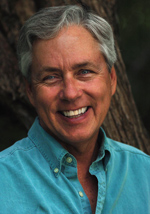
Just because Earth Day is done, doesn’t mean we are. Here, then, is another environmental warrior, pen poised in furtherance of the cause. If you haven’t read any of Carl Hiaasen’s environmental crime thrillers, you’ve been denying yourself. Read on…
It’s Earth Day, and you know what that means — Mom’s Birthday! Not your biological mother, but the Mother of Us All. Since it’s a holiday, we won’t dwell on all the intractable environmental problems that could potentially derail us as a species. We’ll save that discussion for another day. Instead, as a tribute to Mother Earth in all her, well, earthiness, here are ten things you can do to assure She makes it to Her next birthday and a few million after that.
1. Think globally. Act locally.
2. Eat organic.
3. Conserve water, and drink more water, too.
4. Walk more. Bike more. Drive less.
5. Plant a tree or a pesticide-free garden (but not a rose garden; too much fertilizer).
6. Sing. Yes, believe it or not. The planet is made up of sound so show your appreciation and join in Her song.
7. Become consciously aware. Every moment spent rooted in the present is one more you won’t miss. Enjoy it to the fullest.
8. Buy products that have a smaller environmental and carbon footprint, i.e. it’s okay if you can’t afford a Prius. Start small. Buying food sans excessive packaging that would end up in a landfill is perhaps just as important.
9. Reduce, reuse, recycle. Not just bottles and cans, but clothes, shoes, appliances, electronics, whatever you can.
10. Most importantly — vote with your wallet. As consumers, we hold tremendous sway over the products appearing on the shelves in our local markets. If you don’t like them, don’t buy them. And if you really don’t like them, vote with your feet and walk to another store!
Over the next few months we’ll talk more about these things individually, but for now, Happy Earth Day.
“I pray to the birds. I pray to the birds because I believe they will carry the messages of my heart upward. I pray to them because I believe in their existence, the way their songs begin and end each day—the invocations and benedictions of Earth. I pray to the birds because they remind me of what I love rather than what I fear. And at the end of my prayers, they teach me how to listen.” ― Terry Tempest Williams, Refuge: An Unnatural History of Family and Place Read more
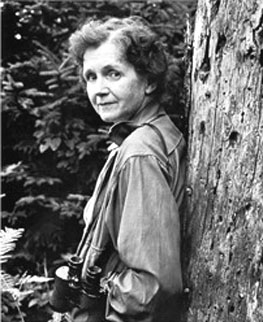
Throughout time, godparents have been an important, often undervalued resource in the raising of children, providing nurturing counsel and emotional sustenance to their charges. Maybe they didn’t grow us, but they provided strength, love, and an alternative point of view, the ally in our evolutionary corner, always ready to step in when needed. Even the Mother of us All could benefit from having one. Lucky for Her then that there was Rachel Carson, and lucky for us.
If Edward Abbey was the godfather of the modern environmental movement, then Rachel Carson was the godmother. When she penned Silent Spring, first published in 1962, Carson probably had no idea that it would be one of the most influential books of the modern environmental movement. Read More Here…




 persephone's step-sisters