we know what we like and we really like this book.
read our review then buy the book in honor of a girl you love. gr.
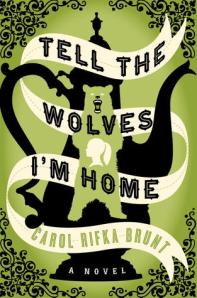

we know what we like and we really like this book.
read our review then buy the book in honor of a girl you love. gr.
 OIL IN WATER
Pam Lazos
Chapter Forty-Six
The day dawned bright and balmy in Houston. Bicky Coleman sat behind his antique mahogany desk, smoking a cigar and reading The Philadelphia Inquirer. Akanabi was taking less of a beating in the newspapers now that Hart was on the scene, commissioning overflights and vacuum boats, throwing all kinds of money at the situation. Maybe it would help them later when the feds and everyone else sued Akanabi out the wazoo for penalties the company didn’t deserve. After all, it had been an accident.
When Hart had called last night he babbled on and on about retiring all of Akanabi’s single-hulled ships. Bicky had humored him, but knew that suggestion would end up in the circular file.
“You want me to retire all the single-hulled ships?” Bicky had asked Hart.
“At least let’s phase them out. Fifteen to twenty percent a year.”
“Hart, my son, are you sure hypothermia hasn’t set in and affected that brain of yours?”
“It’s gonna hit you where it hurts, Bicky, but it’s the right thing to do. The river’s black like you’ve never seen. Just avoiding the devastation to wildlife should be cause enough.”
“Give me a memo. We’ll talk about it when you get back.”
Bicky had said that to shut Hart up; he had absolutely no intention of following through. Building new ships was an expensive proposition. More than half of Akanabi’s supertanker fleet were single-hulled ships, purchased in the heyday of oil drilling. To replace them all at once, even over a period of five years would cost hundreds of billions of dollars. And Bicky was loathe to spend that kind of money. Legislation would eventually force his hand, but why rush things?
The intercom buzzed and Phyllis’s voice jarred him to awareness.
“Jerry’s here.”
“Send him in.”
➣➣➣
Jerry Dixon walked in, looking grim, but impeccable. Bicky’s face was stuck in the paper so Jerry waited. Bicky had several personalities that didn’t always talk to each other, and Jerry thought it best to see which one was in residence.
Bicky looked up and smirked. “How many of those suits do you have?”
“I don’t know. How many do you have?” Jerry said, indicating Bicky’s Armani.
“You know what I mean. Do you spend the whole day ironing or change suits every ten minutes? Cause you know I’m paying you good money to keep things secure around here, so if you’re ironing….” Bicky’s smirk turned to a smile.
Jerry relaxed and sat down. “How’s Hart doing with the spill?”
Bicky studied his buffed fingernails. “Apparently something a little better than damage control. Seems he’s making friends.”
“What are the odds on the cleanup?”
“The river will survive. It’s rebounded before, as have countless of her brethren. It will do so again,” said Bicky, sounding like a Sunday morning TV evangelist.
Jerry scowled, a reflex. Akanabi could dump ten million gallons of oil in the river and Bicky would insist it was nothing.
“You have no faith, Jerry,” Bicky continued. “I’m not even sure if there’s a limit to how far you can go.”
Here we go, Jerry thought.
“Mother Nature is infinitely capable of rejuvenating herself.”
“Yeah, well, she’s not doing such a good job with the ozone layer,” Jerry replied. “I got a spot on my nose here that the doc says is pre-cancerous. Too many hours spent outside in an ozone-lite environment,” he said, rubbing his proboscis. “I’m getting it removed tomorrow.”
Bicky rubbed his own nose absently. His face bore a healthy, radiant glow that smacked of hours spent on a tanning bed. Jerry knew he kept one in an office down the hall. Some people used makeup. Bicky used processed UV light. Jerry wondered just how many of those “freckles” on Bicky’s face had their own story to tell and when they’d decide to start talking.
“Spare me the details,” Bicky said. He stood and stared out the window. “You don’t have any information yet, do you?”
Jerry shook his head, watched his boss, looking for clues.
“No. I’ve made discreet inquiries. No one saw anything.” Bicky flashed Jerry an angry look.
“The coroner says it was an accident, Bicky. Why don’t you believe that?”
“Graighton’s the only other one who knew Sonia had the report. He was at the Union Club that night. It’s only a couple miles to Sonia’s house….”
“You’re saying Graighton left the Union Club, killed Sonia and returned without the report?’ Jerry asked.
“Of course not. Graighton didn’t go himself. One of his lackeys did. You remember where we found the report? Whoever killed Sonia didn’t find what he was looking for. Maybe that’s what angered him in the first place.”
“But what would Graighton gain by killing Sonia and stealing a report he already had a copy of?”
“He was trying to get to me. Put me in my place.” Bicky sat down. “Even that doesn’t make sense.” His head fell against his chair. “Just keep looking.”
“Yeah, sure,” Jerry said.
“One more thing,” Bicky reached into the top drawer. “I want you in Philadelphia.”
“For….?”
“I got another tip.” He handed Jerry a piece of paper. “Recognize the address?” Jerry’s eyebrows shot up, but he said nothing.
“Don’t botch it this time. No commando missions. Nothing getting blown up. No one dying. Just bring me back the technology. You got it?”
Jerry nodded, a face set in stone.
“You’re sure you found out nothing else…about Sonia?” Bicky asked.
“You think I’m not doing my job, old man?” Jerry’s face remained cool and impassive.
“I think, that you’re too quick to accept the opinion of other’s. What’s that jackass coroner know?”
“She had an accident. She died. Accidents happen.”
“Accidents don’t just happen. Not to us. You should know that better than anyone, Mr. Chief of Security.”
“You’re wrong. They do. But what precipitated it? That’s the question. Perhaps she was depressed, worried about her husband, flustered. Or maybe something spooked her. Or someone.” Jerry placed his hands on the front of Bicky’s desk and leaned into it. “Came around hassling her for something she wasn’t inclined to give. She spills her drink. The floor’s wet. She takes a step. She slips. She falls. A body in motion stays in motion. She can’t stop herself from falling. She bangs her head and, is out like a light. And if the baby didn’t decide to come out at that moment, if he didn’t decide to come out upside down, what do they call it, breach? Maybe she’d be alive today. The fact is, unless you were there,” Jerry looked Bicky directly in the eye with malicious intent, “you’re never going to know.”
Bicky shuddered. After several seconds, Jerry stood up and backed away from the desk. He massaged his eyes and forehead with one hand, trying to squeeze the images out of them.
“I loved Sonia like she was my own kid. That she’s dead pains me – like you can’t even believe,” Jerry said. He turned and was gone, an exit as quick and silent as death.
Bicky let out the breath he’d been holding and pulled a silk handkerchief from his breast pocket. He wiped his face and dabbed at the moisture forming in the corner of his eyes.
So far, it had been a hell of an afternoon. He walked to the wet bar, poured himself a scotch and soda and stood at the window sipping it. The world below soothed him. He could control it simply by pulling the blind. When he finally turned away, he pulled out the bottom desk drawer. Below a stack of papers, tucked in the bottom drawer, lay the coffee-stained report. Satisfied, Bicky closed the drawer and thumbed through a stack of mail in his in-box. Phyllis had opened everything, laying it in a pile for his review except for one letter, marked personal and confidential. He ripped the envelope open and pulled out a small stack of papers.
It was a letter from Kitty’s lawyer, a Complaint for Divorce and a Postnuptial Agreement with which she proposed to divest herself of everything just to be rid of the marriage. Bicky sipped his scotch for five minutes before pulling a yellow sticky pad out of a side drawer. He placed one on top of the lawyer’s letter, wrote Forget It! in bold, black ink, and stuffed the papers back into the envelope. Then he buzzed Phyllis.
“Is Jerry still here?
“He just went down.”
“Catch him, will you, and tell him to come back up. I want him to deliver something for me. To my wife.”
to be continued. . .
to read how we got to this state of affairs jump here
copyright 2012
 Journal THAT
a guide to writing
Cynthia Gregory
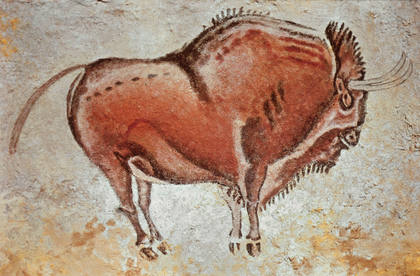
Like photographs, clichés are the shorthand of communication. If a picture truly is ‘worth a thousand words’ (a pretty cliché) it’s because its cash value rests on the fact that the ancient part of the brain, the primitive lizard brain, the dreaming brain, communicates with pictures. I mean seriously, think about it. Before written language, our ancestors drew pictures of actual horses to represent “animal” or “the hunt” or “wild and free” before there were actually spoken or written words to convey the ideas. Now, however, we are wildly sophisticated and have a language (or two) that we can manipulate to communicate otherwise free form ideas floating inside our cabezas.
Storytelling served as a history lesson before written language, and storytelling today is as popular around the campfire, board room table, or cafe four-top as ever. Stories are innately wired into us and as humans, we crave and respond to the story. The stories of our lives, our novels, movies, television and cable news, are a series of pictures – both visual and virtual. Actual photographs and pictures illustrate a narrative we may tell, as in “see? I was in Paris – here’s the Eiffel Tower,” or “here’s a photo of little Sophie Soo, ten years old.” In each case you may be telling a story, constructing a narrative and sharing information about your travels and your dog, backing your verbal story up with photographic evidence. So yes, pictures are worth thousands and thousands of words.
And if all those wonderful words at our fingertips were colors, original ideas are bright, clear fountains of rich hues, and clichés are dull as dirt.
The trouble with clichés is that they are so infused into our daily language, we hardly recognize them for their trite, frayed selves. Advertisers know this. They know that people are put off by formal language, fancy words, words that stand up straight and march with a snap in their step, so they dumb down marketing messages, intentionally inserting clichés so that their uber-sophisticated messages sound “down to earth” (cliché!) and “right as rain” (cliché!). Television programmer know this too, and make sure our televised stories don’t get too smarty pants, else run the risk of losing viewers –although because of the trance-like fog I fall into when I tune into a program I happen to enjoy, “viewing” isn’t exactly what I’d say I was doing. I’d bet a nickel that not one filter remains intact with all that bad, cliché loaded language comes washing over me. While some programs are brilliantly written, most programming I’ve observed seems to be no more than 30 minutes of tired ideas strung together. So when you think about all the hours of programming and bad language we’re exposed to, it’s no wonder we’re up to our eyeballs in clichés.
So, if everybody is guilty of crimes of language abuse, then it must be okay, right? In the words of mothers everywhere, “just because all the kids are doing something doesn’t’ make it right.” Clichés have their place, which is definitely not between the covers of your journal. You want your journal to be clear, concise, absolutely fecund with the rich details of your life, so absolutely pitch-perfect that with even a quick glance, you inspire yourself to write. Even. More.
So, once in a while work your language muscle a little harder. Avoid the flabby turns of phrase. Jettison the flaccid prose that comes so easily. Instead, read an amazingly genius writer and then journal. Turn the TV off, and journal. Instead of taking the easy way out and dropping in an over-worked and sad sad sad cliché and reach for something original. You may just surprise yourself with your own genius.
we read and then we talk about it. it’s what we do.
when we’re not writing, we’re reading. among other things. read all about it here.

Journal THAT
a guide to writing
Cynthia Gregory
There are good adjectives and bad adjectives. There are the regular, hard-working-show-up-in-the-middle-of-the-night-but-go-unnoticed adjectives and then there are what I call the 25 cent adjectives. You know the kind, all flashy and shiny and bright, the kind you notice more than the noun that they’re describing. They’re like fast food; they temporarily distract you from the fact that there is nothing of substance behind them, they are the literary equivalent of a plate of whipped cream.
I know a lot about these razzle-dazzle kinds of describers, these peacocks of poetry. I used to scatter them around liberally, clever as I was. But what happened when I really got rolling, is that the point I was trying to make got totally buried under my ponderous prose. My meaning sagged under the weight of all that reckless description. My language got so pearly and polished that everything I wrote began to sound like a steaming, verdant jungle, packed with all the lush pomegranates, mangoes and papayas of meaning I could wedge in. I mean seriously, an old pair of scruffed sneakers with one broken lace is a perfectly respectable sort of description. But when I got done with it, those Keds sounded like Ritz Carlton glass slippers.
What happened when I began to excavate the core of my message, the humble meaning of my narrative began to emerge as I sliced away one fabulous phrase after another. Everyone knows by now the famous story of what Michaelango said when someone asked how he knew how to carve the statue of David – he said, “oh, I just got rid of what didn’t belong.” You need to do the same with your descriptive language. Pare it down, pare it the hell down. Make it lean and mean and dense. Never use a twenty-five cent word when a nickel will do.
Many people mistakenly think that a short story is easier to write than a novel, because it’s more compact. They think that a poem is even easier, because there are fewer words yet. But the exact opposite is true. Did you know that? The shorter the piece, the harder it is to write. This is because with fewer words, every one has to count. There is no room for extra padding, no place to hide. There are no long stretches of narrative, expeditions into expostulation. You have to say exactly what you mean. Every word, every verb, has to carry the weight of the sentence on its meager back, so it must be strong, and it must be absolutely true. The shorter the writing, the denser it becomes. Not dese heavy, just dense: full of meaning; ripe as a summer peach, juicy and succulent.
It’s easy to see why people fall in love with a flush of flabby, fatuous descriptions; because they mean nothing. We’re a TV culture after all, we’re used to that. Flamboyant descriptors are like a magician’s trick, a sleight of hand. Honest writing, writing from the heart, strips you naked. It’s much easier to hide your fragile heart behind a veil of words. But that takes no courage. If you want to journal, you must be brave. You must go into the room you’re afraid to enter and stay there until you have emptied yourself out. And the next day, you must go in there again. You can never completely empty yourself through journaling. There is always something more, something deeper, something rich and rare and precious because it comes from within you. It comes from a place beyond the glittery surface. It comes slick and dark and wet and you must love it. You must stay with it until your heart stops quaking in your chest and you must put it on the page, make it authentic. This is real courage. This is what true love is made of: entering into that place that terrifies you and staying there, listening, writing, watching, recording it all, until the quiet enters and the writing is complete.
Sometimes you will flow with a million thoughts, like droplets of water over Niagara Falls, and there is nothing wrong with that. I would like to suggest however, that there is a balance. If you can practice both ends of this particular writing scale, you will become a better writer. When you sit down to write, think simply. Don’t think you have to impress anyone, to show off. You have an audience of one, and its you.
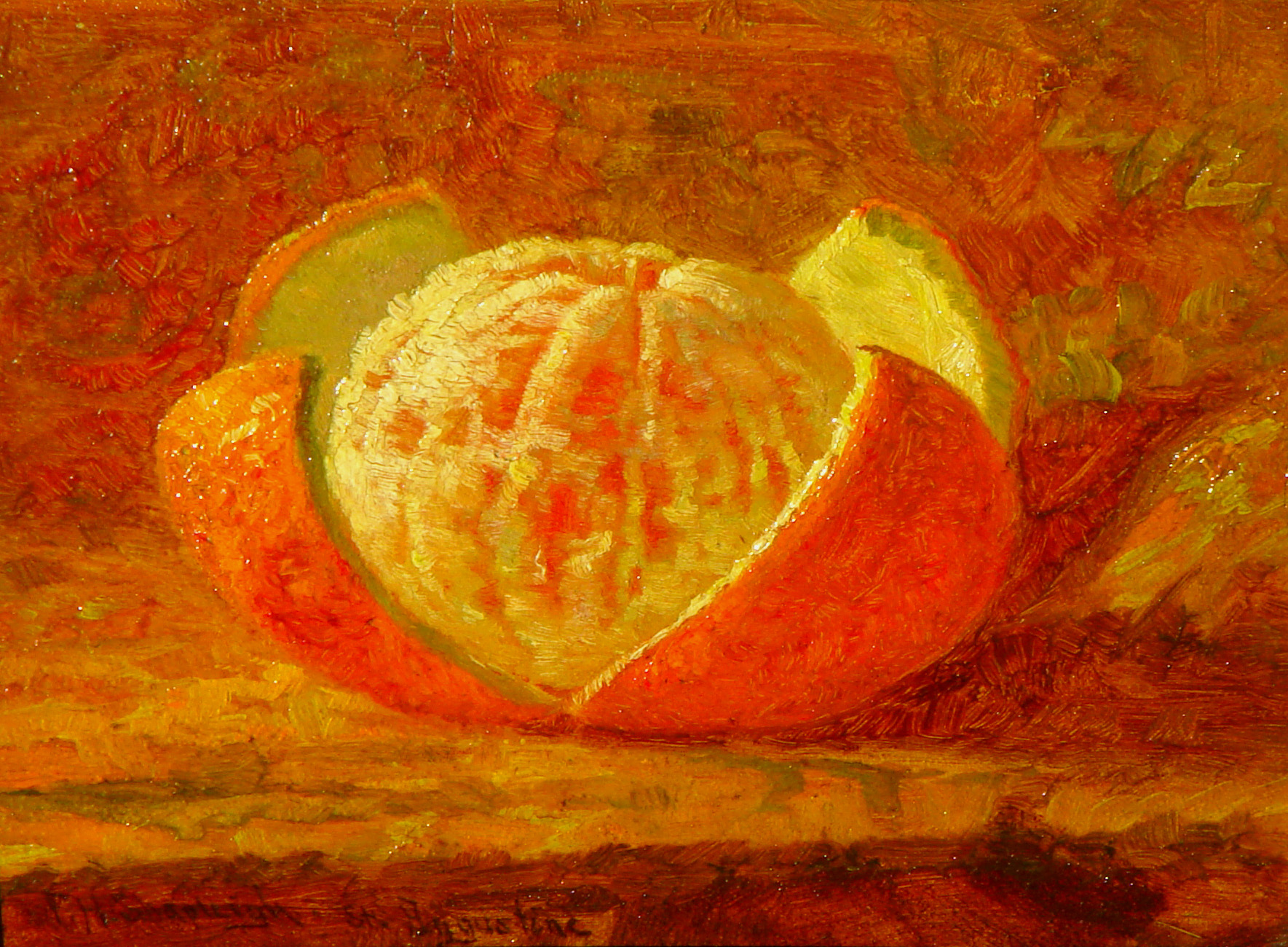
Here is an exercise that will illustrate what I’m getting at. Sit with your journal and an orange, in a quiet place. Write for fifteen minutes describing the dimpled orb of fruit without using the word orange more than once. Go into that room and stay there. You can riff on the orange if you want, start with the fruit, talk about the blossom or the orchard, or the hands that harvested the one you hold in your hand, but Don’t use the word orange more than once in your description. You can use another fruit if you wish, but the same rules apply. So chose a plum, but don’t use purple. Or choose an apple, but don’t use red or green. You get the point. Hold yourself apart from using the descriptor that is most obvious, and what you get in return is a whole new way to relate to description in general.
Be objective, be a journalist. Pick up the newspaper and read an article about an event. Journalists use the fewest adjectives than just about any writer, and most of those are worth a nickel. They don’t say “it was a stunningly sunny day with chalky clouds dotting the horizon.” No, they say, “the day was warm, with scattered clouds.” Period. There is an elegance in that kind of simplicity. Practice being a journal-ist. Practice simplicity with your journal. And be patient with yourself. This stuff takes practice.
we couldn’t make it any easier for you so please just read it now.

meanwhile back at the ranch, we’ve got a whole lotta blushing going on


 persephone's step-sisters