The Sedentaries

                     standing desk

Get On Up

Something’s been happening and I couldn’t figure out whether it was systemic or localized until now. I call it weight creep, as if putting a label on it makes it easier to deal with, even when I know that ’s not the case. Rather, by putting a label on it, I’ve made an enemy, and the enemy is known as “desk butt”.

First it was baby fat, as in “she still hasn’t lost her baby fat.” Of course, chubby legs at 10-years old can no longer be considered baby fat, but I played along. When I joined the swim team, exercising hard three hours a days, that “baby fat” dropped away, replaced by smooth, supple muscles. Then came college and since I was no longer on the swim team, the “Freshman 15” was my reward. Nothing spurs on a midnight chip and dip run like attending a frat party with lots of beer and no food. It’s a perfect storm of bad carbs, and if the beer doesn’t give you a hangover, the double dose of fat from the chips and dip will. But I knew how to exercise this time around, knew the merits of an elevated heart rate, so I started running and playing squash and by Sophomore year, I self-corrected.

Fast forward to my first desk job. I lived in Philadelphia so I walked to work. I was a paralegal in a law office and I sat practically all day, but I walked the office a lot, too — the file room, the break room, the bathroom, various offices of lawyers with whom I needed to speak. Plus I swam a mile before I got to work and usually rode my bike for an hour after work unless it was too cold. Nothing but exercise at every available opportunity which meant no weight creep in my twenties. Sweet right?

Fast forward to marriage. I moved to Central PA in my thirties, but still worked in Philadelphia, a two-hour commute. Now I’m training it into work every day rather than training at the gym and struggling to get a work out in. Those were the hard times, but after a year, my workplace started a flexiplace program that allowed me to work at home a day a week and suddenly exercise was back on the menu. Then the baby came and the baby weight, but since I was exercising and nursing, it came off again. Ah, the miracle of the human body.

Except for now. Thirteen years later, I am still exercising, eating plenty of salads and walking from the train to work (a shorter walk, but still a walk), and guess what? The magic is gone. The weight doesn’t leave with an extra bike ride or a missed meal. It stays and stays, socking itself in for a perpetual winter, as if in preparation for the apocalypse. Rations will be low…. Not everyone will survive….

I’m part of a growing epidemic of office workers who are simply “Sedentaries” (not a noun or even a word, but it should be!) which is what I’ve taken to calling people who sit all day long and who are experiencing the same weight creep or desk butt that I am. We humans spend more time sitting these days than we do sleeping. I typically sleep 6 to 8 hours a night. My work day starts at 6:45 a.m. with a 10-minute drive to the train followed by a 1.5-hour train ride. I walk 15 minutes from the train to work, and sit for up to 8 or 9 hours once I get there with a 30-minute walk at lunch if I’m lucky. Most of the time at work is spent in front of a computer, about 7 hours in the sitting column minus the walk at lunch and the walking around the office. When I get home, I sit in front of the computer working on the project de jure for a couple hours, maybe watching a little T.V., and voila! I’m sitting way more than I’m walking, standing and sleeping combined. While most days I get an hour of cardio at the gym, experts say it’s not enough to right the wrongs of sustained sitting.

Here’s why. You’re sitting, you’re sitting, you’re sitting, and your glutes (gluteus maximus, gluteus medius and gluteus minimus) and hamstrings are being stretched like a rubber band while your hip flexors are shortened. Think of how a rubber band looses elasticity if it’s under a constant stretch and how inflexible your muscles become when you don’t stretch them. Your breathing becomes shallow, and overall, your muscles become weaker, softer, lesser. Health problems could include obesity, high blood pressure, high cholesterol, loss of flexibility, heart disease, etc. and as a result, you begin a slow, at first unnoticeable creep toward the next pants size while in a show of solidarity, the rest of your body takes on a jello-like appearance.

Do you want to avoid your muscles’ slow death march into uselessness? If your answer is “heck, yeah,” then moving around, rather than a trip to the gym is the key not only to a normal weight, but to a longer life, and obesity expert, Dr. James Levine has the research to prove it. Studies show that lean people move around more. They find and utilize walking opportunities; they stretch; they fidget. (Yes, fidgeting will keep your weight down!). So, like James Brown, you gotta Get On Up — from your chair, the couch, your desk, the car, whatever — and move around, get your heart rate going, and start the electrical conductivity that pulses through your body when you do. I’m not even advocating high-end exercise to beat this condition, although it certainly will help. Just to be clear, I am in no way advising you to ditch your gym membership. (I go almost every day.) I am simply iterating that the gym alone is not enough and advocating against sedentariness as a way of life.

Here are 10 ideas to get you moving that won’t require a radical life-style change:

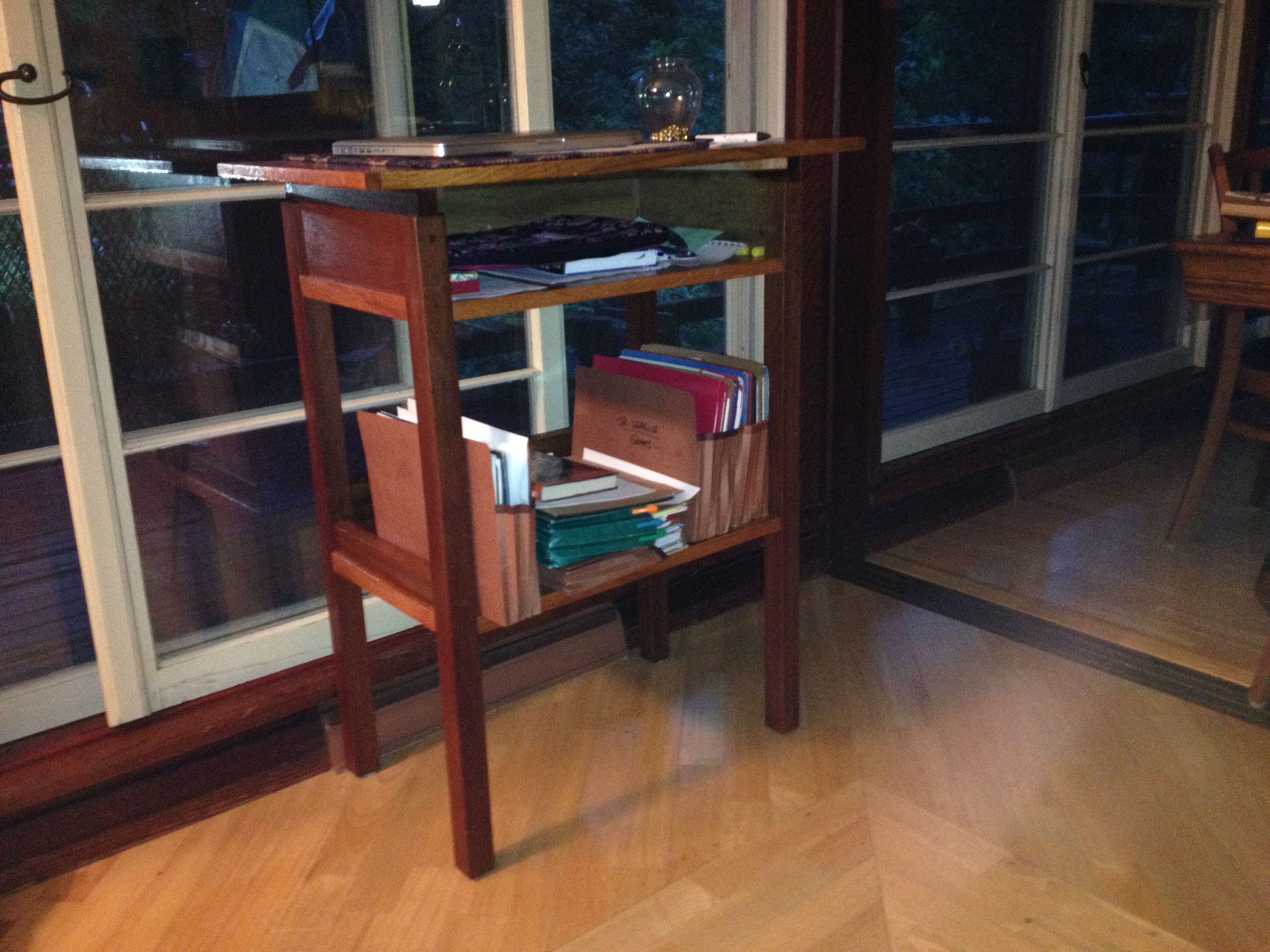
1.  Make or build a standing desk or create some version of it. My father-in-law built me one. It’s fantastic. It has a little shelf to put paper and pens in, and another one below where I can stack my files. I put the desk in front of the window so I could look outside. Sometimes I do squats while I’m standing there. Or leg raises. Or yoga stretches. It’s awesome.

2.  Take the stairs whenever possible — at home, at work, at the mall. There’s a reason the Stair Master was so popular. So get climbing.

3.  Walk the floors every hour. Maybe practice the Ministry of the Silly Walk (you Monty Python fans know what I’m talking about). Use your phone or computer and set an alarm to get up regularly from your desk and do a loop around the office. Working from home? Even better. Loop the yard, go pick up the mail, take the dog out and circumnavigate the driveway.

4.  Get up and stretch. After too much time, your butt conforms to the shape of your chair, and no matter how high end or ergonomically correct, it’s still a chair and your butt should not look like it. Go to yoga after work or practice in your home before you leave for work.

5.  Get an ergonomically correct chair and adjust it to lean back slightly rather than forward. The forward hunch shortens all the muscles in your stomach and hip flexors while the backward lean works the abs, so work it baby!

6.  Start a salsa (or whatever) club and meet during lunch. Where I work in Philadelphia, there is a dance party every day at noon in LOVE Park. They have a little stage, and an area dedicated to dancing, and a microphone and speakers, a little canopy area where the DJ or band stands, the whole shebang. A whole crowd of people get out there and line dance. It’s awesome, dozens of people, shaking their booty at lunch.

7.  Chair dance. When I was a baby lawyer, I worked in an overcrowded, out-dated office with a view of Billy Penn at the top of City Hall in Philadelphia. Because we had more lawyers than offices, we had to double up, which means I had an office mate, and every afternoon, before the 3 o’clock slump set in, we stopped what we were doing, stood on our chairs and danced for a few minutes. Because the chairs had wheels, and rocked somewhat, it took a good deal of balance to stay up. Plus the bonus ab work we got from laughing so hard made it a win-win.

8.  Flap. Want to know what the profession is with the longest shelf-life? Music conductors. Yep. The guys who stand in front of an orchestra. There’s something about all that arm-flapping that’s good for your heart. So even if you don’t have a 20-piece band in front of you, start flapping.

9.  Drop and give me twenty. When was the last time you did 20 pushups? Not only is it good for your heart, abs and arm strength, you’re moving again.

10.  Take a walk after dinner. Probably my all-time fav, the after dinner walk is like a digestif. Not only does it aid digestion, it puts closure on the meal and the day, allows you an opportunity to take in the sights and smells of the natural world, and gives you some extra time to talk to your family or friends. So grab your spouse, your kid, a friend, the dog, whoever, and take a walk!

Pam Lazos  7.28.14

don’t reuse that water bottle

goodbyeDear Water Bottle, We’ve had a beautiful romance, but I’m breaking up with you. It’s simple, really: I’ve learned that you’re a slow poison, and that just doesn’t work for me. In my quest to compost and recycle more I have been studying the various plastics in my life, which until now, I’ve considered a convenience. Well, an evil convenience, but still. Oh Plastic, you have made my life easier, but the fact remains that when the landfills are overloaded and when the Pacific Island of Trash manages finally to put us in a collective gasping choke-hold, I will have no one to blame but myself.

Here are five everyday plastics and why I need to rethink them:

#1 : The most commonly used plastic and can be found in microwavable food trays, water and juice bottles. This plastic absorbs bacteria and should not be reused.

#2: A stiff plastic used in toys, plastic lumber, picnic tables, detergent, household cleaner and shampoo bottles. This plastic is nearly neutral and can be recycled to make detergent bottles, floor tiles, pens.

#3: PVC is a soft, flexible plastic used to make teething rings, toys, cooking oil bottles clear food packaging, mouthwash bottles. Sometimes called “the poison plastic,” it contains phalates that interfere with hormonal development.

#6:  Polystyrene is used to make disposable cups and plates, egg cartons, take-out containers. This material leaches  styrene, a carcinogen, into food (especially when microwaved) and should be avoided.

#7:  Polycarbonates are used to make baby bottles, sippy cups, three and five gallon water jugs. Contains bisphenol (BPA), which migrate especially if heated, and has been linked to heart disease. BPA, is a xenoestrogen, a known ednocrine disruptor.

So you see Water Bottle, it’s over. You and your extended family are simply toxic and I’m done with you.  Now that I know, I will recycle your ilk whenever possible and avoid the worst of you when I can.

Ciao, baby.

Bee Serious

And Then There Were None

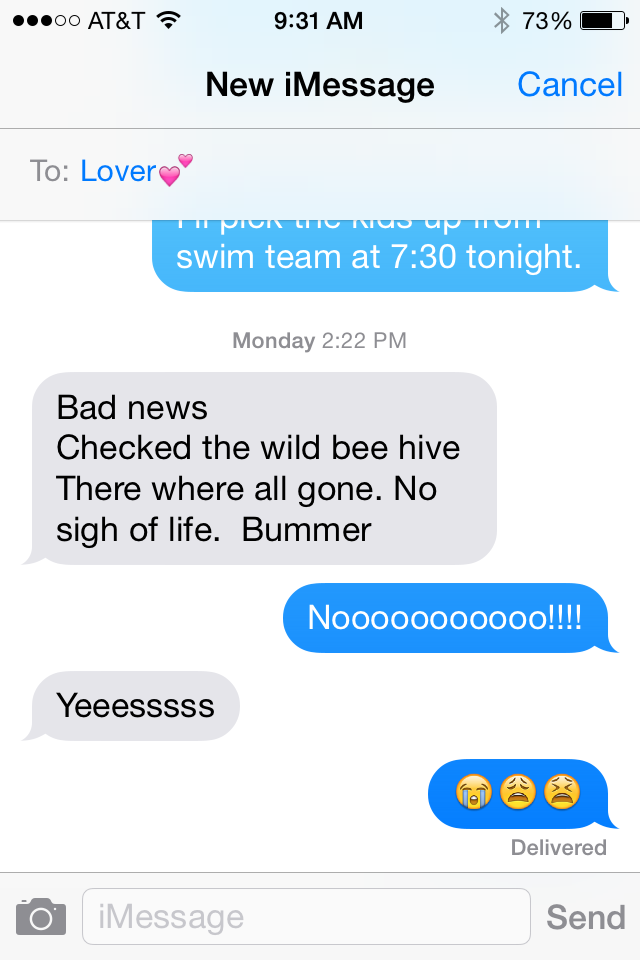
A recent text conversation between my husband and I went something like this:

bee text

First of all, ignore the typos. I blame the smartphone. It gets a little too involved. Second, there were not enough of those little crying emoticon thingees to portray the appropriate degree of sadness, despair, and outright terror I felt about the bee situation. The honey bees, our fuzzy four-winged friends responsible for pollination of about 70% of the foods we eat are dying by degrees and we, seemingly, are powerless to stop it. The story with the wild honeybees is this:  READ MORE HERE…

first day

champion

Do you remember your first day of school?  I remember that I was excited, but I can’ recall more detail than that. I imagine now that when I got home that day, I drove my mom mad with details about amazingly cool! things like chalkboards, desks, coat hangers, paint boxes. No detail was too small, too mundane to be spectacular!

What would it be like if you found everything around you to be new and amazing, if the world was an exciting place to wake up to every day?

We’ve become so conditioned to our habitat, our customs, that we’ve simply stopped noticing anything that appears less than epic. But to a child, a Cheerio is an act of magic! A school bus is a marvel! An artichoke ­spectacular!  Do you sometimes wonder where the wonder went?

No, you are not too old, and unless you really insist, too stuck. You can retrieve it by tuning back in to your enormous and innate powers of observation. They’ve always been there, but over time you got busy, started to ignore them, and they went to sleep from lack of use. No worries, you can get them back by waking them up and putting them to work. Again, and again. Repeatedly.

Our brains have amazing aptitude for recording detail. We hear and see and smell things all the time. We are aware of temperature, texture, weight, balance, language, color, relative safety or danger, constantly. Your conscious brain may be focusing on having a conversation with your hair stylist, but your subconscious, the primitive part of the brain is calculating and recording every detail in a ten foot radius, from the height of the display shelves to the left and the colors of the bottles on them, to your proximity to the door, to the relative humidity of the cool air brushing your skin, to the inflection in your stylist’s voice and whether the smile on her mouth matches the smile in her eyes.

You must think like a reporter. Reporters are trained to see what’s going on, to put the evidence together like pieces of a puzzle, and draw conclusions. You need not come to any grand conclusion from your observations, but observe, you must. You must begin to see the world not in broad strokes; ‘oh, there’s a school,’ and ‘oh see, there’s a dog,’ but in very detailed specifics. Go overboard! Scrape as many details up as you can. You can never be too specific. While you’re looking at the world around you and may be tempted to get lazy and summarize the vista spread like a banquet before you, but don’t fall for that old game. You will surely regret it. You will regret it because you will forget it. You will not remember the exact butterfly pattern on the bobble-head girl’s dress who knocked into the boy at the park playground and made him cry. You will not remember that the scruffy grey dog that dropped a stick at your feet and smelled like week-old salmon and sported one blue eye and one brown. You will not remember that on that particular day, you savored a peach flavor popsicle and that the clouds marched like a row of cream puffs against a sky so blue it made your eyes ache. You will not remember these things and you will not develop a knack for populating your writing with a thousand details unless you begin to flex that muscle of observation and put it to work.

Journal keepers all agree; when you go back and read through the books stacked neatly on your bedroom shelf, when you randomly open a book to a page and scan, it completely brings you back to that day at that cafe in that town, and remember everything about it because on that sultry afternoon fifteen years ago, you sat over an iced coffee, threw crumbs to feed the sparrows, and you wrote in your journal. You took a snapshot of your life -not a fuzzy half-focused one, but an honest to God totally naked look at all the florid details that filled your life for just one miraculous day. You wrote it down as a gift to your future self, and oh my. The sensation of reliving a day you had completely lost track of While you were busy raising children, managing a career, writing a book, caring for parents, making lobster costumes for Halloween parties, baking cookies, loving a spouse, is pure; it is delicious.

 Each day is miraculous in about a million ways, but we humans have a short memory. Then another day comes, and the previous day gets tossed into the comer. And then we get another one! And another one! Pretty soon, there are thousands of such days and I don’t care how good your memory is, how many synapses you’ve got firing, how Leica-like your brainpan is, you can’t remember it all. That’s what a journal is for. Grab your journal and before you open it, open your ears and open your eyes. Learn to observe. Be an anthropologist. Be objective. Be brave. Walk into a coffee shop with nothing but a smile and a journal and sit yourself down at a comer table. Situate yourself with your coffee or your tea, and peer into the room around you. I mean, really look. See things like you had never seen them before and you were taking notes to retreat back to your home planet and report on the customs of the natives in your neighborhood. The man at the next table may be wearing glasses and reading a paper. Okay, good details. But what color are his glasses? What shape? Is the paper he’s reading an international journal or a gossip tabloid? The details tell a story. You can say the girl wore a dress. Okay, many girls wear a dress. But ‘the girl word a red dress’ tells us that maybe she’s a little fiery, a bit of a firecracker. When you fill your journal with details, you bring your images alive.

So get out of your comfort zone. Take a vacation from the familiar. Stop acting like you’ve seen and done it all, because cynicism is just boring. Train yourself to see your world like you’ve never seen it before. Begin to pay attention to the details, at least some of the time. Fill your journal pages with the flavors of your exotic life. You may not think your life is anything special, but I bet you dollars to donuts someone on the other side of the planet thinks it’s gosh-darned amazing. So act like it. Act like your life is a rich stew of tasty details, and write them down.

C. Gregory

as pigs fly

praying mantisOF FOODIES AND FOOLS

I’m on vacation and and have been exposed to more television than one would think possible but then there is the time factor (lots of it) and the the guilty pleasure factor (also lots of it). During the usual course of work and life it hardly makes sense to squander precious time sitting in front of the hypnotic eye. But here I am on vacation, and find myself triggered into watching one of the dozens of food based productions so readily available on TV. Back in the protozoan era of television programming, of say, the Galloping Gourmet or The French Chef, with Julia Child, the subject was cooking. Or good food. Or discovering what the French did with  food that made it so freaking amazing (spoiler alert: it’s the sauce, cherie). Now, however, it seems that it is a competition about which nasty character can win the prize for the least disgusting dish whichincidentallylookstheprettiest. A show in particular caught my eye because it was all about pork. Pork belly, pork shoulder, pork haunch, bacon. Pig, pig, pig! It made me wonder: what is it about our love affaire with all that is porcine?

So okay, full disclosure, I’m a theoretical vegetarian. This means I mostly don’t eat meat which, by the way, isn’t easy. And I don’t ever want to be that person…you know, the one who will force the entire office to redesign the annual picnic to accommodate their very special diet restrictions because goddess forbid they should just shut the hell up and eat macaroni salad and be grateful to be included. But I digress. Back to the issue of pork. Honestly, I prefer fish but will indulge in duck or lamb if it’s locally sourced and not the product of a factory farm.

DO YOU KNOW HOW YOUR OINKER MET ITS FATE?

I am pro-food. You’ll have to trust me on this. However, and increasingly, I am also pro-sustainability. Which factory farming is not. Just one hog produces 17.5 pounds of poo and pee per day.  A theoretical farm of 1,000 theoretical  hogs will produce 6 million theoretical pounds of waste per year. Most factory farms have more like 35,000 hogs…and honey, that’s a lot of poop to process. Factory farms keep pig waste in “lagoons” which sounds lovely, unless you live downwind or factor in oceans of antibiotics or gazillions of  gallons of growth hormones swimming around in there. Or course, this chemical stew  leaks and leeches into the local soil and eventually into the ground water, creating a bio-hazzard so so toxic on so many levels my heart spasms just to ponder it.

As animals go, pigs are clean, social, curious, and work  collaboratively to solve problems, which makes them more intellectually advanced than many producers of reality television and some members of congress. I’m not suggesting that we give up our BLT or prosciutto-wrapped melon, I’m just saying that the price we collectively pay for our food should factor in what it takes to bring it to market.

Bon appetit, baby!

http://youtu.be/6jhGKIkgTcQ

<!–more–