devils at the door

lucifer1OIL IN WATER

Pam Lazos

Chapter Seventy-Three

As Gil’s slippered feet hit the carpeted stairs, Kori was opening the front door. Gil froze. Sunlight blazed in through the door obliterating the man’s visage, but Gil could see the silhouette looming and spreading across the space between the door frame. Kori exchanged pleasantries which Gil didn’t catch because his ears were buzzing. She gestured toward Gil on the stairs and the large man in the Armani suit stood in the middle of the living room moving his mouth, but with no sound coming out. The man smiled his giant toothy smile, waiting for Gil to say something, Gil was sure. Kori slammed the door behind the man and Gil ducked at the sound. The man had one foot on the second stair now. Gil’s throat emitted a strange noise, even by his standards, as the man held out his hand for a shake. Gil grabbed Max by the collar, ran upstairs and locked himself in his room.

➣➣➣

Bicky stood with his foot on the stair, his hand outstretched in the gesture of greeting. He watched Gil’s lithe body retreat until he crested the top of the stairs and disappeared. Bicky turned to look at Kori, his arm still outstretched.

“Was it something I said?”

“He gets like that. He’s really smart. It comes out in weird ways.” She ran a hand through her hair and looked Bicky over, the Armani suit, the soft hands with nails more expertly manicured than her own. “Maybe you want to come back after breakfast? He’s usually pretty communicative after a meal.”

Bicky’s face contorted into something that had the capacity to be a smile, but fell short somehow.

“How about I talk to you for awhile?” Bicky said.

Kori shrugged. “I guess that’s okay.”

“Maybe your other brother, too. Is he home?”

Kori narrowed her eyes and opened her mouth as if to speak.

“The newspaper article,” Bicky said, intercepting her query.

“Oh. Okay.” She turned and led him to the kitchen. Avery looked up from reading his magazine, but his expression did not change.

“Avery, this is Mr. Coleman. He owns Akanabi Oil. He wants to talk to us about the TDU.” Bicky held out his hand for a shake, but Avery ignored it. Instead, he stood, coming eye-to-eye with Bicky, and sneezed.

“Excuse me,” Avery said, and walked around Bicky holding a hand over his nose to hide the runny mucus. He sneezed again, grabbed a few tissues and blew out a noseful of snot. He tossed the tissues in the trash can, then held out his hand to Bicky who dropped his own hand to his side. Avery sneezed again, but it was only the first in a continuing series.

Kori counted ten sneezes before she said, “Why don’t we go sit in the living room and wait until Avery’s done.” Bicky nodded and retreated. Kori glanced back over her shoulder to see Avery pulling out the tissues three and four at a time.

➣➣➣

Bicky settled himself in an armchair as Avery continued sneezing in the kitchen. Neither Bicky nor Kori noticed Gil sitting in the shadows at the top stairs, peering through the banister.

“So, I read about you kids in the newspaper. I understand you’ve invented an amazing new piece of equipment.”

“Actually, we didn’t. My father did.”

“Yes. I’m sorry about your father,” Bicky said with as much emotion as he could muster.      Kori nodded, sighed and drew a deep breath. “We don’t know what we’re going to do with it yet.”

Bicky kept the emotion in his voice well-checked, and continued. “Perhaps I’ve come along just in time.”

“In time for what?” Avery walked into the living room holding a box of tissues.

“You done now?” Kori asked. Avery nodded.

“Sorry. It’s like I breathed in something toxic.” He looked directly at Bicky’s impassive mask.

“You sound all stuffy now,” Kori said.

“I feel like someone sprayed caulk up my nose.” Avery said. Gil giggled from his spot on the stairs and covered his mouth. Bicky turned toward the sound, but said nothing.

“So, Mr. Coleman,” Avery said. “I’m sure that as the head of Akanabi Oil you’re acquainted with one David Hartos.

“Yes, I know one David Hartos,” Bicky said, struggling against the dozens of facial muscles tugging valiantly at the corners of his mouth, pulling them toward a full-fledged smile. “He works for me.”

“It was my understanding that he’s currently on sabbatical from the oil industry so technically speaking, he is not working for you at all, but rather, for himself at present.”

“You sound like every lawyer I’ve ever hired.”

Avery held his smile in check with a stern, tight-lipped countenance. “Kori, can I see you in the kitchen for a minute?” Kori gave her brother a weird look, but rose to go.

“Excuse us, Mr. Coleman,” Avery said. “We’ll be back shortly.

As soon as Avery and Kori had left, Bicky smiled, his first genuine, uncoached smile in years.

➣➣➣

Avery pulled Kori out the back door onto the deck, leaving the door ajar.

“What is wrong with you?” Kori asked. “First the gnarly sneezing and now you’re being so rude. This guy’s the head of a big oil company. He probably wants to buy the TDU and if that’s the case, I say good riddance for all the trouble it’s caused.”

“What about Hart? We told him we’d work with him.”

“You didn’t sign anything, did you?”

“Listen to you!”

“No, listen to you, Mr. Lawyer. If you didn’t sign anything, where’s your obligation?

“We made a deal to work with him, me and Gil. Gil thinks the guy walks on water. And I think we can trust him. He’s out looking for financing, right now. I’m not going to call him up and tell him the deal’s off.”

“Spare me the drama.”

“I’m serious.”

“So am I. If the TDU is so fantastic, investors will be pounding down our door.”

“Well it looks like that parade might have just started.” Avery poked his head in the door and strained his ear toward the living room. He could hear nothing.

“He might be about to offer us some serious money, Avery. And I think we should take it. Wouldn’t it be nice to be out of debt for a change? I mean, this morning…”

“We can’t do that, Kori. I don’t like him. And I don’t trust him.”

“You don’t even know him.”

“I know I’m having an allergic reaction to him.”

Kori rolled her eyes. “That is the dumbest thing I ever heard. You’re not going to take his money because of a few sneezes?”

Avery blushed.

“Give me one good reason why we shouldn’t work with him, Avery.”

“Dad.” Avery said. “Dad would never sell out.”

Kori stared at her brother and when she spoke, her voice was quiet, reluctant. “Well, Dad isn’t here to provide for us anymore, Avery. And we need to pay our bills and keep food on the table and all those other things that parents do for their kids, but we now have to do for ourselves.” Kori turned to go inside, but Avery grabbed her wrist.

Avery drew a deep breath. “All right. We’ll listen to what he has to say. But no decisions until we talk to Hart. Okay?”

“All right.” She sighed, squeezing Avery’s arm. “Let’s get back in there.”

➣➣➣

Gil strolled down the steps with Max. Bicky heard them coming, but acted surprised when they entered the room. Holding Max by the collar, Gil took a seat on the couch and stared at Bicky until even the unflappable Coleman became a bit unhinged.

“What?” Bicky finally said.

“What?” Gil replied.

“What are you looking at?”

“What are you looking at?”

“I asked you first.”

“I asked you first.”

“Is this some kind of joke?” Bicky shifted in his chair, annoyed.

“Is this some kind of joke?”

“You’re not one of those idiot savants, are you?”

“You’re not one of those…”

“Oh shut up, already. I get the game.” Bicky huffed as if the very idea was ridiculous to him. “My own daughter used to play it all the time. I didn’t like it then and I…”

“What happened to your hand?” Bicky covered his bandaged hand with his free hand in response.

“What are you doing here?” Gil asked.

Bicky looked Gil over, the piercing, intelligent eyes, the purposeful posture, the fact that he had his own hand resting lightly on the neck of a seventy-five pound ferocious looking dog with a mean set of teeth. In that instant he knew this child, for that was what he was, could not be trifled with, and moreover that it was more than intellect working in that compact, graceful body. He decided instantly, subconsciously, that truth was the best course of action.

“Well, I’m not here to help, obviously. I’m a businessman and businessmen do not become successful by helping,” Bicky said. True confessions.

Gil nodded, a beneficent king waiting for his subject to continue.

“But I’m not here to steal anything from you either. I’m willing to pay the fair market value for the product you’ve invented, and should that not be possible given the scope and reach of the product, then I’m willing to bring you in as a partner, to a limited extent, of course, given that I’m taking all the financial risks, and to make sure your family receives money from the development and sale of this product for years to come. You’ll never have to worry about money again, that’s for sure.”

“I’m ten. I don’t worry about money now. That’s for Kori and Avery to worry about.”

“Well, what do I have that would interest you? I’m sure there’s something I can give you to make this deal not just acceptable, but attractive to you.”

Gil shook his head slowly back and forth. “We don’t need you. We have Hart.”

Bicky smiled slightly, relishing the delivery of this news. “Hart works for me.”

“I know that. But he’s not doing this with you. He’s doing this with us.”

“Hart can’t give you what I can give you.”

“He can get as much money as we need to build a factory.”

“Hart’s a very rich man and I’m sure he’ll be true to his word. But have you thought about the expense of not only developing your machine, but building, staffing and maintaining an oil refinery? It’s not just the cost, but the labor that’s very intensive. The insurance alone on a facility like that’ll kill you. I can offer you a fully functional, completely operational facility. Already built and running and only a scant thirty or so miles from here.”

“We already have one in the backyard,” Gil said.

Bicky’s raised his eyebrows, but he didn’t say anything.

“They’re not hard to make if you know what you’re doing.”

“Surely you don’t think you’re going to build something of this magnitude in your backyard?”

“I told you. I’m only ten. That part’s up to Avery.” As if on cue, the backdoor slammed and Bicky heard strangled whispers and two sets of footsteps approaching. And given the four seconds he’d spent in the presence of the sixteen-year old – for Chrissakes was everyone in this family a prodigy? – Bicky knew he needed to make his move now or lose his chance forever.

“The plant will be a monument to your father. I’ll even rename the refinery after him. By the time we’re finished, not just the U.S., but all the world will know how great he was. We can even market some of his other inventions. I mean, he didn’t create something like this in a vacuum. The man was obviously a genius.” Bicky paused for effect. “Of course, I’ll leave it up to you whether you’d like to pursue those other avenues.”

“Hey, Gil,” Avery said, coming into the room. “I see you’ve met Mr. Coleman. He…”

“He’s taking us on a tour of his oil refinery this morning,” Gil said, before turning to Kori. “Do we have any pop tarts? Me and Max are starving.”

“Ah. Okay,” Bicky said. “Shall we take breakfast on the road?”

 to be continued. . .

read what came before

copyright 2013

she might catch fire

icebergOIL IN WATER

Pam Lazos

Chapter Sixty-Six

The will had been on file in Kitty’s attorney’s office for years and Bicky had full knowledge of it. He was well aware of the provisions it contained and had pestered Kitty relentlessly after Sonia’s death for her to update the document. Otherwise, he’d argued, the disposition of more than a fortune would be left to the vagaries of Sonia’s will. Bicky was reasonably sure that Sonia’s will left everything to Hart, but he saw no reason to take the chance. Besides, Hart wasn’t blood, and the events of the last few weeks had born that out in crystalline form. Unfortunately for Bicky, Kitty had ignored him, or so he thought, and soon after became sick and since his suggestions angered her so, he ultimately let the whole matter drop. At the time Bicky reasoned that with a little finagling he could fund a buyout of PGWI’s stock using his own assets as collateral and thereby retain ultimate control of Akanabi. But now? The stakes were a good deal higher and though he hated to admit it, there may not be a way to do this deal.

Bicky’s father, that bastard, had set it up so Sonia and Kitty, operating together, could overrule Bicky’s business decisions. Knowing Bicky’s relationship with his wife and what the senior Coleman perceived to be Bicky’s indifference toward his daughter, Bicky’s father made it impossible for him to leave his wife and child without risking the loss of everything. For some reason, Sonia and Kitty never took advantage of their monopoly. Even more amazing, they stayed with him all those years when, had the tables been turned, Bicky would have taken his fifty-one percent and left.

Bicky ran a hand over his stubbled chin and rubbed his bloodshot eyes. The codicil was executed three months after Sonia died. Since Kitty possessed all her faculties up until the end, it would be difficult to argue that Jerry had put her up to it.

“Christ, there’s got to be a way around this mess,” he said out loud. He punched the intercom for Phyllis.

“Yes?”

“Can you come here, please?”

“Certainly.” Phyllis was in the door in moments. “What’s up?”

“I don’t know.” He eyed Phyllis for a moment. “I think I need help.” Bicky slumped back in his seat looking older than Methuselah.

“Do you want me to call your doctor.”

“No. Not that kind of help.” Bicky dropped his head to his hands and rubbed his face. His voice cracked. “I just need a friend, is all.”

“Do you have any friends?” Phyllis asked, smiling. Bicky didn’t return the gesture.

“Do you know anything about Kitty and Jerry?”

“You mean, for instance, Kitty was your wife and Jerry has worked for you for about as long as I’ve worked for you, but now he doesn’t?”

“How did you know?” Bicky asked. His face had assumed its mask-like qualities.

Phyllis’s eyes grew wide, but if she had a quip, she kept it to herself, limiting her retort to the obvious. “With so much cabling in this place word travels fast.”

Bicky tossed a copy of Kitty’s will across the desk. “Did you already read this?”

Phyllis stepped forward, reviewed it quickly, and nodded. It was her turn to put on the mask.

“Did you know?” Bicky asked.

“Know what?”

“That they were having an affair?”

“Well, if the question is have I ever see them hiding behind the water cooler, locked in an embrace, then no, I didn’t.”

“C’mon, Phyllis. Cut the sarcasm,” Bicky replied.

“What’s it matter now, Bicky? Kitty’s gone. What would you do with the information?” Phyllis picked at a loose thread on her suit jacket.

“I just want to know, is all.”

“Well, you’re going to have to draw your own conclusions.” She looked at him with an expression that relayed it to be her final word on the matter and stood to go.

“I just want your opinion.” There was a remote quality to his voice, as if he were speaking into a fierce wind that blew all around him,  sending his words to far off places. “Do you know you are the only person in my entire life that’s never judged me,” Bicky said. “Or at least if you did, you kept it to yourself. If I’ve never thanked you before, I’m doing so now.” The words had the desired effect. Phyllis sat down.

“Why did you torture her so much?”

Bicky responded in a voice that belied years of unrequited love. “Because she didn’t love me. And I was too proud to show her why she should. And now, well, all that crap about it being too late would be appropriate here.” Bicky coughed and rubbed his eyes dry. When he spoke again, his voice was level.

“This could ruin me, you know. A hostile take-over. I’ve not made many friends in this industry. I’d be out on my ass faster than stink. And if Jerry and Hart got together….”

“Ah, the truth comes out,” Phyllis said. “Maybe it’s time to take early retirement.” The sarcasm was notably absent.

“Maybe. Just let go of it all.” He traced his finger over the beautiful mahogany desktop. “That’s been my problem all along, you know. Ever since my mother died, I spent my life with my arms wrapped tight around everything I owned, squeezing the air out of it. Even my own wife.”

Phyllis reached across the desk and patted Bicky’s hand.

“I know I wasted a lot of time. Time I can’t get back.” He pulled his hand free and walked to the window. He stared out across Houston’s skyline for several minutes before continuing. “But what am I supposed to do? Roll over and die? Do you really think anyone will remember me?” Bicky slumped back in his chair looking frail and pathetic. Phyllis spoke softly, with tenderness.

“You have resources. Plenty of friends. People with fat checkbooks.”

“Is that supposed to make me feel better?” Bicky snapped. Phyllis recoiled as if stung, all the goodwill of the last moments evaporating with a word.

Phyllis stood up and said in ice blue tones: “It’s just an observation.”

“Yeah, well keep your observations to yourself.” Phyllis focused on the back of Bicky’s head.

“I could fight this for years, but he’s still going to win. He’ll bring on witness after witness that says my wife was of sound mind and body when she executed that codicil. Witnesses that will say I was a lousy husband. Hundreds of pages of briefs will be filed and they’ll have life expectancy charts and police testimony and psychological exams. My life will be on complete display for the gossip columnist and at the end of the day, he still wins.”

Bicky rested his forehead against the cool glass and stood as if cast in bronze.

“Well if you have nothing else to say, I have something,” Phyllis said. Bicky didn’t bother to turn around. “I’m tendering my resignation. As of today. I’m giving you two weeks notice.”

Bicky was stricken, a look Phyllis couldn’t see. “Why?” he croaked.

The standard line.  “I want to spend more time with my family.”

He wanted to say to say something to change her mind, tell a joke, rehash the past, anything, but words had abandoned him. He felt the weight of Phyllis’ stare, but the profundity of his misfortunes rooted him to the spot: he couldn’t even turn around. Finally, Phyllis left.

And for the first time in over thirty years, Bicky Coleman was suddenly and completely alone.

 ➣➣➣

Phyllis sat in front of the computer reading her email when Jerry walked into the office, looking drawn. She smiled, stood and walked around to the front of her desk. They hugged, a bit stiff, like old friends who had served in the same war, but hadn’t seen each other since experiencing all the pain and suffering they had learned to forget. When they pulled away, they both looked sad. Jerry nodded toward “the big door,” but Phyllis shook her head.

Jerry walked back out into the hall and returned with a cardboard box filled with keys. “My instructions were to leave these with you.” He set the box on the desk and backed away as if it were something extremely fragile. “Guess that’s it. Thirty years of loyal service,” Jerry said in a voice redolent with sarcasm. He laughed, a dry mirthless sound emanating from his throat, and stared at the box to see if some part of those years would replay before him.

Phyllis touched him on the shoulder and he stared at her so intently she thought she might catch fire. She bristled and looked away, breaking the connection. Jerry laughed, at first a small chuckle which grew into a giggle and then a full-fledged belly laugh, ultimately careening into complete hysteria. Phyllis stared at him in mute horror, then turned and walked to the other side of her desk, her hand on the hidden button underneath. Jerry’s laughter died down until he, too, became silent. If he noticed Phyllis’ hand on the button, he didn’t say.

“I guess you heard about Kitty’s will,” he asked.

Phyllis nodded.

“I didn’t ask her to do that, you know. I never asked her for anything. Except to just leave with me.” Jerry stared at his well-manicured nails, his tone flat and even. “She couldn’t do it. Never could bring herself to leave that son-of-a-bitch. Now she’s gone and left us both.” He looked up at Phyllis without emotion.

“I’m sorry for you.”

“You think I was wrong, don’t you? To love her like that.”

“It’s not for me to say, Jerry. Everybody has to live by the dictates of their own conscience. Otherwise you’re not living, just going through the motions. But since you asked, no, I don’t think you were wrong. Love is never wrong.”

“Maybe if I would have tried harder to convince her.” Jerry shook his head. “It was always because of Sonia, you know. That she would never leave. She didn’t want Sonia to lose out on what Kitty thought was rightfully hers and if the truth came out that…” Jerry stopped, his mouth still open, the unspoken words still on his lips.

“What?”

“Nothing.” Jerry dropped into a chair as if he were suddenly very tired. “Right now it feels as if my whole life’s been one giant lie.”

“So make it right.”

Jerry nodded, leaving Phyllis with the impression that the words were reaching him only after covering a great distance.

“How do I do that?” he finally said.

Phyllis shrugged. She’d said her peace.

After a minute, Jerry turned to stare at Bicky’s door. “You’re right.” He sighed and heaved himself up. The young, virile man was gone. An old, regretful man had taken his place.

“Thanks.”

“For?”

“Always being an ally in the war against tyranny.”

“You’re welcome.”

 ➣➣➣

Hours later, Bicky sat in front of the fire, stone-drunk. He paced the room like a caged animal, wringing his hands in despair. He wailed, a deep, mournful, bellowing sound that started in the pit of his stomach and ascended, higher and higher, until it reached a screeching pitch that even he couldn’t abide. He fell to the floor, covering his own ears, thrashing and hissing at the unseen demons that surrounded him, a man possessed. He banged his head on the floor, a rapid succession of syncopated rhythm. He pulled his body in close and fell over on his side into the fetal position, wrapped his arms around his knees and began to rock like a baby. He cried, using the tears he’d stockpiled for the last thirty years, until he’d drained enough of the agony from his body that he no longer felt like throwing up. Hopelessness was quick to fill the void, however, and he succumbed to the fresh onslaught.

When his body grew tired, he sat up, dried his eyes and cast an appraising glance around a room that for years had been shrouded in egotism and greed. He walked over to the side table and picked up a framed photograph of himself and Kitty on their honeymoon. The tears were back and he was about to scratch them out with his own fingers, but rubbed his eyes sharply instead, and with so much pressure that he experienced a stab of pain, causing him to stumble backwards. He shook his head to clear his vision and Hatred, Anger’s nimble first cousin, flew in, replacing the light. He screamed, raised the photo above his head and threw the picture into the fire. The glass in the metal frame shattered when it landed. Bicky stared after it, momentarily stunned, ready to accuse the perpetrator.

“Aaaaahhhhh,” he yelled, and ran to the fire. The edges of the photograph had begun to singe and without thinking, Bicky reached into the fire with his bare hand, his skin melding with the hot metal. He screamed again, this time from the burns, but he wouldn’t let go of her, never let go . The skin on his fingers began to melt so he dropped the frame. It clattered as it landed on the hardwood floor. He grabbed a pillow from the couch and blotted at the photo. His raw hand had already started to blister. He looked at the appendage as if it belonged to someone else, shook it twice then knelt down, hovering over the photo. He pushed aside the remaining pieces of broken glass with a pen from his pocket and pried the picture free, shoving the ruined frame away with his good hand. He knelt down on the floor, his chest to his legs and leaned in to kiss Kitty’s face. He traced her body with his good fingers, the lovely creme taffeta dress flowing around her like a breeze, and kissed her now browned visage before starting to cry again.

 ➣➣➣

At his apartment, Jerry packed one suitcase with winter clothes and a second one with shorts, T-shirts, suntan lotion and other summer weather sundries. He walked over to the bookshelf and took down a dozen of his favorite titles along with a few he hadn’t read yet and tossed them in the “warm” suitcase. He glanced around the room. Other than the floor-to-ceiling book case that lined one entire wall of his bedroom, there was nothing in this room he wanted.

He sat down on the bed and called Kitty’s lawyer giving him instructions to sell half the Akanabi stock Kitty had left him once the will was probated and to put that money in trust that named PGWI as the recipient. The fund was to be placed under the direction of David C. Hartos with specific instructions to invest the money in either a private or publicly traded company as long as Hart had an affiliation with it. Each year, the dividends earned on such a phenomenal amount of money were to be turned over to PGWI, used to drill wells and build wastewater treatment plants in developing countries all in memory of Kitty Coleman and Jerry Dixon. Should the principal devalue in any given year, the dividend was to be reinvested, thus assuring the principal remained intact.

What to do with the rest of the Akanabi stock was the more difficult question and one he’d have to deal with Bicky directly on. For now he’d instructed the lawyer to hold the stock certificates and gave him power of attorney so Jerry could access the revenue, should it be necessary, from anywhere in the world. Jerry himself had no use for the money. He’d lived a Spartan existence all these years and saved a ton of his own money, because if nothing else, Bicky paid well. And other than the gobs of money he spent on books, Jerry had no real hobbies. For him to get this kind of money now in his life meant nothing. Had he had it when she was alive, well, it may have made a difference. He shook his head. It didn’t help to think about it.

He placed two firearms in the “cool” suitcase. He’d have to notify airport security and show them his permit. Likely it would be no problem as long as the guns were stowed in the cargo hold. He snapped the suitcases shut. Leather bound and heavy, they once belonged to his father. He knew today’s models didn’t take much in the way of coordination to carry and many came on wheels, but he like the weight of them, the feel of the strength in his arms as he hefted them off the bed. He set one down, took a last look around the room, shut the light and headed out to put things right.

 to be continued. . .

start with this and move on

copyright 2012

trickle down theory

as blushing guardians of Gaia we could do better. . .and that’s a hard pill to swallow.

pass a glass of water, would you?

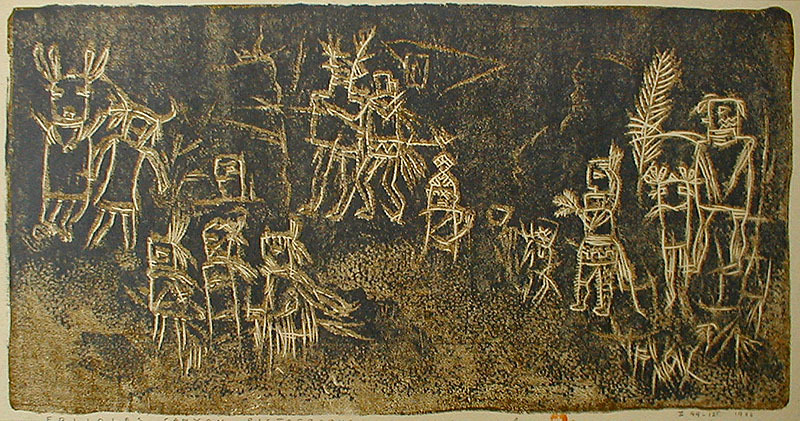
Frijoles-Canyon-Pictographs-by-Gustave-Baumann

mother love

copyright 2011/all rights reserved

OIL IN WATER

a novel by

PAM LAZOS

CHAPTER SIX(b)

“I don’t care how you do it.  I just want it done.”  Bicky’s anger was distinct even through a closed door.  “And don’t come back to me until it’s finished.  Capice?”

Sonia heard a muffled assent and, without even thinking, shoved the report in her brown leather backpack, knocking a cup of water across the desk in the process.

“Damn.”  She grabbed a bunch of tissues and was mopping up when Bicky burst through the door.

Sonia smiled.

“Sorry.  I hope it doesn’t leave a mark.”

Bicky stared at his daughter as if he couldn’t place the face before bewilderment gave way to annoyance.

Sonia jumped to her feet.  “Oh, sorry, I . . . was tired.  Your seat is the most comfortable.”  She stood, draped her backpack over her shoulder, and exchanged places with her father.

“How long have you been here?” he barked, and with a gentle touch antithetical to his tone, moved his mother’s picture out of the water’s trajectory and onto the windowsill.

“I don’t know.  Half an hour,” Sonia said, clearing her throat.  “I see you got a new Dickinson.”  She nodded in the direction of Bicky’s rare book collection.  “Nice catch.”

“It came at quite a price, let me tell you.”  He smiled and Sonia regained her composure, relieved to be on neutral territory.  Bicky took his seat behind the desk, a reigning monarch, and pressed the intercom.

“Phyllis, some paper towels, please.”  Bicky released the intercom before Phyllis could answer, snapped open the humidor and pulled out a cigar.  Sonia cleared her throat.  He shut it with a muttered apology.

“So. What can I do for you, babe?” Bicky asked, adopting an air of lightheartedness.  Sonia responded by shoving clammy hands into the wide pockets of her maternity dress and wrapped them around the baby.

“It’s about David.  I just wanted to know – when is he coming back?”  She squared her shoulders as if getting out the words freed her to stand straighter, and thrust her belly forward, marking her question with an additional exclamation point.  Bicky stared at her and she held his eye, trying to remember if growing up had always been this emotionally draining.  She remembered so little of her father’s presence from childhood that it couldn’t have been the case.

“I already dispatched a guy.  Your husband’ll be on the next plane home.”

“Really?  Oh, Dad, thanks!”  She ran around the desk and threw her arms around Bicky’s neck, a move instigated by relief and unbridled hormones.  Bicky shifted uncomfortably in his seat and looked to Sonia like he might run.

“Sorry,” Sonia said, stepping back.

“That’s all right,”  Bicky said.  He rubbed his neck gingerly, feeling for the welt.

Sonia hadn’t touched her father in so long, hadn’t wanted or needed to, and so had forgotten his adversity toward the simple act of it.  She rarely saw her parents touch, much less kiss.  It didn’t bother her, but under the circumstances, she never understood how she’d been conceived.  She slumped in the closest armchair with relief.  “So what changed your mind?”

Bicky waved his hand.   “Your mother . . . she didn’t want you to be upset.”

So there it was.  Kitty had trumped him.  Sonia tried to summon some love for the stranger that sat across the desk sorting wet mail.  Feeling none flow, she stood to leave.

“Thanks,” she said, grateful no matter what the circumstances that forced her father’s hand.  Bicky dismissed the gesture with another wave and smiled, a cross between an impatient grin and a grimace.  The phone buzzed and relief washed Bicky’s face clean.

“Where are the paper towels?” he barked into the intercom.

“Try the bottom drawer of your desk,” Phyllis responded, her tone syrupy sweet.

Sonia bit her lower lip.  Phyllis had put up with Bicky since he came to Akanabi over thirty years ago and showed no signs of relenting.  For reasons Sonia couldn’t decipher, Bicky attracted and held people in his life, quality people, like flies to the spider’s web.

The phone buzzed and Bicky checked the caller ID.  “I gotta take this,” he said.  He tried another unsuccessful smile as Sonia turned to go.

“Your mother wants you to come to dinner tonight,” Bicky said, reaching for the receiver.  Sonia waited for any additional proclamations, but Bicky grunted and jerked his head toward the door.  Sonia took this as her unmistakable cue to leave.

Sonia leaned against the smooth, polished walnut, fingering the clasp on her backpack and listening to Bicky’s imperial tone through the lavish doors.  She reached in and touched the edges of the envelope.  She could drop it on Phyllis’s desk, no questions asked, and walk out.  Or…

“Hey there, girly.  Where’ve you been?”

Sonia stumbled and Phyllis was at her side in an instant, directing her to a chair.

“I remember these days,” Phyllis said.  “All top heavy and off-balance.  Like one of those Weeble-Wobble toys.  You remember them?”

“Weebles wobble, but they don’t fall down.”  Sonia sang.

“Isn’t it amazing how you can forget your kid’s birthday, but remember ads from twenty-five years ago,” Phyllis said.  Phyllis was a lithe figure, still beautiful well into her sixtieth year, all grace and high cheekbones.  She pushed an ottoman in front of Sonia’s chair.

“Feet up,” Phyllis said with the authority of a drill sergeant.  She smiled and squeezed  Sonia’s shoulder.  Bicky’s personal line rang and Phyllis put him on speaker phone.

“Where the hell’s my report?”

“Try looking on your desk.”

Bicky ended the conversation with a dial tone.  Phyllis rolled her eyes at Sonia.

“Your father,” Phyllis started, “is not big on patience.”

“Or much anything else unless there are dollar signs attached.  Really, Phyllis.  How do you stand it?  You couldn’t pay me enough.”

“Oh, he’s not so bad.  He was so green when I first got him.  All eager to prove himself to your grandfather.  Who knew he’d grow to be the pompous ass he is today.  I think a part of him died with your grandmother and it’s been rotting inside him ever since.  And between you and me, I feel a little sorry for him.  He’s just a kid who really misses his mother.”

Sonia considered this a possible reason for Bicky’s strong gravitational pull:  memory and pity.  Memory of what the man was; pity for who he’d become.  And a desire to help him crawl out of the quagmire.  Sonia had made the same mistake many times, thinking that her father would then include her as a relevant part of his life only to find that Bicky considered himself a single planetary solar system, a man who shared the cosmos with no one.

From the wet bar, Phyllis grabbed a bottle of chilled Evian and handed it to Sonia.

“When my son was born, my husband was in Vietnam.  I thought I would lose my mind.  I got through it, though.  You always do.”   She smiled and stroked Sonia’s hair.  “We’re tougher than they are.  That’s why we bear the babies.”  Phyllis strode across the room, grabbed something off her desk and handed it to Sonia.

“I printed out a copy of his itinerary.  He’ll be in about the middle of the night so don’t wait up,”  Phyllis admonished.  She smiled, revealing a lovely set of pearly white teeth.

“Thanks, Phyllis,” Sonia said, standing.  She gave the older woman a hug.  “I’ll call you as soon as something happens,” she said, a hand on either side of her belly.  “They have these websites now, where you can log on and see the newborns just a couple days after they’re born.  You won’t even have to go to the hospital.”

“Bye love,” Phyllis said, throwing a kiss to the air.  Sonia watched Phyllis bound toward her desk before turning to the elevator.

&&&

The elevator opened in the lobby and Jerry stood waiting as if summoned.

“How do you always know?” Sonia teased.  Jerry tapped his chest and smiled.

“My heart beats a little more quickly when you’re around,” he said.  “You let us know the minute our baby pokes its head into this world.”  He smiled, dazzling her.

Sonia kissed him on the cheek and turned to leave.  “I will, Uncle Jerry.”

He opened the door and watched as she walked away, their usual ritual.  At the moment before Sonia rounded the corner, she turned and blew him a kiss as she’d done a million times before.  His turned his cheek to catch it, reeling backwards, holding one hand on his heart and the other over the newly planted kiss so as not to let it slip away.  She smiled and disappeared around the corner; the smile did not leave Jerry’s face.

&&&

Dave Hartos knelt inside the base of an oil rig, fiddling with a stalled pump.  He whacked his wrench against the pipe and the wrench clanged to the ground.  Even in the bowels of the derrick, the sand writhed and swirled, infesting the machinery.  With a heavy sigh, he lifted himself out of the hole and climbed the metal rungs of the ladder back up to ground level.

An open-air jeep approached, a dust bowl swirling behind.  Andrew Mahajan, second-in-command to Hart and his best friend, got out grinning.

“Good news.  You’ve been sprung.”  Mahajan handed Hart a telegram.  “Go home and help your wife pop that baby out.”  Mahajan clapped Hart on the back with one hand and handed him a box of Cuban cigars with the other.  “For when the baby comes.”

“Hey, I don’t need to get arrested on the way home.”

“Customs won’t bother if you have less than a box,” said Mahajan.  He opened the lid and removed two cigars, clipping the ends.  “Now there’s less than a box.”  Mahajan produced a lighter from his pocket, but desert winds foiled attempts to light it.  He shrugged and pulled a bottle of Jamieson and two whiskey glasses from the jeep.

“Let’s celebrate.”  He wiped his brow with a bandana and motioned toward the trailer.

“Isn’t it bad luck to toast before the baby’s born?”  Hart asked.

Mahajan shook his head.  “Only thing bad is not taking advantage of an opportunity when it bites you in the ass.  C’mon.  A driver’s coming for you soon.”

Hart grabbed the glasses out of Mahajan’s hand.  “You gonna be all right here?”

“Right as rain, buddy.  Right as rain.”  Mahajan wrapped an arm around Hart’s shoulders and pushed him to the trailer.

to be continued. . .

the mother of invention

copyright 2011/all rights reserved

 OIL IN WATER

PAM LAZOS

CHAPTER ONE (b)

Marty stopped and laid his face against the side of the metal grate.  It was cool to the touch and not at all indicative of the processes going on inside.  He shook his head and started his hop, skip and jump dance all over again, this time adding an ecstatic laugh to the mix.

He’d done it.  Just like Dr. Frankenstein, he’d brought the beast to life:  his Thermo-Depolymerization Unit, or TDU, lived – years in the making, like nothing the world had ever seen, and until five minutes ago, only a theory.  Marty had envisioned that the TDU would take garbage, computers, old sneakers, last night’s dinner, yard waste, old fence posts, plastic tupperware, with or without lids, old sweatshirts, used ball point pens, broken picture frames, old love letters, paint waste, empty cardboard boxes, broken refrigerators, busted telephone poles, wrecked car parts, or the whole car for that matter, old comic books, unwanted furniture, hell, this machine could take anything carbon-based, and do something magical with it, something that, to date, no one else had figured out how to do – take trash, and convert it into oil –  pure, unadulterated, car-starting, engine-revving, turbo-driving, eighteen-wheeler-moving oil.  Marty figured that the TDU would mimic what Mother Nature did every day hundreds of miles below the earth’s surface:  break down fossils into fuels.  But Marty’s contraption would take about three hours instead of millions of years, combusting nothing, and leaving no waste.  After twenty years of toil, Marty’d had his share of false starts.  But now the whir and hum of booster pumps and coolant fan units was evidence:  modern-day alchemy.  Marty had called down the vision.

But the world had no template for it.  Like the shaman of the first American Indian tribe to come into contact with Columbus, Marty had to mold the vision into a discernible shape, give the people something palpable that they could recognize.  For even as Columbus’s ships approached the shores of the New World, the Indians couldn’t see them, not until their shaman provided them with a frame of reference.

But being a shaman was at times an exhausting, aching and lonely occupation.  So Marty did what any man in his place would do when faced with a discovery of unrivaled proportions.  He propped himself up on the hammock in the corner of the barn and took a nap.

to be continued. . .

Eureka

copyright 2011/all rights reserved


OIL IN WATER

PAM LAZOS

Chapter One

Marty Tirabi sat on a stool aside his drafting table, an aluminum pie plate in each hand.  His eyes were closed, his spine erect, his breathing slow and regular, his conscious mind sitting on the pinnacle of present awareness.  At the exact moment Marty’s consciousness shifted, sliding across the threshold from beta to alpha to delta like a single-base hitter stealing home, Marty’s grip slackened and the pie plates clattered to the floor.  He woke with a start and stared, wide-eyed, at the back wall of the barn where It sat, all the while scanning his interior databases for a revelation that refused to be retrieved.

Marty rubbed his forehead.  This was how Thomas Edison did it, mining the gem-rich ground of his subconscious by bringing himself to the brink of sleep, then pulling back with a start for a third-party observer’s view.  The result of Edison’s efforts was the light bulb and one thousand and ninety-two other patented inventions, but Marty’d be damned if he could get Edison’s process to work.  For him, it was just there, a vision that sometimes crept, sometimes hurtled from unconscious to conscious awareness – claircognizance some called it, a simple knowing – and suddenly Marty would know how to pull it all together.

But not tonight.  Frustrated, Marty spun his stool around, laid the pie plates and his overtired brain on the drafting table, and stared at his father’s oil lamp, its soft, incandescent glow casting ectoplasmic shadows on the blueprints beneath his head.  He started to fall – no aluminum to stop him this time – but was halted at the threshold again.

A faint hum jarred him back, a soft, deliberate noise like the whir of a refrigerator motor or the patter of a soft rain.  He felt it in his feet first.  It climbed up his legs as it grew in intensity, settled in his heart, and then shot up to his forehead.  His head vibrated.  Marty rose slowly so as not to disturb the hum’s cadence and strolled across the barn floor toward the back wall, convinced that a nonchalant attitude was imperative to the hum’s survival.  He tried not to smile, tried not to look directly at It until he had stopped in front of the thousands of pounds of steel assembled in six distinct units.  He sniffed the air.  Dozens of smells slid past the cilia in his nose and traveled along his olfactory nerve, stopping at the cerebral cortex to register:  methane, plastic, burning rubber, decay, ash.  Even in a closed-looped system, the vapors, like his dreams, always escaped.

And then, suspended in the air like dust motes lollygagging in a single ray of sun, the smell of oil, sharp, sweet and slightly acrid, knocked on the registrar’s door, tap, tap, tap, piercing Marty’s nasal cavity and shattering his equilibrium.

“Hahahahaaaaaaaaaaaa!”

Marty clapped his hands and because he was half-Greek, did the only dance he felt comfortable doing, a little hop/skip combo that was the backbone of most traditional ethnic dances.  He repeated the steps over and over until he came full circle.  He added a little jump to his combination.  The word Eureka came to mind.

to be continued. . .