
knit this: words, dreams, stories

JOURNAL THAT

a guide to writing

cynthia gregory

Have you given yourself over to a brand new, never-been-done project? It’s tricky business. A couple of years ago, I decided that I was going to knit a sweater. I could see it in my head, the seafoam green color, the nubby texture. When I told a friend of my intention, she asked if I was an accomplished knitter. “No,” I replied. “I’ve never done it.” She gave me a funny smile. Then she said, “Well, maybe you should start with a scarf.”  First I was offended, but then I took her advice and shopped for a pair of needles, an instruction book, and some beautiful skeins of yarn, then went on to knit a series of fabulous scarves, which I then gave away as Christmas gifts. The first ones were something only I would wear, but they got better with time and effort.

Oh, I know what you’re thinking: knitting is not writing. But you know, maybe it is. You start where you start, and each time you do it, it become a bit easier, a little less freakish. Keep at it long enough, you become adept, and your new passion will give you a glow. Look at a hand-knitted sweater closely; it will reveal a story to you. Was the hand that made it loose and confident, or was it tense and fighting the yarn? Knit one, purl two.

There is always a learning curve, whether you’re knitting or writing or making paella. Don’t beat yourself up. Start at the beginning. Make an effort. Take a giant leap of faith. You may not be accomplished in the beginning, but make an honest effort. Become a channel of the spirit of the thing and eventually, with enough practice, your hand will relax and the yarn will flow.

There may be times when you’ll look at your journal and be tempted to pull a string and unravel the whole mess. It isn’t what you thought it would be. The words fall heavily on the page, tight as turds. It isn’t the beautiful creation you intended. But you cannot judge these things. What would a teacher say about your knitting, your journaling? She would be gentle, she would be kind. She would say, “That’s very nice, this here. You see where you did this so beautifully? And here – you can do better than this. Pay attention. Practice.”

At lunch one day, my friend Kate told me that she has kept a journal for twenty years, consistently, except for one year. “What happened,” I asked, curious about that empty year. “I had a room mate,” she replied. “I found out that when I wasn’t home, she ready my journal without my permission.” This was a violation of the worst kind. I sympathized. Journals are not something to share randomly; they are an intensely private affair. Kate’s roommate had found a string, pulled it, and unraveled a precious creation.

In a way, it is easy to understand the temptation of the roommate. There is something pure and delicious and overwhelmingly seductive about the discovery of uncensored thoughts. When we’re small, we’re programmed to not say certain things, not to even think them. So we exile such thoughts to an underground of sorts, in order to gain acceptance from the people who have the power to dole out or withhold love. But the years trickle by and as adults, the thoughts don’t just evaporate, they go underground. Therapy is one route to release them, journaling is another. Journaling can become an outlet for the millions of thoughts jumbled in our heads. We may not wish to acknowledge them, but the thoughts are there nevertheless, and it feels good to get them down on paper. Very good. Soon, if you give yourself permission to get used to creating a personal narrative, journaling become s a delicious habit.

Once you get used to writing in your journal, you may find that you want to keep that sacred text with you at all times. You carry it around in your purse, your bag, your car, the way little grannies carry around their tapestry bag of knitting needles and yarn. When you are waiting on line at the DMV, lunching on a park bench, sitting on a bus; you’ll pull your journal out and look around for a moment and then move the pen across the page, knitting words, narratives, belief, into something lasting. You may even find yourself arriving early to appointments, just to give yourself that space of time to sit quietly, to write.

After Kate and the intrusive roommate were no longer sharing a living space, she began to journal again. You see, the evil roommate couldn’t stop my friend from keeping a journal, for the desire to write was too strong and the satisfaction from having written was too sweet. Now, as if confessing, she tells me that she doesn’t record her thoughts every day, but still, she journals. “Some journals are a single year,” she says. “Some journals contain two years.” She journals for the peace it gives her, the gifts she will one day make of this deep art to her children.

Kate doesn’t journal daily, but she writes often, and keeps her journal on the table beside her bed so that before she sleeps, she can place her thoughts where she can see them, touch them, keep them in a safe place. She, and you, and me, we create something when we journal.

Knit one, purl two.

to be continued. . .
having written

JOURNAL THAT

a guide to writing

cynthia gregory

Everyone has heard the old chestnut to “write what you know about.” But, cherished friend, it ain’t that easy. We’ve also been told to “write like you talk” – and that’s just foolish. This kind of advice just leads to unrealistic expectations, not to mention bad syntax, sloppy verb conjugation, and mangled grammar. This is not to say that you should worry about any of these in your journal because journaling ought to be at the very least an exercise in jumping into the stream of consciousness with both feet and an inner tube.

Journaling is not for sissies.  You have to really want it with a desire born so deep only a seismographer can find its source. You have to do it; you just do. And you don’t have to explain or justify it any more than you have to justify breathing. Great genius is born of desire. And once the desire to write is established, the next most important part is means; and the method of true genius is to journal by hand. You know, the old fashioned way. Pen. Paper. Good lighting, a comfortable chair. Not too comfortable, just saying.

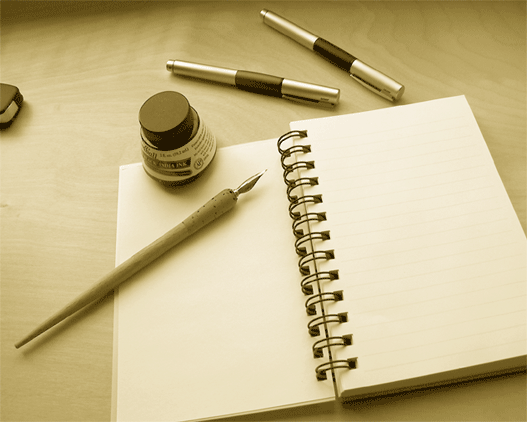
Why, you may well ask, is it important to write by hand when its so much easier to tap away on three rows of electronic buttons? Isn’t that why God invented Steven Jobs? The answer is that true writing is a tactile experience and because you think differently when you have to push a pen over a rough sheet of reconstituted tree pulp and because the process of writing is refined – just a little – when you have to make the words exact and legible and pretty on the page with nerves and tissues and with the fine muscles of your fingers. Writing becomes a whole body experience when you do it by hand. Transcribe your thoughts later if you must, but start first with an unblemished  piece of paper and fill it with observations, feelings, and a million details. Write. By. Hand.

Writing by hand is visceral and it connects with the most primitive parts of the brain; also the most elevated and elegant parts of the thinking apparatus. However, don’t think too much: just write. A mentor once said to me, “Don’t worry about how it all comes together. Just write. The story will take care of itself.”

So I pass this along to you: write. Just, write. And I really insist: by hand. So, you get cramps in your fingers; so what. You’ll get over it. And when you do, you will have written – and you feel like you climbed Kilimanjaro.

to be continued. . .

write, writer, written

copyright 2011/all rights reserved

JOURNAL THAT

a guide to writing

cynthia gregory

A journal is not a diary. Well, it can be, but at its best, it is not. It is not about recording your deepest, darkest fears; the ones you don’t want anyone (especially that one you love) to read. It is not about judgment in the sense of  “am I a good writer?” or “what does it say about me if I can’t put a few scribbles on a blasted sheet of paper?”  kind of judgment. It is, in part, killing the editor in your head. You know, the one who says, “who cares what you think? You know you’re never going to write anything worth reading anyway, why bother?”

Kill the editor. The editor is only your insecurities with carte blanche and the power to stop you in your tracks before you uncap your pen. This is what you do: write. Write for fifteen minutes every day, no matter what. Even if you just write “I have nothing to say today.” Even if you just fill the page with gibberish. Write knowing that our journal is not about you. Do you get that?

Your journal isn’t about you, sweetheart.

No offense, and as important as you are, your journal is not an extension of you. Rather, it is like a Polaroid camera that you aim at everything around you and with which you snap a photo. This café. That conversation. That wide, beautiful coastline with clouds hovering over the water like cottoncandy and the smell of the surf pushing spring toward the desert on a mission from God.

It is a recording. It is a gift from the universe. How is it a gift? It is a gift because no one, not one soul who has ever been or will be, has the power of observation from your perspective, with your history, with your love of crossword puzzles or majong or Thai noodles with peanut sauce. You are a dazzling flower on the furthest branch of the tree of life and what you see around you is a devotion in the truest sense.

So write about the hamburger you ate for lunch. Write about the girl who brought it to you, whose shoes seemed unnaturally worn maybe because she’s working her way through art school and she deserves a little extra tip so maybe she can sleep in tomorrow and dream of a watercolor that will turn the world on its collective ear. Your journal is not about you. It is a gift to the world.

My ex-husband’s grandmother kept a journal every day of her married life. When Grandma died at 96, my father-in-law gave a journal of the year they were born to each of the grand kids. You could say that there was nothing extraordinary about it, but there was something precious in the grocery lists she made in her spidery hand. There was a door into the life of a woman who made a family so big that galaxies were created just to contain the love she had for them.

The laundry lists, the shoes to be taken to the repair man, the small concerns, were a door into a world we none of us had seen before. This was a picture of a woman not as we knew her, but a woman who when she wrote the journal, was younger than we who were reading it, and it was astonishing.

So write your journal, and don’t worry about being brilliant. Just write. Just do it, knowing whatever you say is sacred, in a context you can’t even imagine. Or not.

Hallelujah, amen, and wahoo!

to be continued. . .